I did see a lot of the students in the results from the survey and the students doing a lot of work and trying to do their work and getting away from all the troubles that they go through. Students that choose to work in the dark help them be able to focus when they are doing their work in the study rooms. Just being able to not have other people like their friends bother them when they are in the middle of studying. Working in the dark while studying for an exam or test is helpful for the students. When people are in the study rooms working alone a lot of their friends would come into the study room with them and start to talk at times and kind of get away from their work. I feel like I was like an observer watching people and trying to see how people’s moods are while working. Either if their work is stressing them out or if they enjoy having their friends with them in the room to help get away from their work if it starts to stress them out a lot. I felt like an insider among my peers because I use the study rooms in the SSC and normally, I am there alone and then at times my friends are with me too at times as well. A lot of people that go to the SSC go there for all different reasons to either study or just meet their friends in the study rooms as well.
Author: kdenham
Memories held in check
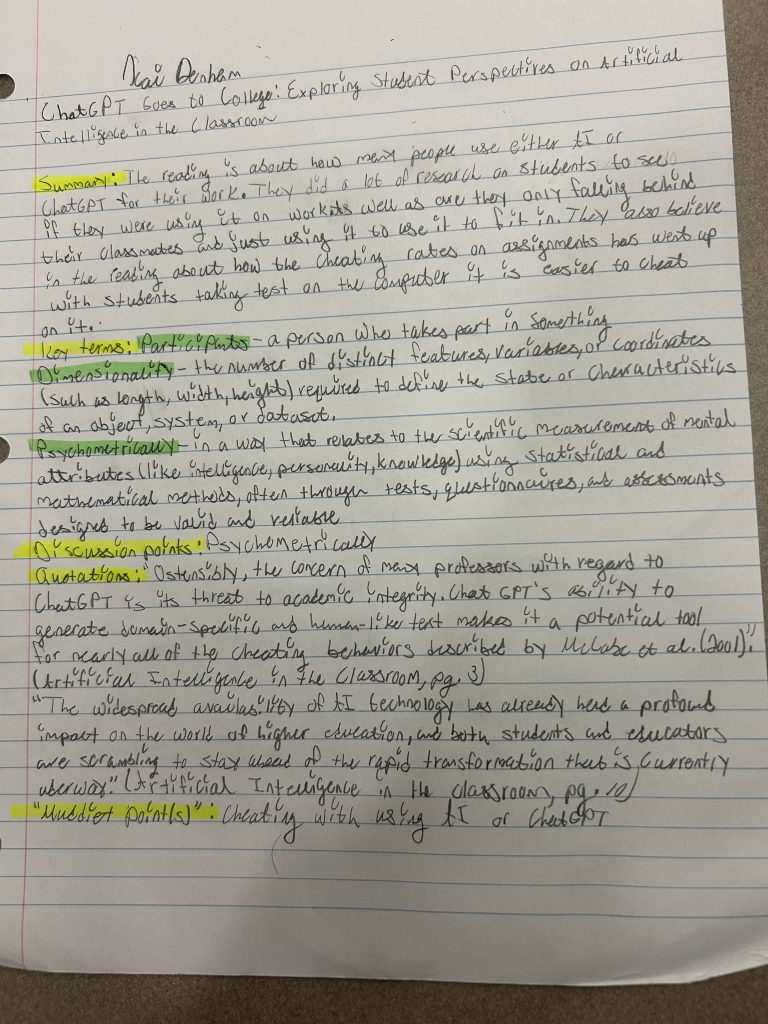
Summary: Memories held in check really centers around how people can manage, suppress, and reinterpret their memories rather if it’s dealing with painful or formative memories. another main point is how people’s memories aren’t freely expressed but can be controlled or even contained.
Key terms: Redolent- strongly reminiscent or suggestive of., Manifest- clear or obvious to the eye or mind., Mementos- an object kept as a reminder or souvenir or a person or event
Discussion Points: Checks
Quotations: “I do not believe he even rode in an airplane until he was forty-six years old, for a one-time only business trip to Chicago, an event I now remember as a source of some excitement.” “Like the grid of streets in the suburban development on Long Island, New York, where I was born, my father’s neatly stacked checks map a whole postwar way of life.”
“Muddiest point(s)”: money
Chapter 5 Comparative historical research- Give Methods A Chance
Summary: Chapter 5 explains how sociologies studying the past by comparing the different places and time periods to understand why certain social patterns exist today.
Key terms: Immigration- the action of coming to live permanently in a foreign country. Discriminatory- making or showing an unjust or prejudicial distinction between different categories of people, especially on the grounds of ethnicity, sex, age, or disability. Gazettes- a journal or newspaper
Discussion Points: Immigration
Quotations: “For them, looking into the post was powerful because it allowed them to understand historical trajectories and how “something that might seem natural in one given setting can actually vary quite a bit across other cases”.” (ch.5 pg. 41) “A researcher could, for instance, do a similar study by looking at institutions or organizations instead of the written law.” (Ch.5 pg. 48)
“Muddiest Point(s)”: Law
- Rose: Being able to focus on myself and spend time alone.
- Thorn: Remembering to take my allergy medicine and making sure not to be behind in my classes with work.
- Bud: Going home and spending time with my family and friends.
Give Methods a Chance, chs. 1-2
Chapter 1: Interviews and Telling a Good Story
Summary: Chapter 1 focuses more on the interviews as a research method and helps explain how sociologists use the methods to tell meaningful and accurate stories about the people lives. Kyle and Sarah argue that the interviews are powerful because it allow the researches to hear directly from individuals about either their experiences, beliefs, and perspectives.
Key Terms: Ethnographic- relating to the scientific description of peoples and cultures with their customs, habits, and mutual differences. Examination- a formal, detailed inspection, investigation, or testing process used to evaluate the condition, quality or knowledge of someone or something. Recruiting- the process of employing new people to work for a company or organization.
Discussion Points: Ethnographic
Quotation: “Studying a sensitive topic can make recruitment difficult”(pg.11). “In contrast to journalists, a social scientist uses stories to make broader connections”(pg. 14).
“Muddiest Point(s)”:Interviews
Chapter 2: Getting Focus Groups Right
Summary: Chapter 2 discuss how focus groups work as a research method and how they do them. A focus group is a guided discussion with a small group of people about certain topics. Instead of the researchers interviewing individuals one-on-one, researchers study how people talk more and more.
Key Terms: Consensus- a general agreement. Methodological- relating to the system of methods used in a particular area of study or activity. Mundane- ordinary, commonplace, and uninteresting
Discussion Points: Consensus
Quotation: ” A focus group seems like a rather straightforward undertaking: ask a few questions, let the group talk” (pg. 18). “Focus groups provide a semistructured setting for people to respond to questions, share their views, and engage in discussion” (pg. 15)
- Checking In
- What is starting to feel good is that I am starting to get comfortable with everything in the program and getting use to how to work everything.
- The annotations 1 was a little bit confusing but I got the hang of it after asking for help.
2. Conversations with Librarians
- Learning how DeAnna started the different programs at her library helped with giving all of ideas with seeing what we need to work on or even do.
- What stood out was how DeAnna helped the kids that did not have a lot of food resources and making a cooking class out of it so the kids have food to eat.
- The conversation helped with bringing more ideas to my head to try and see what we can do to help out the library with bringing more people together.
3. Motivation + Planning
- I feel motivated with actually coming up with a plan to try and help out the library and the community as well.
- Making sure I am on top of my planning and knowing what I need to focus on and do it.
Today’s Class
- I felt like going over where the different research teams with where they are going to go and who they are going to be speaking to.
- What felt a little confusing is what to do on my part of Lab 1: Research Plan
Guided Meditation
- Before I did any work, I had colored before and after doing work.
- I did it at my desk in my dorm room. I felt really relaxed before and after I had colored.
- I noticed that while coloring and listening to music it helped me a lot with feeling more calmer and actually relaxing my mind and my body from all the stress from any work.
Accountability Partner
- We all were each other’s accountability partners with checking in the group chat with everyone to see if everything was getting done.
- We used Teams to check in on each other.
- Making sure all the work is getting done on time.