Class Portfolio
| A Work | B Work | C Work |
-Misses one class or less, or completes make-up work for excused absences -Annotates all readings thoroughly -Makes substantive comments in discussions -Completes all assignments on time (or has an approved extension request) -Work demonstrates intellectual engagement, care, effort, and growth in response to feedback -Collaborates substantially, contributes to vision, works equally with peers | -Misses two classes or less, or completes make-up work for excused absences -Annotates readings -Often participates in discussion -Completes all major assignments on time (or has an approved extension request) -Completes most SAs on time -Work demonstrates care, effort and growth in response to feedback -Collaborates equally, completes required work | -Misses three classes or less, or completes make-up work for excused absences -Completes most readings -Sometimes adds to discussion -Completes all major assignments on time (or has an approved extension request) -Completes at least four SAs -Meets minimal expectations on assignments; shows limited growth in response to feedback -Completes required collaborative work |
First-Week Introduction
The reason why I chose my five goals is because they are something I want to contiune to work on. I also believe that the assignments I will have to complete this semester will be heavily focused on those skills. The assignment that makes me most excited for the semester is the data collection, where I will be conducting interviews, because I have come to enjoy interviews as well as being able to step into the mind of the individual and see where they’re coming from. The assignment that seems like it will be the most challenging is the previous assignment, data collection, because you never know if you’ll get enough people to participate, and this can make or break your process. The strategies I want to set for myself to make the semester a success is to not procrastinate, ask for help when I need it, and to fully apply myself to each and every assignment. This will allow me to set myself up for success and lead to this semester going great.
Midterm Introduction
During the first half of the semester I experienced a lot of ups and downs. What I enjoyed the most was being able to be in class because although it was trying, it was also pretty fun and exciting. What I struggled the most with was staying on track with getting everything done during the time frame. It was sometimes hard because somethings ended up being harder and taking more time to get through. At the moment I would say that I want to continue developing all of my goals during the second half of the semester. I say this because all of the evidence needed to showcase I have excelled at my goals have to do with my interviews. I’m still in the process of wrapping them up and organizing all of my data into reports. So, it’s hard to tell how I am doing regarding these goals. However, I do believe that I can continue on to accomplish my goals because of the effort I have put forth for my research.
Final Introduction
Now that the semester is over, I feel like I really did try my hardest and I achieved my goals. However, there is always something that I can work to be better on. I worked to meet my goals, but I didn’t try to overachieve. I tried my hardest, but I didn’t fully give my all. I feel that moving forward I should always think about how I can overachieve instead of how I can just meet my goal. As I look back on this semester, I see a lot of opportunities where I could have gave my entire self and achieved goals I hadn’t even set out for myself. So, the strategies I want to continue developing as I move forward is obviously time management, but also my motivation to reach higher than the bar.
Course Goals
Goal 1 (10%)
Based on 1a. Demostrates ability to efficiently collaborate with community partner and research group.
For my first artifact, it is a paragraph from my 5th reflection. This is where I talk about how the meetings with our partner, HeartLands Conservancy, went.
“Throughout the semester we had multiple meetings on Teams with our partner
HeartLands Conservancy. During those calls, me and my team would take turns explaining
where we were in our research, such as what we want to focus on, how we’re going to collect our
data, what the progress of it is, and much more. This was very helpful as it gave us a chance to
somewhat “pitch” our idea and hear how it sounds out loud to someone who wasn’t there when
you were coming up with it. They would give us feedback as well helping to steer us in a
direction that would contribute most to their mission as well as ours.”
This showcases how I met my goal because I was able to take the feedback that our partner gave me and redirect my project based on that. Also, being receptive to that feedback shows my ability to collaborate with them. This is important in everyday life but especially in situations like this where we need mutual respect and openess while working together towards our missions.
My 2nd artifact is a reflection on me and my team’s updates as well as the link to our presentation slides. There is nothing physical for the team updates, but they are still relevant, so I also included the slides as they can showcase us coming together as a team to make it.
https://docs.google.com/presentation/d/16sDH8LwJWuZSfY5JKlA7tS12w11QwB_t4cm0ytAN6Kk/edit?usp=sharing
A couple times throughout the semester, me and my group would get together during class and dicuss what we were currently working on, how our process was going, and overall updates on how we are doing regarding our research. It was very similar to the meetings we had with our partners and that’s because it is also important for us as a team to collaborate and bounce ideas off of each other. As for the google slides presentation, this shows the progress that each of us went through during this semester and it had to do with us working together as a team. This meant doing our parts by completeing assignments, being ready for our partner check-ins, as well as putting in the effort for this presentation.
Goal 2 (15%)
Based on 4a. Applies a deep understanding of multiple worldviews, experiences, and power structures while initiating meaningful interaction with other cultures to address significant global problems.
My 1st artifact is some outside research that I did by reading through the SIUE Factbook: 2025 edition.
https://www.siue.edu/inrs/factbook/pdf/FbCurrent.pdf
I did outside research in order to get a better feel of the student population at SIUe from a quantitative perspective. So, I found the SIUe Fact Book: Institutional Research and Studies. It was the 2025 edition, so when I looked at the section that had data all about the students, I was able to see numbers all the way up to 2024. I used this Fact Book to see what the make up of the student body looked like. This outside research helped me to improve because it allowed me to see the level of diversity in the school and take that into account when curating my questions.
My 2nd artifact are the questions I came up with for my interviews. This will show that I met my goal because of the content it contains.
- Do you believe that people our age are interested in conservation? Why or why not?
- Do you believe more people should get involved in conservation? Why or why not?
- Have you known about or participated in any events, club activities, etc. that have promoted conservation?
- Do you know of any environmental clubs on campus?(Geography, Environmental Careers, Wildlife & Conservation Biology, Biology)
- Follow-up: Would these clubs be something you’re interested in?
- Follow-up: Have these clubs done anything to grab your attention?
- Do you believe there is a disconnect between these events and young adults, or that these events aren’t being publicized enough?
- Follow-up: If you could change anything about what they do, what would you change
- If you had unlimited resources, what would you do to get more people our age involved in conservation?
- Follow-up: What if you only had limited resources?
- Would you be interested in learning more about organizations that help with nature and conservation?
While creating my interview questions, I put effort into making sure that they were as open-ended as possible while also making them inclusive to the diverse population on campus. In the questions I don’t assume their knowledge of nature conservation, but I also explained to them when asked ensuring them it was a safe space for questions.
My 3rd artifact is my content assignment draft which is an informational brochure. This showcases how I met my goal because it shows my understanding of how I can best address the problem of my research question.
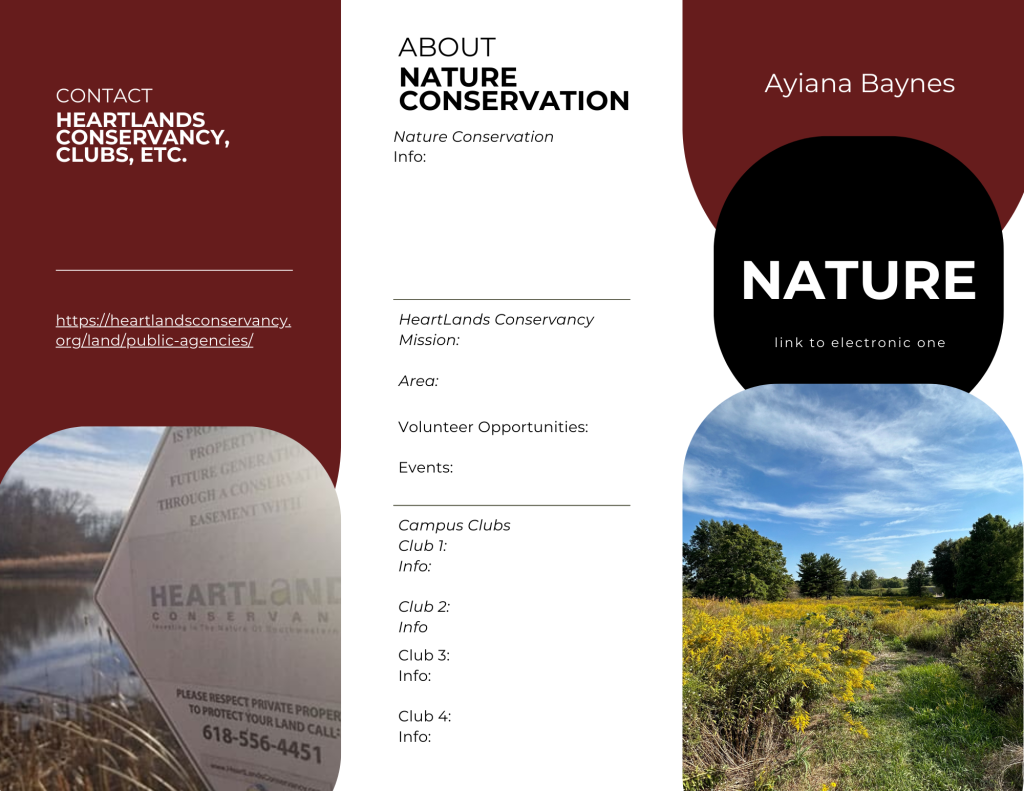
This informational brochure shows that I can help to address the global problem of engagemet in nature conservation. From my research, I found that there is a lack of “in your face” publicizing of nature conservation events, opportunities, etc., so by coming up with these products and putting them everywhere it will help students on campus to have access to this information. Also, the information mentioned will have to do with our partner HeartLands Conservancy, campus clubs and events, as well as other volunteer opportunities. This will help young adults to be able get a quick insight into the choices they have around them.
Goal 3 (25%)
Based on 7b. Pursues knowledge and educational experience beyond the classroom.
My 1st artifact is the SIUE Factbook again as there was a lot of useful information in this edition.
https://www.siue.edu/inrs/factbook/pdf/FbCurrent.pdf
While researching the diversity, or lack of, in SIUE, I found this Factbook where they post so much information about the population at SIUE. This was outside research that I analyzed in order to get a better grasp on what SIUE was looking like. This helped me to understand certain demographics, but it also was something that helped to remind me that this is still a PWI and there are minorities here that aren’t catered to who I need to keep in consideration when conducting my current research and any other research going forward.
My 2nd artifact is the interviews I conducted since they were done outside of the classroom.
I conducted interviews with 10 students attending SIUE and proceeded to analyze their answers in order to further my research. This outside research that I did was very informal as I tried to keep it as convenient and relaxed as possible. This obviously helped to further my research as this was an important part to my data collection.
My 3rd artifact is the meetings we had with our partner, HeartLands. They were done in the classroom but still are considered outside research.
During these calls I received relevant and helpful information that aided in curating my research question, inteviews, as well as my future product. Throughout the semester we had these meetings and it consisted of me and my team telling our partner what our current actions and progress was and they in turn gave us feedback on how we can continue to help their mission and ours.
My 4th artifact is my visit to the watershed here in Edwardsville.
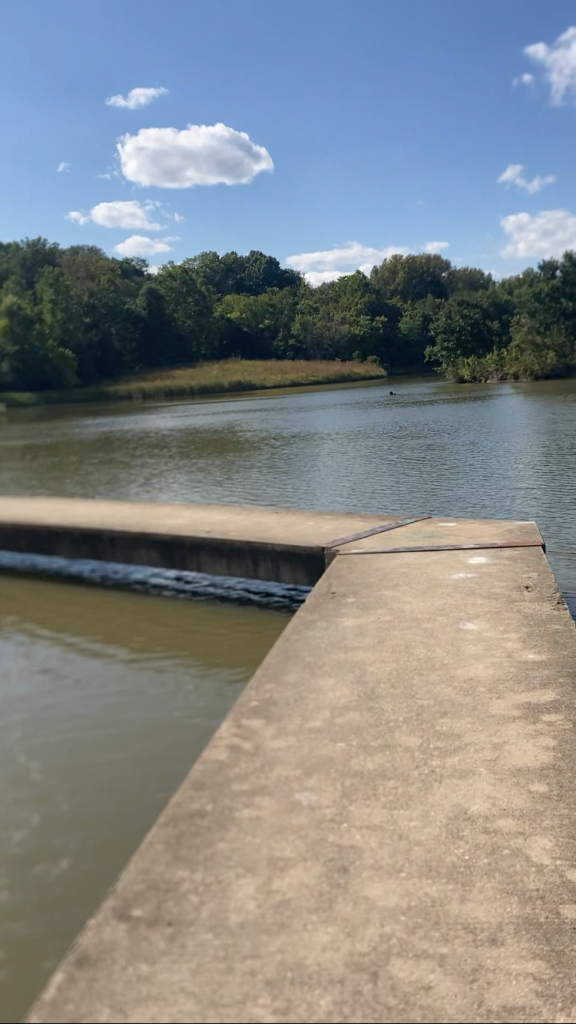
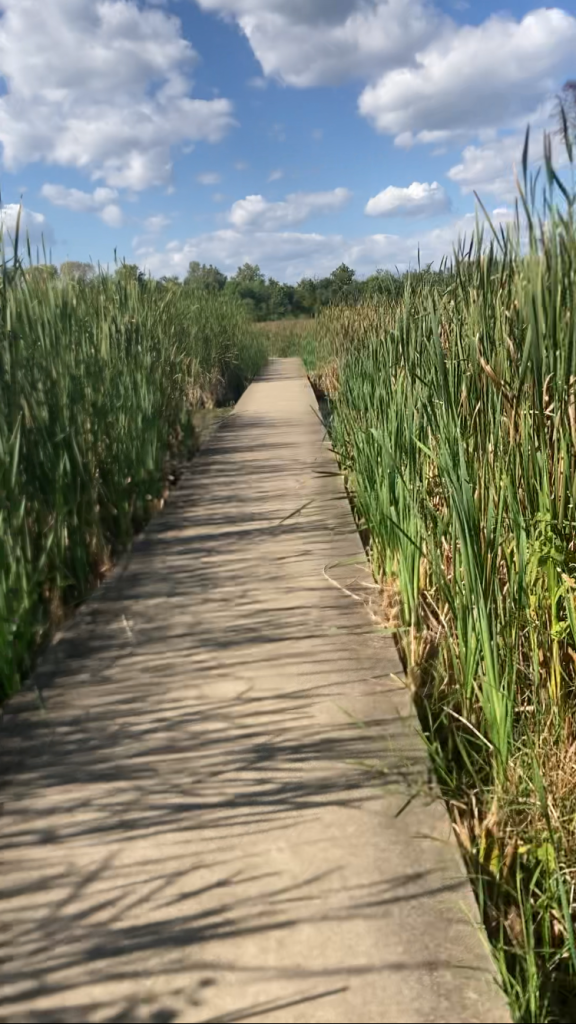
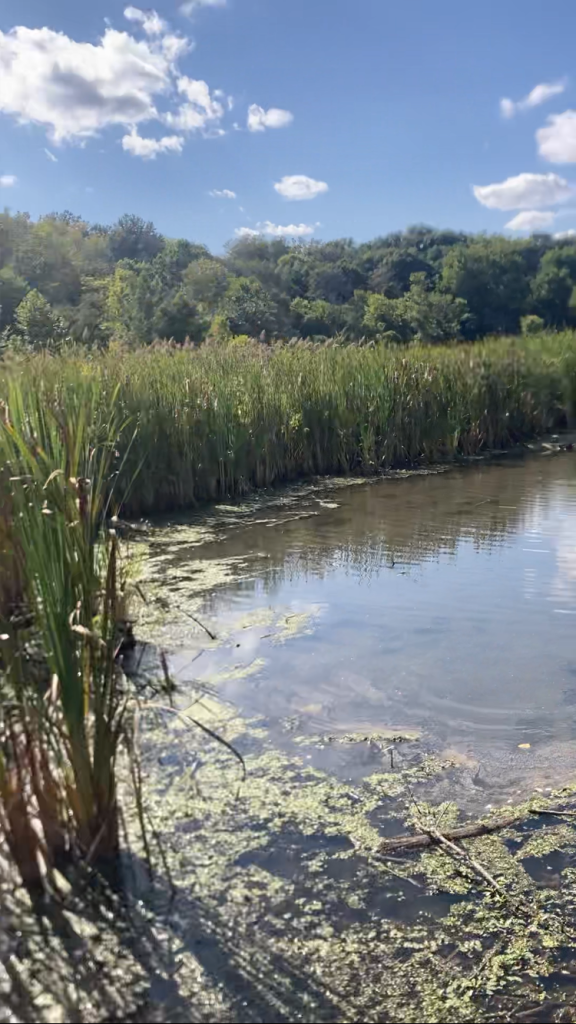
I had never even knew that this town housed a watershed and someone pointed it out to me, so I had to check it out. I walked around a bit and even walked over the “bridge” that had been built across it. This outside research helped me to get back in tune with nature as well as have a resource that I can point other people towards as they get more and more into nature conservation. Although we all attend SIUE, sometimes people don’t know that this is a nature preserve which is why there is variety of animals, plants, and more. So, this visit to the watershed helped me to realize that everyday places can be an opportunity to get young adults more engaged in nature conservation.
Goal 4 (40%)
Based on 8a. Uses clear organizational patterns and is skillful at presenting content cohesively.
My 1st artifact are the interview questions I came up with in order to conduct my interviews.
- Do you believe that people our age are interested in conservation? Why or why not?
- Do you believe more people should get involved in conservation? Why or why not?
- Have you known about or participated in any events, club activities, etc. that have promoted conservation?
- Do you know of any environmental clubs on campus?(Geography, Environmental Careers, Wildlife & Conservation Biology, Biology)
- Follow-up: Would these clubs be something you’re interested in?
- Follow-up: Have these clubs done anything to grab your attention?
- Do you believe there is a disconnect between these events and young adults, or that these events aren’t being publicized enough?
- Follow-up: If you could change anything about what they do, what would you change
- If you had unlimited resources, what would you do to get more people our age involved in conservation?
- Follow-up: What if you only had limited resources?
- Would you be interested in learning more about organizations that help with nature and conservation?
The reason why these interview questions demonstrates my learning process for this goal is because it showcases how I organized my questions to help my interviews flow. The questions coupled with the follow up responses helped me to dig deeper into the answers that the participants gave me. The way I came up with them beforehand and organized them helped me to not be nervous going into the interviews as I knew what I had to do and say aside from listening and responding to their responses.
My 2nd artifact is the interviews I conducted as they were like mini presentations in the form of dicussions.
The way I conducted my interviews was very straightforward and consice because my questions were already written out; follow-up questions as well. This leads into how I was able to clearly state my questions and keep the interviews flowing and organized. There was no room for me to be nervous or hesitant since I knew what I had to say and how to bring a deeper answer out of them. These interviews I conducted helped me to achieve my goal because they showed me that I can speak clearly, organized, as well as get to the point without the feeling of being rushed.
My 3rd artifact is the coding I did using the transcripts from my interviews.
First Takeaways:
- Feeling of helplessness
- They all feel that they, and young adults, would be more engaged if there were more “in your face” advertisement. To be more involved in nature conservation it needs to be publicized more.
- Flyers in the dorms, MUC, etc., ads on the tvs, emails, events, etc.
- They all didn’t know much about the environmental clubs on campus
- They need to be advertised more
- There is interest in nature conservation, but there are also factors that get in the way of being able to do so
- Mental Health
- Stress from school and other everyday activities
The way I structured my codes using the “first takeaways” helped me to understand if my initial analysis conicided with my thoughts as I read through them again and again. This method of organization aided in me being able to keep up with the codes and themes I found while reflecting on them and coming up with future steps based off of them.
My 4th artifact is the outline I created for my content assignment.
By creating this outline, I was able to put into words what I was looking to have in my informational brochure. I didn’t have anything that complicated what the brochure would be about. It was straightforward about what it would contain and where it would be shared.
My 5th artifact is my content assignment draft where I produced a visual outline of how I want my brochure to look.
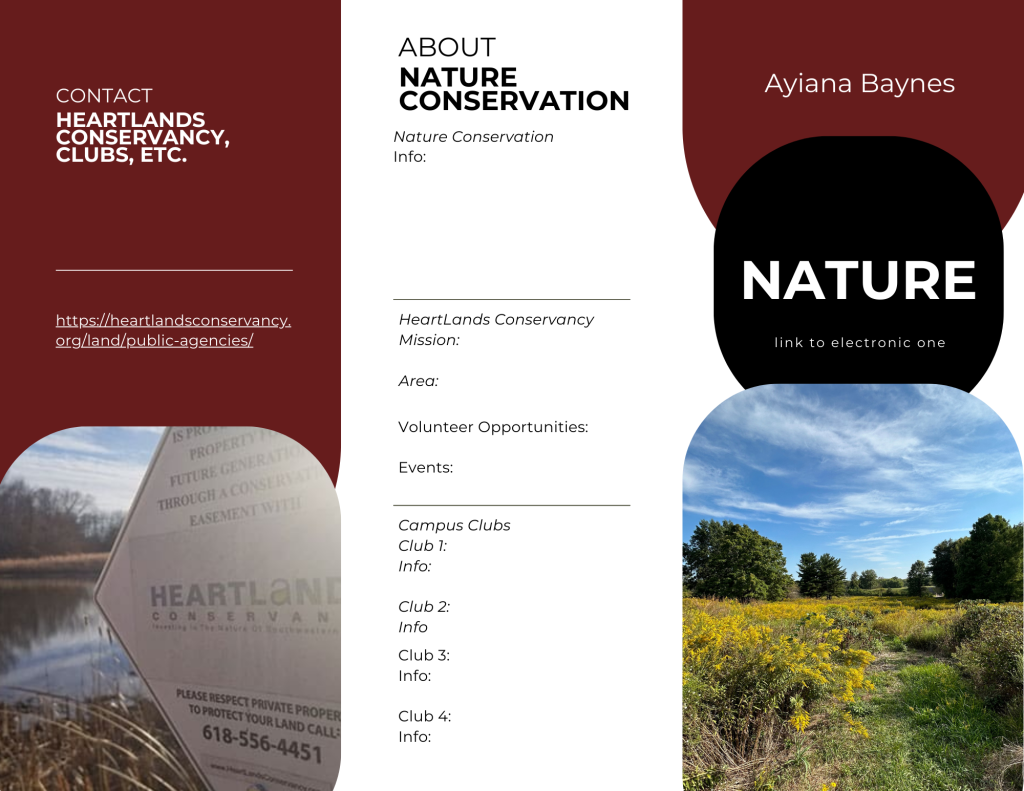
For my content assignment draft, I turned my outline into something I could visually see in order to understand how I would be moving forward with this brochure. The way I organized this clearly showcases my intentions with the information I will be sharing as well as how it will look for the final draft of the product.
My 6th artifact is the slides I created for my part of our research team presentation.
First Slide:
- My research question: How do young adults want to be engaged in nature conservation?
- Data Collection:
- Interviewed 10 students
- Questions about involvement and engagement
- Coding:
- Transcribing and coding
- No knowledge of campus clubs/activities
Second Slide:
- What I learned:
- No publicity
- Need for “in your face”
- Future Product:
- Informational brochure
- Physical: School buildings, the dorms, and Cougar Village.
- Electronic: TVs around campus, and posted on social media and websites.
These slides showcase how I met this goal because I organized the process and results of my research into points that I want to share during the presentation. I organized them into bullet points as well so it can be efficient for me and the audience. This means that I won’t be reading directly from the screen the entire time and the audience won’t be forced to read so much writing; they can instead focus on what I am telling them.
My 7th artifact is the note cards I will be using during the presentation.
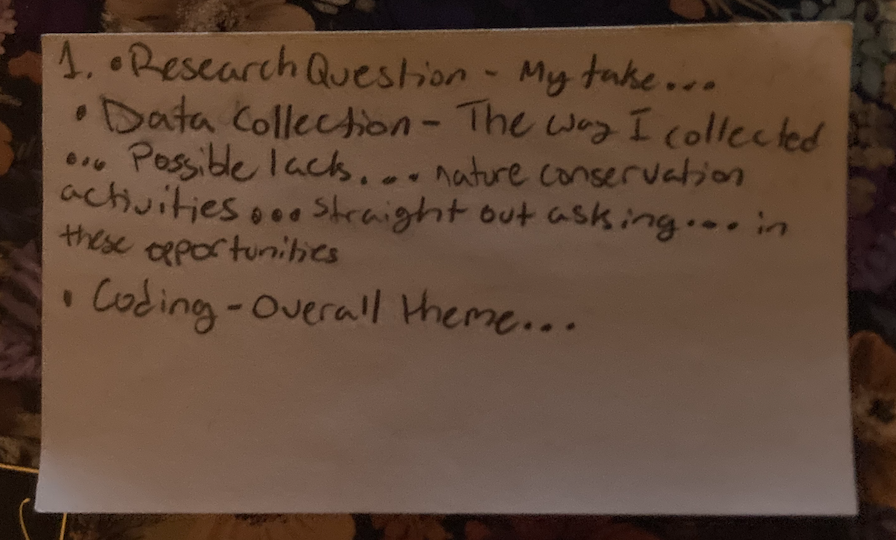
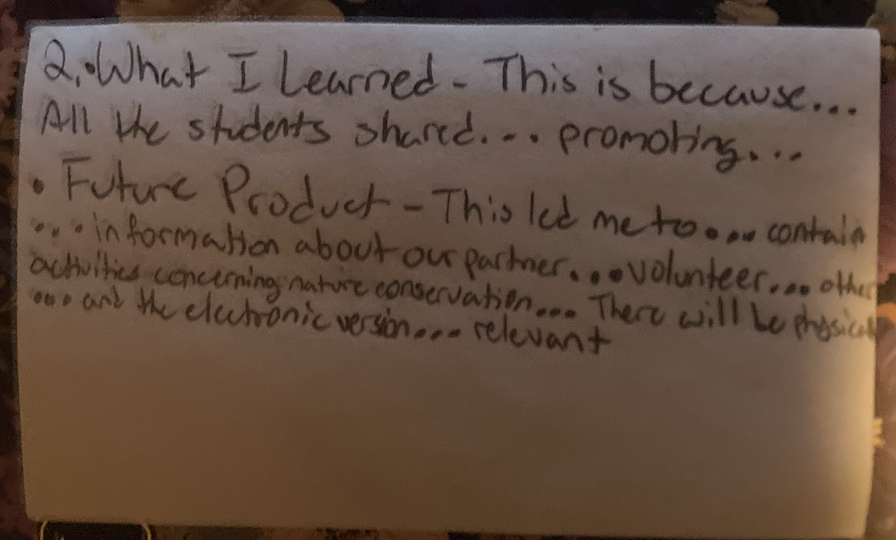
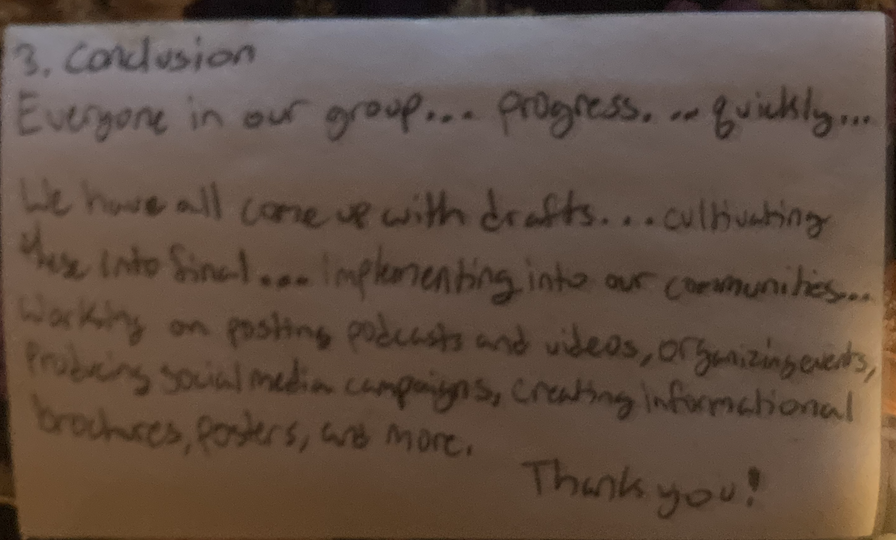
These note cards are organized in a way where I can just glance at them if I am feeling lost with my presentation. The slides have the points I’m making and the cards have the words that I will be using while speaking to the audience. That way if I happen to forget the specfic way I planned to start that sentence or a certain word I wanted to use, I could just look down and see the next phrase that I followed the previous one.
Goal 5 (10%)
Based on 11c. Reads using an appropriate lens and can engage in a continuing dialogue within and beyond a discipline or a community of readers.
My 1st artifact is my 3rd reflection where I talk about the process I went through during my data collection.
“To answer my research question of how young adults want to be engaged in nature
conservation, I conducted interviews. By using interviews to collect data, I feel that I would be
able to understand their responses without having to guess. Before I started my interviews, I had
to come up with a list of questions to ask them. I wasn’t too sure what questions I could ask in
order to indirectly get an answer to my problem. I felt that I needed to circle around the issue and
let them come to the conclusion on their own as this would bring out their perspective on this
issue. However, after taking some time to consider what would be the best course of action, I
realized it would be much easier, and effective, if I just straight out asked them the question. This
led me to ask them questions such as “what would you do to get more people our age involved in
conservation?” By asking them directly how they want to be engaged, I was able to get a straight
forward answer to what the problem was in people our age getting involved in nature
conservation.”
When I was coming up with how I would go about these interviews, I spent a lot of time trying to fiure out the best possible plan of action since I would be interviewing a diverse group of people. I had to figure out what would be the best delivery method, how I should present myself, such as if I should be very formal and professional or very down to Earth and welcoming. This paragraph from my reflection shows my process of honing in on the best way to make sure that the dialogue between me and my participants is very insightful, honest, and open.
My 2nd artifact is the codes I got from the transcripts of my interviews.
First Takeaways:
- Feeling of helplessness
- They all feel that they, and young adults, would be more engaged if there were more “in your face” advertisement. To be more involved in nature conservation it needs to be publicized more.
- Flyers in the dorms, MUC, etc., ads on the tvs, emails, events, etc.
- They all didn’t know much about the environmental clubs on campus
- They need to be advertised more
- There is interest in nature conservation, but there are also factors that get in the way of being able to do so
- Mental Health
- Stress from school and other everyday activities
This coding showcases that I met this goal because I was able to hear out the participants as well as go back and read their words in order to get to these conclusions. I was then able to use this data to push my research forward and start to form products to resolve the problem that my research question presented.