Class Portfolio
| A Work | B Work | C Work |
-Misses one class or less, or completes make-up work for excused absences -Annotates all readings thoroughly -Makes substantive comments in discussions -Completes all assignments on time (or has an approved extension request) -Work demonstrates intellectual engagement, care, effort, and growth in response to feedback -Collaborates substantially, contributes to vision, works equally with peers | -Misses two classes or less, or completes make-up work for excused absences -Annotates readings -Often participates in discussion -Completes all major assignments on time (or has an approved extension request) -Completes most SAs on time -Work demonstrates care, effort and growth in response to feedback -Collaborates equally, completes required work | -Misses three classes or less, or completes make-up work for excused absences -Completes most readings -Sometimes adds to discussion -Completes all major assignments on time (or has an approved extension request) -Completes at least four SAs -Meets minimal expectations on assignments; shows limited growth in response to feedback -Completes required collaborative work |
First-Week Introduction
The reason why I chose my five goals is because they are something I want to contiune to work on. I also believe that the assignments I will have to complete this semester will be heavily focused on those skills. The assignment that makes me most excited for the semester is the group presentation because I have come to enjoy giving presentations and public speaking. The assignment that seems like it will be the most challenging is research paper, because how well you prepare for it can make or break your process. The strategies I want to set for myself to make the semester a success is to not procrastinate, ask for help when I need it, and to fully apply myself to each and every assignment. This will allow me to set myself up for success and lead to this semester going great.
Midterm Introduction
During the first half of the semester it was a struggle. What I struggled the most with was staying motivated while getting the assignments done. At the moment I would say that I want to continue developing most of my goals during the second half of the semester. I say this because the majority of the evidence needed to showcase I have excelled at my goals have to do with the research I am doing with my group. I’m still in the process of getting all of my data and sources together and then we still have to start the final research paper and presentation. However, I believe I am on the right track with my 5th goal because there have been a lot of relections we have done, so I am able to showcase the creative outlooks and critical thinking I put into the readings.
Final Introduction
Now that the semester is over, I feel that I was able to meet the goals I set out to achieve. I learned that I don’t have to always push myself past the breaking point in order to please unappeasable people. I feel that this semester I really learned how to take things one day at a time instead of constantly worrying about what’s next to come. Going back to my goals, I believe that these goals will help me to push forward as a student and person exploring the life of college. These goals not only help me complete assignments, but they also help me to broaden my skills for my daily activities in life.
Course Goals
Goal 1 (20%)
Based on 2c. Transforms ideas through synthesizing knowledge from multiple domains.
My 1st artifact is the annotated bibliography that me and my group did for our research paper.
While completeing the Annotated Bibliography, I brought in three different sources from different domains. For research paper 6, I introduced a scholarly paper that explains how microplastics possibly affect the human body based on how prevalent they are in our environment. For sci-comm paper 1, I introduced a scholarly article that talked about the experiments they conducted showcasing how easily microplastics leach into our food from plastic containers, take-out items, and more. For sci-comm paper 2, I introduced a scholarly article that talked about the experiements they conducted to test how microplastics affect our health when consumed. These were brought from multiple sources and contained different levels of content which helped to enhance the annotated bibliography. I received feedback on my rubric indicating I completed A-level work.
My 2nd artifact is my jigsaw prep for the biodiversity and speciation papers.
For the jigsaw prep assignment, I had to analyze information from a scientific article and summarize my findings with these questions. I had to pull in different aspects and data from the paper in order to thoroughly answer each question, ensuring I give a thoughtful, and relevant, response. I received feedback on my rubric indicating I completed A-level work.
My 3rd artifact is my jigsaw summary for the biodiversity and speciation papers.
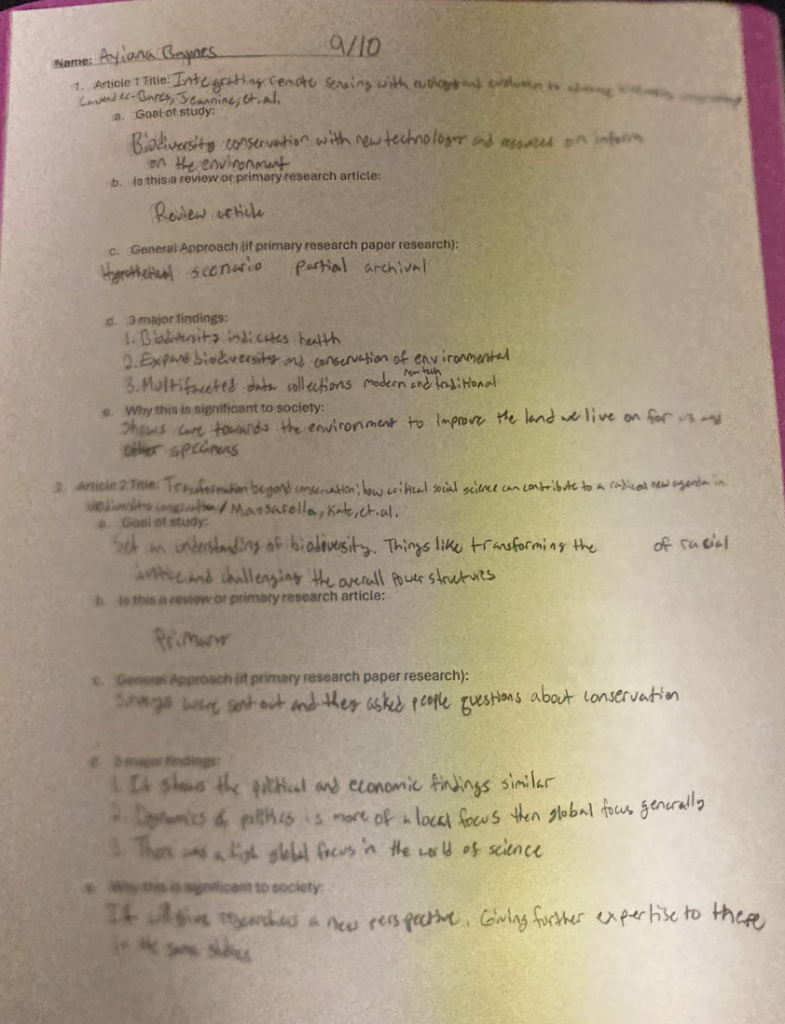
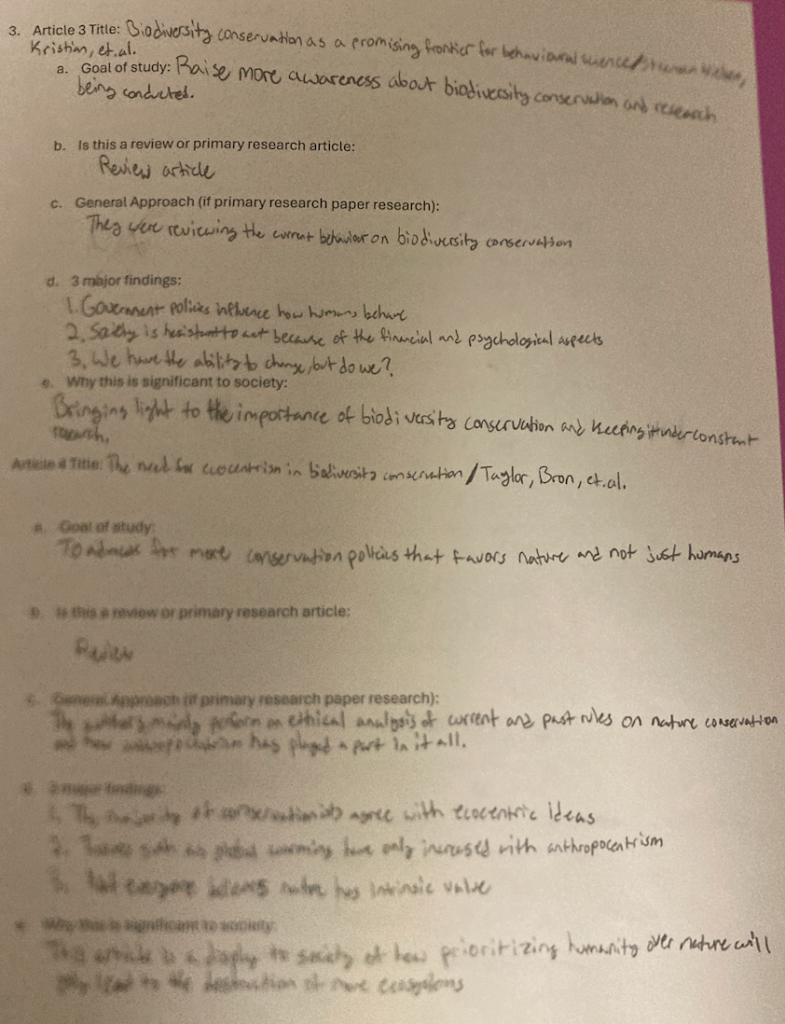
For this artifact, I had to confer with members in my paper’s group to come to a conclusion of what this article was about, as well as what the biggest takeaways were. After compromising on those responses, I then had to join groups with members doing the remaining papers. During this time, I listened to their explanations of their papers and wrote down the responses that came along with it. This allowed for me to understand the articles I hadn’t physically read and answer the questions that followed. I received feedback on my rubric indicating I completed A-level work.
My 4th artifact is the project ideas that me and my group came up with when we were coming up with an issue to research.
This piece of evidence shows that I achieved this goal because we started to think of issues surrounding our daily life. We thought about the issues regarding the water infrastructure as well as issues that we have talked about in our CODES classes. This allowed us to come to a conclusion on the 5 questions we wanted to explore. We received feedback on our rubric indicating we completed A-level work.
Goal 2 (20%)
Based on 10c. Uses quantitative information to support arguments and draw logical conclusions.
My 1st artifact is the 10 citations I produced for my groups research paper.
For this assignment, I had to find 10 different articles related to my topic and create citations from them. I found all of these research articles using Google Scholar, so they are reliable sources that include scholarly research and review papers, as well as science communication articles. By using all of these sources, I was able to bring quantitative data into our project that helped us to add to our research. I received feedback on my rubric indicating I completed A-level work.
My 2nd artifact is my group’s presentation.
Me and my group came together and shared the data we gathered from doing our own individual research in order to come together for a presentation sharing those findings. We received feedback on our rubric indicating we completed A-level work.
My 3rd artifact is the experimental design section of my group’s research paper.
“After analyzing all of our research, we decided to come up with an experiment that could prove or disprove our findings. For our experimental design, we will have 200 individuals, ranging in different age groups (0-10, 11-20, 21-30, etc.), screened to see how much microplastic concentrate resides in their body. However, the first 100 participants will be individuals who live in East St. Louis, Illinois and the remaining 100 participants will be individuals who live in Orlando, Florida.
After screening all participating residents, each participant’s results will then be put into a group based on their age in order to find the median for that age group. The age group’s results will then be compared to see if there is a pattern in the amount of particles found in each age group’s body. Lastly, the results for each city will be compared to see if there is a difference in microplastic concentrate based on the area they reside in.
Our independent variables are the ages of the 200 participants as well as the cities they live in. By bringing in different age groups of people from two different cities, it will allow us to see a variety of microplastic concentrates to help us determine if the patterns we see are consistent or a fluke. Our dependent variables are the microplastic concentrates. We are screening these individuals in order to test how much microplastic particles have accumulated in their bodies. Our control is the way we screen for these fragments because we have to use the same method each time or our results can come out false.
After conducting this experiment, we propose the results will conclude that the older you are, the more microplastic concentrate you will have in your body. This is because we consume microplastics in everything, such as tap water, water bottles, take-out food, plastic containers, etc. So, as we continue to ingest these particles, they continue to build up in our body. Therefore, someone who is 40 will have more microplastic concentrate in their body than someone who is 12. We also propose that individuals from East St. Louis will have a higher concentration of microplastics than individuals from Orlando as the water quality in the former city has more issues than the latter.
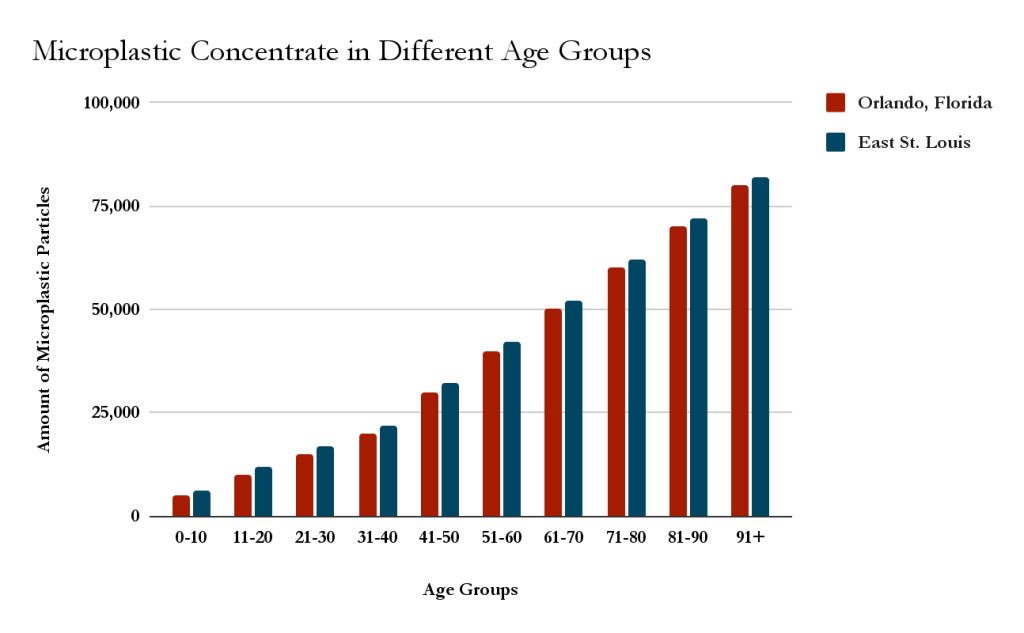
Figure 1. Amount of accumulated microplastic concentration in 200 individuals ranging in age. 100 participants from Orlando, Florida, and remaining 100 from East St. Louis, Illinois.”
While completeing our research in order to produce our research paper, we had to come up with a feasible hypothetical experiment that would aid in visualizing our evidence. For the experiement, we were able to come up with a figure that showcased our proposed results which aided us in our evidence even further. This showcases I met my goal because my group was able to use our research to produce an experiment that conicided with our paper. We received feedback on our rubric indicating we completed at least C-level work.
My 4th artifact is my group’s draft outline of our ideas narrowed down into 2 thought out ones.
After coming up with 5 ideas we wanted to explore, me and my group dug deeper into the problems we were thinking of. This allowed us to narrow down towards two ideas that we thoroughly thought out using the questions shown above. The methods we used was simply bouncing ideas off of one another and compromising with what we came up with. We received feedback on our rubric indicating we completed A-level work.
Goal 3 (15%)
Based on 5b. Accesses information using effective, well-designed search strategies and appropriate sources.
My 1st artifact is the 10 citations I produced for my groups research paper.
For this assignment, I had to find 10 different articles related to my topic and create citations from them. I found all of these research articles using Google Scholar, so they are reliable sources that include scholarly research and review papers, as well as science communication articles. Through searching for all of these sources, I was able to practice sorting through reliable, scholarly articles to find the data that is relevant to my current needs. I received feedback on my rubric indicating I completed A-level work.
My 2nd artifact is my jigsaw prep for the Biomes papers.
For this jigsaw prep, I had to answers they questions by searching through a scientific, scholarly article that had paragraphs for the abtract, methods, results, and more. When reading articles such as these, I first start by reading the abstract to get a sense of what I am looking for in the rest of the paper. That way I am not going in blind when I first start reading the paper, especially since articles like these are ridden with scientific jargon and data. I received feedback on my rubric indicating I completed A-level work.
My 3rd artifact is the figure from my groups final research project.
The reason why this figure showcases that I met this goal is because of the process it took me to create it. In order to get this data, I first had to conduct research pertaining to our research question, as well as find evidence that would prove our proposed results is as close to accurate as we can possibly get it. So, in order to create this figure, we had to thoroughly search through our research and gather data that could support our argument. We received feedback on our rubric indicating we completed at least C-level work.
Goal 4 (25%)
Based on 8a. Uses clear organizational patterns and is skillful at presenting content cohesively.
My 1st artifact for this goal is my group’s presentation.
For my group’s presentation, we took our findings from our research paper and presented them to an audience. By looking at the slides, you can see that we clearly stated our reasonings behind our research question, the articles we found as a result, the experiment we proposed, and lastly, the summary of our process. This shows that we were able to present our findings in an organized and clearly stated way. We received feedback on our rubric indicating we completed A-level work.
My 2nd artifact is the notes I came up with for my part of the presentation.
“Summary of Scicomm articles
We researched two science communication articles both having to do with microplastics and their effects.
The first article talked about how easy it is for microplastics to leach into our food and drinks. When we use takeout and plastic containers, plastic water bottles, just anything that involves plastic, we set ourselves up to be exposed by these tiny fragments.
In this article, they conducted an experiment where they tested how many microplastics were present on food before and after using them. So, warming up food in a plastic container or putting hot food in takeout boxes. The results showed that the after effects of these actions caused the amount of microplastics on the food to increase.
In the second article, it explores how microplastics in different areas of the body can affect us. They strives to add to the research on the affects of these particles on your lungs, brain, bones, etc.
The way they conducted this experiment is by having participants consume basically a handful of microplastics and then examine the short and long term effects whether that was sickness or disease later in life.
A similarity between the two articles is that they both heavily suggested that we find healthier alternatives to plastics as they are detrimental to our environment and our health.
Proposed Experiment:
After we analyzed our research, we came up with an experiment that where we have 100 individuals, ranging in different age groups, be screened to see how much microplastic concentrate resides in their body. Each participant’s results will be put into groups based on their age in order to find the median for that age range.
Looking at out figure, we propose that the older you are, the more microplastic concentrate you will have in your body. This is because as you age, those tiny fragments will accumulate in your body, so someone who’s 3 won’t have as much microplastics in their body as someone who’s 30 because the latter person has had an extra 27 years to ingest those plastics.”
These are the notes I prepared for the presentation as I practiced what I would say when I shared my parts. By coming up with full, thought out speeches for each section, I was able to understand how I wanted to talk about each section, as well as practice the specific words I would say in order to help my presentation run as smoothly as possible. For our oral presentation, we received feedback on out rubric indicating we completed A-level work.
My 3rd artifact is the scientist spotlight on Dr. Ayanna Elizabeth Johnson
Simply put, I organized my reflection on this scientist in a clear, and concise way. There is little to no beating around the bush when it comes to answering the questions from the assignment. Lastly, when completeing this assignment, I strived to have as much qualitative responses in my reflection instead of a bunch of random and irrelevant words and sentences. I received feedback on my rubric indicating I completed A-level work.
My 4th artifact is my group’s draft outline of our ideas narrowed down into 2 thought out ones.
After coming up with 5 ideas we wanted to explore, me and my group dug deeper into the problems we were thinking of. This allowed us to narrow down towards two ideas that we thoroughly thought out using the questions shown above. The way we structured our two ideas is easily understandable and doesn’t include any fluff. Therefore, this showcases how clear and concise we were when presenting our ideas. We received feedback on our rubric indicating we completed A-level work.
My 5th artifact is my jigsaw prep on the Indigenous Knowledge papers.
The way I respond to each question is very straightforward while also giving the thought out answer that the assignment requires. This showcases that I achieved this goal as I was able to pack in the necessary answers into 1-2 sentences, allowing for people to understand this scholarly article without having to read all of the pages. I received feedback on my rubric indicating I completed A-level work.
Goal 5 (20%)
Based on 11c. Reads using an appropriate lens and can engage in a continuing dialogue within and beyond a discipline or a community of readers.
The artifacts I used for this goal are the reading reflections on “Braiding Sweetgrass” I completed throughout the semester as well as a scientist spotlight on Hindou Oumarou Ibrahim.
These assignments showcase how I achieved this goal because of how I responded to each question. Each of these assignments are reflections on a book called “Braiding Sweetgrass” and on a scientist named Hindou Oumarou Ibrahim. For the reflections, I sometimes answered each question provided, getting straight to the point, but other times I went completely away from the questions and just reflected on how I perceived the writing or video, as well as how it made me think. I received full points for each of these assignments; consistently completeling A-level work.