At Southern Illinois University Edwardsville (SIUE), I have been researching young adult engagement in local community issues. Together with my CODES (Community Oriented Digital Engagement Scholars) research team and Heartlands Conservancy, I have been looking for ways to involve young adults, ages 18-24, in problems relating to water conservation. My specific region of focus for this project was to focus on connecting Heartlands Conservancy, our community partner, to students at SIUE who may be interested in learning more about their work. Since reaching out to individual students is not an easy feat, I decided to reach out to professors who were scheduled to teach classes like ecology and environmental science the next semester. All of my research regarding this topic is being accumulated into my research team’s project for this semester. The data for my portion of the research project was collected through surveys. The first step in my process was to build a survey on Qualtrics that asked about the professor’s experience with community organizations. I wrote questions that were a mix of short response and multiple choice, with 8 questions in total. The main objective of the survey was to find out how professors at SIUE feel about community organizations and how willing they would be to collaborate with them in future courses. Afterwards, I created a list of teachers that I could email my survey to. This list was mainly composed of science and ecology professors who would be most interested in water conservation issues. In the end, I found 40 SIUE professors that I sent my survey to via email. The main goal of this project was to give Heartlands a list of teachers that they could collaborate with in the future. These collaborations could be in the form of extra credit or even lectures taught by people who work at Heartlands Conservancy.
Month: November 2025 (Page 1 of 2)
After a week of waiting, I had received a little over 10 responses from professors at SIUE. Even though I had received less answers than I originally expected, I did notice some patterns in the responses. While only 3 participants mentioned teaching or planning to teach a course, such as Environmental Anthropology, that would benefit from the input of a community organization, those same participants went on to state that they had prior experience working with a community organization in a classroom setting. Also, only one out of three participants claimed that they had a negative experience with these organizations. A common theme throughout these responses appears to be a positive outlook on community organizations from the professors.
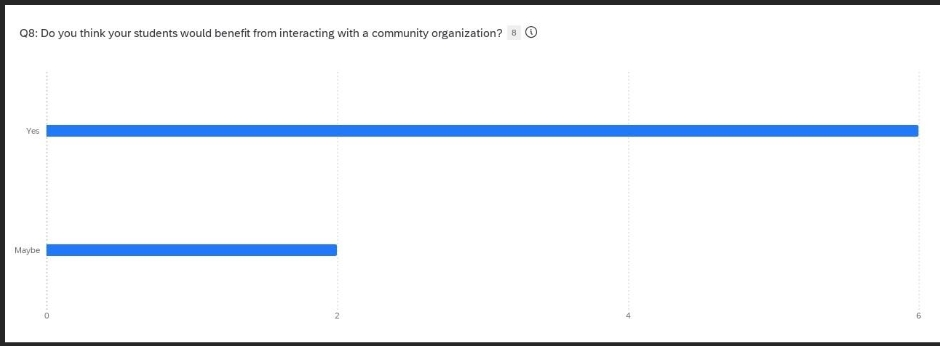
Figure 1. Professors’ response to community organizations relationships benefiting students
Overall, the majority of the professors seem to believe that the use of community organizations is beneficial for students in and outside of school (Figure 1), with several of them arguing that it gives the students both practical and real-world experience. From the responses, it is obvious that many of these professors are willing to offer lecture time to these organizations as well. When asked what these community organizations can do in a classroom setting, the majority of them suggested either giving lectures or networking with students.
After asking whether or not students would benefit from collaborating with community organizations in a classroom setting, I went on to ask why the professors chose this answer. The majority of the responses I received suggested that it would offer much real-world experience to those participating in the course. However, there was one response that I decided to take a closer look at.
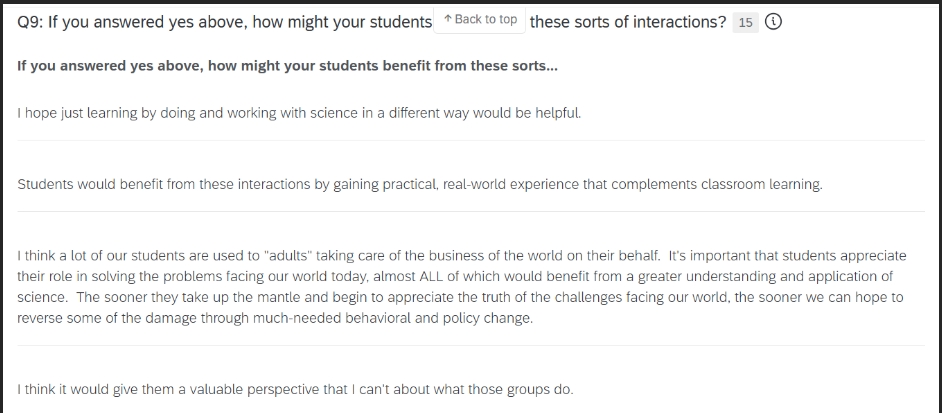
Figure 2. Open responses to benefits to students
The last response to this question has highlighted the idea that community organizations can offer both experience and knowledge that college professors cannot provide to their students. While this was only one opinion out of multiple, this specific professor has shown how community organizations can offer input from actual community works, while professors can only show students what to expect. The professor could not provide a specific example for a class that they could teach to contribute, but they are willing to support these efforts regardless. Even if it is difficult for the average professor to help with this issue, we do have people who are willing to do what they can to allow their students to learn from community organizations.
What is a windigo to you? What would be analogous to a windigo in your culture, religion, or lore? (250 word minimum)
A windigo, to me, represents the selfish, primal nature that exists within all of us. This nature often shows itself in the form of our overconsumption. With our access to resources having improved drastically in the last 100 years, those who have the greatest access often take more than they need. We eat more food than we need to be satiated, we take more from the earth than we actually use, and we buy more and more useless gadgets and accessories while many people cannot even afford to rent an apartment. I believe that this reflects a primal nature that has existed in humanity since we came into existence. There has always been a “us vs them” mentality in us, which has directly led to a lack of empathy in our modern society.
This windigo is a direct representation of this endless hunger for “more”. It is our desire to take as much for ourselves as possible, because we know the “others” are going to do the exact same thing. The closest thing I could find to compare this entity to is the Seven Deadly Sins. Three of these sins, pride, greed, and gluttony, can be summed up into the idea of believing that you are better than the people around you. Pride, specifically, is centered around having a higher view of yourself compared to others. Meanwhile, greed and gluttony both focus on taking more than what you need, disregarding the needs of those around you. Wrath and envy, two more deadly sins, represent hatred or dislike for people who are not like you.
What is your favorite new word or phrase you’ve learned reading this book and why? What chapter of the book did this phrase appear? 100 word minimum)
“Even a wounded world is feeding us”. This quote stood out to me specifically because of what it means for humanity as a species. Despite all the damage we have made to our planet, it is still able to sustain and entertain our growing populations. While the effects of human activities, such as global warming and deforestation, are not permanent, they have still caused a major change in the
Earth. It makes me realize that we do not deserve the world that we live in. We take nearly everything from the natural world and do not appreciate the benefits that it gives us. We do not even make any efforts to make up for our shortcomings; we just continue to make the same mistakes repeatedly.
- The most interesting part of the resources for me was noticing how climate change impacts cultures worldwide. We often look at climate effects such as rising sea levels and higher yearly temperatures and think that we have it terrible, yet choose not to do anything about it. I believe that seeing how climate change is affecting countries in Africa puts everything in perspective. It also makes sense how there is a massive push against climate change in African countries, since they are receiving the worse end of the problem.
- While scientific knowledge may apply to the majority of the real world, but
Indigenous Knowledge can apply to locations centered around a certain culture. In the TED Talk, Oumarou tells a story about a scientist who was brought to her home to look into climate change effects. When Oumarou predicts that it will rain long before any scientific signs, the scientist doubts her and decides not to pack his items. Eventually, the rain started, just as Oumarou had predicted. Just like scientists make observations in their environment to conduct experiments, indigenous cultures make observations in their home to predict when natural occurrences will reappear. - Oumarou shows that scientists are those who recognize the contribution that they can make to worldwide knowledge. She knows that Indigenous Knowledge can really help advance scientific discoveries, so she is doing whatever she can to make sure it gets recognition.
- I would like to know how many concepts Indigenous Knowledge can apply to. Does Indigenous Knowledge go past natural and animal patterns? Can we predict astronomical occurrences, or biological occurrences using Indigenous Knowledge. I am curious as to how interconnected Indigenous Knowledge and scientific knowledge can become.
Article Title & Authors: Native Perspectives from a Focus Group Study. Smythe et al.
- What is the purpose/goal of this study? (at least 2 sentences)
The purpose of this study is to get the perspectives of Native Americans on mixing Western science and traditional knowledge. The focus groups featured in this study consist of teachers and students from a STEM conference. - Why is this issue significant/why do we care? (at least 2 sentences)
This issue is significant because Western science mainly prioritizes facts and evidence, while Traditional Knowledge focuses on connecting with nature. Combining these two methods could further a lot of efforts around climate change and sustainability. - What words/vocab do you need to know to make this make sense? Define them here. (at least 3 terms).
Traditional Knowledge comes from Indigenous cultures and centers around a connection with the land and nature itself. Western science is a system of knowledge that focuses on experimentation and observations. Epistemology is the study of knowledge and how we know what we know. - What approach are they taking in this study? (Describe the specific qualitative or quantitative methods used, at least 3 sentences). The authors used a qualitative approach in this study. Two focus groups were conducted with participants from STEM conferences. These focus group sessions were then transcribed and analyzed.
- What are the results of the study? Explain what they found when they compared or measured different variables. If there are figures – write a sentence summarizing each figure/table. (at least 3 sentences).
The focus groups explained how they saw both Western science and Traditional Knowledge as community-oriented tools for reform. They also believed that the implementation of these two complementary methods could be good for cultural identity and even classroom engagement. Unfortunately, there is the issue of Traditional Knowledge being misappropriated during this process. - Does the data make sense based on your experiences? Explain why or why not. (at least 2 sentences)
I have done research on the implementation of hybrid teaching methods, and the results do seem to line up with what I have found. Many people advocating for active learning strategies suggests creating a hybrid of passive and active strategies, which matches the results of this article. - How is this pushing the field forward and helping society? (at least 2 sentences)
With the integration of these two methods, the process of conducting research could be reformed as a whole, changing the way many people look at science. On top of that, this pushes a strong community-centric ideology, allowing for more equality in issues such as climate change.
What does it mean to you to be “indigenous to the land?” Is it possible for the descendants of European white settlers to be indigenous to the land of people occupied by displacement of native people? Why or why not?
To be “indigenous to the land” is to have a history of living on and tending to a piece of land that spans generations. I believe that it is possible for the descendants of white settlers to be indigenous to America. Even though this land was taken away from the Native Americans, that does not take away from the fact that most modern Americans have had many generations of their family born on this land. White Americans who descend from early colonizers and settlers in the
1600s have over 4 generations in their family before them that were born on this land. While 400 years may seem like nothing compared to the thousands of years that the Native Americans spent in the Americas, it is still important to recognize the time and effort that was put into the land by those who came after them.
In what ways do you feel yourself connected to the divine through relationship with the land?
I feel like whenever you recognize the fact that the world was given to us by God, you grow an appreciation for the land that you have. Many people take for granted the land that they live on every day of their lives. We like to complain about the country that we live in or the type of landscape we live in, yet we make no effort to change our environment. Most people just choose to settle for a space that they despise and never learn to appreciate what they have. But noticing how the land you have is a gift from God can allow you to recognize the importance of what you have.
An implicit part of all the stories Kimmerer shares is that she has somehow developed intimate familiarity with each of the natural settings with which she interacts. What are the features that invite lots of the kind of interaction Kimmerer seems to think is valuable?
I believe that features that represent common experiences between a group of people, or ones that show the history of a people, can allow for more intimate familiarity. Humans are very social creatures, because of that, we like to identify with people who we have things in common with, like similar physical features, similar interests, or even similar life experiences. Even if we do not have the same experiences in life, as long as we identify with that group of people, it is as if those experiences are shared for us as well. These features could be trees with intricate designs, hills from hometown areas, or even parks that we used to visit as children. While these features could be ties to a greater shared history, they could also be connected to events that we experienced by ourselves or with friends and family. Anything natural that connects us with our old selves, or people we used to know, has the potential to also connect us to the natural world itself.
- What was most interesting to you in reviewing these resources?
Dr. Johnson’s TED Talk dived into the idea of performing climate actions in ways that you enjoy. It was interesting to me how there are so many pathways to go through in order to help avoid climate change. Many people assume that helping with climate change involves working with nature or fossil fuel emissions, which may not interest everyone. Fortunately, there are several other works that factor into climate action, such as energy storage and transportation, which people could get involved in to help make a change. - What did you learn from these resources about ocean conservation?
I learned that ocean conservation is not as simple as just regulating where the trash is sent. There are a lot of policies already set in place by world governments that would have to be changed by everyone to have a lasting positive effect on the planet. On top of that, there are industries that would have to change what they do to contribute to this, such as the trash or recycling industries. Trying to implement these rules could change politics and economies across the world forever. - What new questions do you have after reviewing these resources?
One question I have is how can people start working on climate change right now? If someone was truly dedicated to making a change in the world and trying to restore our planet, where could they go to start? Which organizations work directly against climate change and how could you get into these organizations? These are all questions that people who are serious about climate change would want to know so they do not waste any of their time in the process. - What do these resources tell you about the types of people that do science?
These resources show me that the types of people that do science are those who have an interest in the inner workings of our universe and a skill that could help discover more about our universe as well. Dr. Johnson shows that not everyone who works on climate change has to have ecology or environmentalist skills. Not everyone who contributes to science needs to have every set of scientific knowledge on their topic, they could contribute with math skills, or even communication skills.
Article Title & Authors: Amazonian vegetation types and indigenous lands threatened by upcoming climate change: Forecast impact for Brazilian biomes. Arruda et al.
- What is the purpose/goal of this study? (at least 2 sentences)
The purpose of this study is to estimate how much natural biomes in Brazil will change in response to future changes in climate. The majority of the biomes in the study are located in the Amazon, where the climate is consistently changing. - Why is this issue significant/why do we care? (at least 2 sentences)
Climate extremes that are unprepared for could cause biodiverse biomes, like the Amazon, to lose several species and vegetation. These effects can also apply to places far outside of South America if strategies are not put in place to prepare for these issues. - What words/vocab do you need to know to make this make sense? Define them here. (at least 3 terms).
Biomes are ecological areas on Earth’s surface with a certain climate, vegetation, and animals. Anthropogenic pressure is stress on the environment caused by issues like deforestation, agriculture, and pollution. Ecological niche modeling is a method used to predict the distribution of species based on the conditions in their environment. - What approach are they taking in this study? (Describe the specific qualitative or quantitative methods used, at least 3 sentences). The authors of this article mostly used models to predict changes in plants. A few of these models involved mapping out biomes alongside indigenous territories. These models were all set to continue until the year 2070.
- What are the results of the study? Explain what they found when they compared or measured different variables. If there are figures – write a sentence summarizing each figure/table. (at least 3 sentences).
The authors found that future climate changes in the Amazon will cause a decrease in biodiversity overtime. A major cause is the lack of a habitat to support these animals. Along with that, these climate changes cause an environment to become more vulnerable to further stressors. - Does the data make sense based on your experiences? Explain why or why not. (at least 2 sentences)
Yes, the results of this study make sense to me, simply because of how fragile natural ecosystems already are. The survival of multiple species often relies on one or two organisms, which explains why these ecosystems are so sensitive when it comes to climate change. - How is this pushing the field forward and helping society? (at least 2 sentences)
The information from this study lets us know that we need to prepare for the effects of climate change before we start to lose hundreds or thousands of organisms. If we do not prepare now, then the problem will not be the loss of organisms, but the loss of entire ecosystems.
Research Question: How do passive vs active learning strategies affect student engagement on water conservation education?
Review Paper 1
- Team member evaluation:
Sonia Sheryr - Citation for the article:
Siripoulos, Costas and Pomonis, Gerasimos. “Alternatives to ‘Chalk and Talk’:
Active Vs. Passive Learning – A Literature Review of the Debate”. SSRN, 3 April 2007. Alternatives to ‘Chalk and Talk’: Active Vs. Passive Learning – A Literature Review of the Debate by Costas Siriopoulos, Gerasimos A. Pomonis :: SSRN - 1-paragraph summary:
Using over 20 different sources to collect data, Siripoulos and Pomonis develop four different hypotheses on the advantages of learning strategies in college courses. Each hypothesis they come up with pits “lecture learning” against a different teaching method. At the end of their research, they
discovered that the majority of the authors they had looked into supported either hybrid or active learning. For the first hypothesis, all of their sources argued that lecture methods were outdated and needed to be replaced by hybrid methods. The same results panned out for the second hypothesis, with all of the sources agreeing that active learning was better for student understanding than lecture learning. For the use of case study methods, only 25 out of 40 sources supported their adoption, due to the fact that it could
lead to students adopting passive learning styles if taught wrong. Long distance learning over lecture learning was only supported by 13 out of 40 sources since it does not have any major effects on student learning. - What information does this source contribute to your research question?
This source supports the idea that lecture methods are not good enough to teach advanced courses to students. Some implementation of active learning strategies are essential to teach many college level courses. - How does the source relate to other sources in your bibliography?
Ultimately, hybrid strategies are praised the most, just like in most of the other sources. - What are the strengths and weaknesses of the source? While the authors’ use of 40 sources does make the results more significant, these results only apply to college level courses, leaving out any information on the effects of active learning on students of younger ages.
- How does the source fit into your research topic? Why is it useful?
This source provides an argument for active learning being more helpful for a student’s education than passive learning.
Review Paper 2
- Team member evaluation:
Jaiden DeBoe - Citation for the article
Gamo, Joel. “Anatomy Education-Paradigm Shift from Passive to Active Learning-Effects on Student Engagement, Comprehension and Retention A Review of Literature from 2012 to 2022”. The FASEB Journal, 13 May 2022, vol. 36, issue S1. Anatomy Education‐Paradigm Shift from Passive to Active Learning‐Effects on Student Engagement, Comprehension and Retention A Review of Literature from 2012 to 2022 – Gamo – 2022 – The FASEB Journal – Wiley Online Library - 1-paragraph summary:
In order to determine the true advantages of active learning over passive learning, Gamo analyzes studies conducted on the subject from 2012 to 2022. Most of the studies come back to the same conclusion, that active learning allows for better student engagement, comprehension, and retention. In fact, the National Training Laboratories in Maine provided a statistic which states that passive learning, on average, leads to a 30% retention rate, while active learning leads to retention rates of 50%-90%. This is because active learning strategies force the students to seek out information on their own, while passive learning strategies simply force feed a lot of knowledge to the students, leaving many of them disinterested. - What information does this source contribute to your research question?
This source not only shows how active teaching is more effective in a student’s education, but also offers reasons why this is the case, such as comprehension and retention. - How does the source relate to other sources in your bibliography?
Similar to the first source, the studies used in this article also come from college level classes. - What are the strengths and weaknesses of the source?
This article does a great job at explaining why people believe active learning is better than passive learning. However, Gamo does not mention what specific sources had to say about the topic, instead opting to summarize what the majority of his sources agreed upon. - How does the source fit into your research topic? Why is it useful?
Gamo is able to show real results for the switch from passive learning to active learning instead of just claiming that one is better than the other.
Research Paper 1
- Team member evaluation:
Sonia Sheryr - Citation for the article
Munna, A. S., and Kalam, M. A. “Impact of Active Learning Strategy on the Student Engagement”. GNOSI: An Interdisciplinary Journal of Human Theory and Praxis, vol. 4, no. 2, Apr. 2021, pp. 96-114. ED614302.pdf - 1-paragraph summary:
Munna and Kalam were curious as to why student participation was as low as it is today. To best answer this question, 50 college level students, who are taught by the authors, were taught using four different learning strategies. The first strategy was called Explore First, where the teachers gave them
certain tasks and allowed them to complete these tasks on their own. The second strategy, Peer Learning, allowed the students to learn from their teacher while also working in groups to help each other understand the material better. The Networking strategy was similar to the first strategy, but involved working in groups instead of individually. The Game Based strategy had students utilizing interactive games in order to learn classroom material. In the end, the students were given a questionnaire regarding the use of the learning strategies used. Game Based and Peer Learning were seen as the most effective by the students because it made them more willing to show up to class and engage themselves in the topic. - What information does this source contribute to your research question?
This source proves that students are most engaged in school when they are allowed to learn their own way and at their own pace, which are both aspects of active learning. - How does the source relate to other sources in your bibliography?
Just like in the previous source, active learning strategies are shown to be a major motivator in student engagement - What are the strengths and weaknesses of the source?
The use of multiple different strategies in this study allows the authors to truly understand what it is about active learning strategies that engage students. Unfortunately, the sample size is too small to be able to give significant results. - How does the source fit into your research topic? Why is it useful?
This source simplifies the question of why active learning strategies are important by highlighting which ones are favored among students.
Research Paper 2
- Team member evaluation:
Jaiden DeBoe - Citation for the article:
Diepreye, Fapohunda and Odukoya, Jonathan. “The Impact of Passive and Active Teaching Methods on Students’ Learning Among Secondary School Students in Yenagoa, Bayelsa State”. Journal of Physics: Conference Series, 2019, vol. 1378, issue 2. The Impact of Passive and Active Teaching Methods on Students’ Learning Among Secondary School Students in Yenagoa, Bayelsa State – IOPscience - 1-paragraph summary:
The authors of the study gathered 196 high-school-level students in Yenagoa, Nigeria, 72 boys and 124 girls, and had them taught biology topics using four different methods. These methods consisted of practical teaching, class discussions, traditional lectures, and video watching. Afterwards, the students were tested on these topics using the same test. On average, the students who were taught using practical teaching or class discussions scored between 84% and 85% on the test, while students who were taught
using traditional lectures or videos scored between 61% and 70%. - What information does this source contribute to your research question?
Passive teaching methods that involve teachers simply “reading words” to students negatively impact their school performance, while active methods that allow students to learn for themselves allow
them to perform better on tests. - How does the source relate to other sources in your bibliography?
This source connects to our second review paper because they both demonstrate how active learning strategies can be better for comprehension and retention of knowledge. - What are the strengths and weaknesses of the source?
The large sample size of this source does allow for accurate data. However, the difference in numbers between boys and girls could cause the results to be less accurate for the average student. - How does the source fit into your research topic? Why is it useful?
Once again, active learning methods are shown to be more effective in increasing school performance. This specific source highlights this idea in a high-school-level course.
Research Paper 3
- Team member evaluation:
Sonia Sheryr - Citation for the article:
Singh Minhas, Paras et al. “The effects of passive and active learning on student preference and performance in an undergraduate basic science course”. American Association for Anatomy, 20 March 2012, vol. 5, issue 4. The effects of passive and active learning on student preference and performance in an undergraduate basic science course – Minhas – 2012 – Anatomical Sciences Education – Wiley Online Library - 1-paragraph summary:
72 students in a college animal physiology course had their class split into two sessions, a normal lecture from a professor and a peer-led seminar. After each class, the students were asked to rate the efficiency of the teaching method. This study lasted for 2 years, where in the end, the students’ interest in peer-led seminars and their exam scores both increased. 68% of the students in the study argued that implementing active learning strategies along with passive learning strategies would be most effective for
them. - What information does this source contribute to your research question?
Active learning strategies, such as peer-led seminars, are an important part of a student’s education. However, they are most effective when coupled with traditional passive learning strategies - How does the source relate to other sources in your bibliography?
Similar to our first review article, this source shows that the use of hybrid learning strategies is most favored among college students. - What are the strengths and weaknesses of the source? The length of time used in this study allows for multiple assessments on the efficiency of the learning strategies used, which gives the students enough time to consider whether or not these methods are effective long term. The only main downfall of this study is the small sample size.
- How does the source fit into your research topic? Why is it useful?
The authors of this source show how important active learning strategies are for student engagement and performance.
Research Paper 4
- Team member evaluation:
Jaiden DeBoe - Citation for the article:
Mikolaj, Christy. “Effective Instructional Strategies in Sixth Grade Inclusion Mathematics Classrooms: The Effect of Active and Passive Engagement on Concept Learning and Opportunity to Learn”. ProQuest, December 2019. Effective Instructional Strategies in Sixth Grade Inclusion Mathematics Classrooms: The Effect of Active and Passive Engagement on Concept Learning and Opportunity to Learn – ProQuest - 1-paragraph summary:
Taking place in a classroom setting designed to teach 6th-grade students with special needs, six students were taught using a normal lecture method while four students were taught using a project-based method. 23 students who did not require special needs education were also placed in the lecture group,
and 17 other students who did not require special needs education were placed in the project-based group as well. After four days of tests and surveys, the researchers found unexpected results. While students
who did not have special needs performed better when learning using project-based methods, students who did have special needs performed slightly worse when using project-based methods. - What information does this source contribute to your research question?
On average, active learning strategies can positively impact student performance. However, not every student is able to learn the same. Many students require a mix of active and passive learning strategies, while some students may require primarily passive learning strategies. - How does the source relate to other sources in your bibliography?
This source relates to my second review article, because it shows that many students are not able to perform well in school because the education system is unable to match their individual needs. - What are the strengths and weaknesses of the source? The split of students between active learning methods and passive learning methods makes the results more distinct. The bad part about this source is that the small length of time and unproportional representation of special needs students make the results less accurate.
- How does the source fit into your research topic? Why is it useful?
This source supports the idea that hybrid methods could be the best way to teach every student in a way that benefits them individually.
Research Paper 5
- Team member evaluation:
Sonia Sheryr - Citation for the article:
Haidet, Paul et al. “A Controlled Trial of Active Versus Passive Learning Strategies in a Large Group Setting”. Springer Nature, March 2004, vol. 9, pages 15-27. A Controlled Trial of Active Versus Passive Learning Strategies in a Large Group Setting | Advances in Health Sciences Education - 1-paragraph summary:
Residents at a medical institution were given an after-hours teaching session. During this time, the first group were taught in a teacher-student manner, while the second group was taught in a student-student manner. After surveying the residents before and after the sessions, the researchers
determined that both teaching methods led to increased test scores. The only differences were that the first group appeared more engaged and that the second group valued the sessions more. - What information does this source contribute to your research question?
This source supports the idea that active learning strategies can increase student engagement while also arguing that both active and passive methods are equally important in student education. - How does the source relate to other sources in your bibliography?
This source best relates to the idea that hybrid learning strategies are more effective than just active learning strategies, similar to my first review article. - What are the strengths and weaknesses of the source?
Surveying the students right before the session, right after the session, and weeks after the session allows the researchers to measure student perception and student retention. Unfortunately, since this study is only conducted during after-hour sessions, it is difficult to determine whether or not their increase in knowledge is primarily due to these sessions. - How does the source fit into your research topic? Why is it useful?
This source also demonstrates the importance of using both active and passive learning strategies, instead of just one or the other.
Research Paper 6
- Team member evaluation:
Jaiden DeBoe - Citation for the article:
Mahmood, Muhammad et al. “STRATEGIES FOR ACTIVE LEARNING: AN
ALTERNATIVE TO PASSIVE LEARNING”. SAVAP International, November 2011, vol. 1, issue 3. Microsoft Word – 2011_1.3-20_ - 1-paragraph summary: This relates to the issue of learning and offers strategies for active
learning as an alternative to passive learning. Passive learning does not always give a real understanding. While active learning lets students engage by participating and can improve motivation and interest. Active learning is more enjoyable by being hands on and where the student can retain more knowledge. - What information does this source contribute to your research question?
It directly compares active and passive learning correlates to student engagement. - How does the source relate to other sources in your bibliography?
This source best relates to the idea that active learning strategies are more effective than passive learning
strategies, similar to the first review article. - What are the strengths and weaknesses of the source?
Strengths are that it clarifies what they measure regarding student engagement such as interest, motivation, autonomy, and anxiety making it useful to relate it to our variables. Also, they provided qualitative data and multiple strategies that show how active learning can be implemented. Unfortunately only 20 students participated, and the study only lasted a week, so it doesn’t relate to long term. - How does the source fit into your research topic? Why is it useful?
This source relates to active and passive learning strategies and measures how each affects student engagement. It provides us with evidence that active learning strategies is more effective than passive learning such as lecturing.
Science Communication Paper 1
- Team member evaluation: Sonia Sheryr
- Citation for the article: Murgel, M., et al. “Science Communication Project: Articulating
Teaching.” Journal of Chemical Education, vol. 102, no. 1, 2025, pp. 88–96. American Chemical Society, https://doi.org/10.1021/acs.jchemed.4c01569 - 1-paragraph summary:
This was focused to improve students’ understanding of concepts, communication skills, and engagement. Results showed students had a deeper grasp of the material, gained more motivation, and confidence in explaining concepts in clear and detailed ways. These findings highlight how active learning strategies left students with a deeper understanding of concepts by connecting them to real-life situations. - What information does this source contribute to your research question?
This source focuses on how active learning influences the students’ understanding on a deeper level. - How does the source relate to other sources in your bibliography?
This relates to paper 6, regarding active vs learning strategies in a classroom; and relates to several other sources along the same lines as well. - What are the strengths and weaknesses of the source?
This source emphasizes student engagement with active learning which relates to our topic. This relates to
one student topic, but not for long term engagement. - How does the source fit into your research topic? Why is it useful?
This describes how active vs passive methods affect engagement, this paper provides an example of students actively communicating science.
Science Communication Paper 2
- Team member evaluation: Jaiden DeBoe
- Citation for the article: Shivni, R., Martinez, A., & Green, A. (2021). Establishing a baseline of science communication skills in an undergraduate environmental science course. International Journal of STEM Education, 8(1), 45. https://doi.org/10.1186/s40594-021-00304-0
- 1-paragraph summary: This source showed that while many students could explain the topics, they
often struggled to adapt themes or clear concepts. The authors suggest that structured, active communication tasks in science classrooms can help students develop stronger engagement and public communication abilities. - What information does this source contribute to your research question?
This source contributes directly to our research question because it establishes that active learning helps students develop stronger engagement and retention. - How does the source relate to other sources in your bibliography?
This relates to research paper 6 where the authors suggest active learning over passive. - What are the strengths and weaknesses of the source?
This focused on a real environment, but it was conducted with a small group. Also, this relies on qualitative data over quantitative. - How does the source fit into your research topic? Why is it useful? This talks about active engagement in environmental education which relates to my focus on active vs passive learning. It is useful to show that hands on learning experiences promote a sharper understanding on students and their overall retention.
Project Idea Draft Title:
Learning Strategies for Student Engagement
Research Question: (stated as a testable question)
How does passive vs. active learning strategies effect student engagement on water? conservation education?
Hypotheses: (stated as mutually exclusive answers to your research question)
Active learning strategies engage students in classroom activities better than passive learning strategies.
Prediction: (stated as a range of expected results will lead you to reject or accept the stated or null hypotheses)
If passive learning strategies are replaced by active learning strategies in a school
environment, then student participation will increase.
Evidence: (Rationale of your hypotheses based on peer-reviewed scientific literature and science news on your topic)
Review Articles: (list the citation and what it says about your topic)
Siripoulos, Costas and Pomonis, Gerasimos. “Alternatives to ‘Chalk and Talk’: Active Vs. Passive Learning – A Literature Review of the Debate”. SSRN, 3 April 2007. https://ssrn.com/abstract=977283
Articles written by instructors stress the need for active learning strategies.
Gamo, Joel. “Anatomy Education-Paradigm Shift from Passive to Active
Learning-Effects on Student Engagement, Comprehension and Retention. A Review of Literature from 2012 to 2022”. The FASEB Journal, 13 May 2022, vol.
36, Anatomy Education‐Paradigm Shift from Passive to Active
Learning‐Effects on Student Engagement, Comprehension and Retention
A Review of Literature from 2012 to 2022 – Gamo – 2022 – The FASEB
Journal – Wiley Online Libraryissue S1.
Interactive methods such as peer teaching, blended classrooms, and augmented
reality led to over 50% retention, while passive learning strategies only led to
30% retention.
Pitterson, Nicole et al. “Measuring cognitive engagement through interactive, constructive, active and passive learning activities”. IEEE Xplore, 1 December 2016. Measuring cognitive engagement through interactive, constructive, active and passive learning activities | IEEE Conference Publication | IEEE Xplore
The ICAP framework found that students are actively learning when they discuss
school topics with their classmates or their teacher.
Willett, Laura Rees. “Comparing Active and Passive Learning: What Does the Evidence Really Say?”. Academic Medicine, May 2017, page 573. Academic Medicine
The author in this article is reviewing a research article which concluded that
active learning was the superior method in student education.
Research Articles: (list the citation and what it says about your topic)
Munna, A. S., and M. A. Kalam. “Impact of Active Learning Strategy on the
Student Engagement”. GNOSI: An Interdisciplinary Journal of Human
Theory and Praxis, vol. 4, no. 2, Apr. 2021, pp. 96-114, ED614302.pdf
The main problem in student engagement is teaching students based on their
current knowledge level.
Diepreye, Fapohunda and Odukoya, Jonathan. “The Impact of Passive and
Active Teaching Methods on Students’ Learning Among Secondary
School Students in Yenagoa, Bayelsa State”. Journal of Physics: Conference
Series, 2019, vol. 1378, issue 2. The Impact of Passive and Active Teaching
Methods on Students’ Learning Among Secondary School Students in
Yenagoa, Bayelsa State – IOPscience
The results of the study show that active learning strategies have more of an
impact on student education than passive learning strategies do.
Singh Minhas, Paras et al. “The effects of passive and active learning on student
preference and performance in an undergraduate basic science course”.
American Association for Anatomy, 20 March 2012, vol. 5, issue 4. The effects of passive and active learning on student preference and performance in an undergraduate basic science course – Minhas – 2012 – Anatomical Sciences Education – Wiley Online Library
A study performed on students in an animal physiology course shows that most
students would prefer a class with a mix of instructor-led and peer-led teaching.
Mikolaj, Christy. “Effective Instructional Strategies in Sixth Grade Inclusion
Mathematics Classrooms: The Effect of Active and Passive Engagement
on Concept Learning and Opportunity to Learn”. ProQuest, December 2019. Effective Instructional Strategies in Sixth Grade Inclusion Mathematics
Classrooms: The Effect of Active and Passive Engagement on Concept
Learning and Opportunity to Learn – ProQuest
This study shows that the average student would require a mix of learning
strategies in order to better understand school topics.
Haidet, Paul et al. “A Controlled Trial of Active Versus Passive Learning
Strategies in a Large Group Setting”. Springer Nature, March 2004, vol. 9, pages
15-27. A Controlled Trial of Active Versus Passive Learning Strategies in a
Large Group Setting | Advances in Health Sciences Education
Although peer-led seminars allow for the most active engagement among
students, many of them will not care for the sessions as much compared to classes
taught my instructors.
Mahmood, Muhammad et al. “STRATEGIES FOR ACTIVE LEARNING: AN
ALTERNATIVE TO PASSIVE LEARNING”. SAVAP International,
November 2011, vol. 1, issue 3. Microsoft Word – 2011_1.3-20_
Active learning strategies make students more determined to seek out
information instead of blindly taking in facts.
Proposed Experiment: (Experimental Design of your research project)
Independent Variables: (What treatment or comparison groups or what factors will you modify)
The type of learning strategy (Active vs passive)
Dependent Variable: (What will you measure)
Student engagement and participation
Control Variables: (What will hold constant between treatments)
Age range, course, and classroom material
Procedures: (What you will do, how, how much, how often, how long, when)
We will develop lesson plans that utilize different learning strategies on the same
material. These lessons will be implemented for a fixed period of time and rotated
between various groups in between that fixed time.
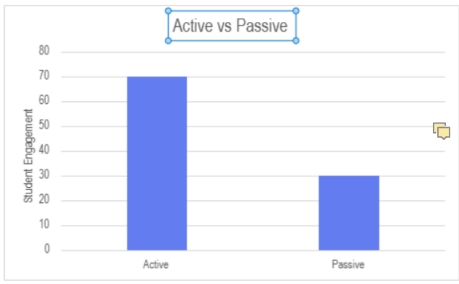
Constructed Figure(s): (graphic representation of the proposed results of data that supports your proposed hypothesis/research question. hint: it’s based on your Prediction Statement)