Project Idea Draft Title:
Learning Strategies for Student Engagement
Research Question: (stated as a testable question)
How does passive vs. active learning strategies effect student engagement on water? conservation education?
Hypotheses: (stated as mutually exclusive answers to your research question)
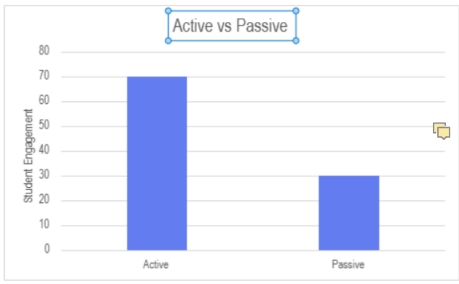
Active learning strategies engage students in classroom activities better than passive learning strategies.
Prediction: (stated as a range of expected results will lead you to reject or accept the stated or null hypotheses)
If passive learning strategies are replaced by active learning strategies in a school
environment, then student participation will increase.
Evidence: (Rationale of your hypotheses based on peer-reviewed scientific literature and science news on your topic)
Review Articles: (list the citation and what it says about your topic)
Siripoulos, Costas and Pomonis, Gerasimos. “Alternatives to ‘Chalk and Talk’: Active Vs. Passive Learning – A Literature Review of the Debate”. SSRN, 3 April 2007. https://ssrn.com/abstract=977283
Articles written by instructors stress the need for active learning strategies.
Gamo, Joel. “Anatomy Education-Paradigm Shift from Passive to Active
Learning-Effects on Student Engagement, Comprehension and Retention. A Review of Literature from 2012 to 2022”. The FASEB Journal, 13 May 2022, vol.
36, Anatomy Education‐Paradigm Shift from Passive to Active
Learning‐Effects on Student Engagement, Comprehension and Retention
A Review of Literature from 2012 to 2022 – Gamo – 2022 – The FASEB
Journal – Wiley Online Libraryissue S1.
Interactive methods such as peer teaching, blended classrooms, and augmented
reality led to over 50% retention, while passive learning strategies only led to
30% retention.
Pitterson, Nicole et al. “Measuring cognitive engagement through interactive, constructive, active and passive learning activities”. IEEE Xplore, 1 December 2016. Measuring cognitive engagement through interactive, constructive, active and passive learning activities | IEEE Conference Publication | IEEE Xplore
The ICAP framework found that students are actively learning when they discuss
school topics with their classmates or their teacher.
Willett, Laura Rees. “Comparing Active and Passive Learning: What Does the Evidence Really Say?”. Academic Medicine, May 2017, page 573. Academic Medicine
The author in this article is reviewing a research article which concluded that
active learning was the superior method in student education.
Research Articles: (list the citation and what it says about your topic)
Munna, A. S., and M. A. Kalam. “Impact of Active Learning Strategy on the
Student Engagement”. GNOSI: An Interdisciplinary Journal of Human
Theory and Praxis, vol. 4, no. 2, Apr. 2021, pp. 96-114, ED614302.pdf
The main problem in student engagement is teaching students based on their
current knowledge level.
Diepreye, Fapohunda and Odukoya, Jonathan. “The Impact of Passive and
Active Teaching Methods on Students’ Learning Among Secondary
School Students in Yenagoa, Bayelsa State”. Journal of Physics: Conference
Series, 2019, vol. 1378, issue 2. The Impact of Passive and Active Teaching
Methods on Students’ Learning Among Secondary School Students in
Yenagoa, Bayelsa State – IOPscience
The results of the study show that active learning strategies have more of an
impact on student education than passive learning strategies do.
Singh Minhas, Paras et al. “The effects of passive and active learning on student
preference and performance in an undergraduate basic science course”.
American Association for Anatomy, 20 March 2012, vol. 5, issue 4. The effects of passive and active learning on student preference and performance in an undergraduate basic science course – Minhas – 2012 – Anatomical Sciences Education – Wiley Online Library
A study performed on students in an animal physiology course shows that most
students would prefer a class with a mix of instructor-led and peer-led teaching.
Mikolaj, Christy. “Effective Instructional Strategies in Sixth Grade Inclusion
Mathematics Classrooms: The Effect of Active and Passive Engagement
on Concept Learning and Opportunity to Learn”. ProQuest, December 2019. Effective Instructional Strategies in Sixth Grade Inclusion Mathematics
Classrooms: The Effect of Active and Passive Engagement on Concept
Learning and Opportunity to Learn – ProQuest
This study shows that the average student would require a mix of learning
strategies in order to better understand school topics.
Haidet, Paul et al. “A Controlled Trial of Active Versus Passive Learning
Strategies in a Large Group Setting”. Springer Nature, March 2004, vol. 9, pages
15-27. A Controlled Trial of Active Versus Passive Learning Strategies in a
Large Group Setting | Advances in Health Sciences Education
Although peer-led seminars allow for the most active engagement among
students, many of them will not care for the sessions as much compared to classes
taught my instructors.
Mahmood, Muhammad et al. “STRATEGIES FOR ACTIVE LEARNING: AN
ALTERNATIVE TO PASSIVE LEARNING”. SAVAP International,
November 2011, vol. 1, issue 3. Microsoft Word – 2011_1.3-20_
Active learning strategies make students more determined to seek out
information instead of blindly taking in facts.
Proposed Experiment: (Experimental Design of your research project)
Independent Variables: (What treatment or comparison groups or what factors will you modify)
The type of learning strategy (Active vs passive)
Dependent Variable: (What will you measure)
Student engagement and participation
Control Variables: (What will hold constant between treatments)
Age range, course, and classroom material
Procedures: (What you will do, how, how much, how often, how long, when)
We will develop lesson plans that utilize different learning strategies on the same
material. These lessons will be implemented for a fixed period of time and rotated
between various groups in between that fixed time.
Constructed Figure(s): (graphic representation of the proposed results of data that supports your proposed hypothesis/research question. hint: it’s based on your Prediction Statement)