For professors:
Heartlands Conservancy is a nonprofit community organization located in Belleville, Illinois. Founded in 1989, it has been their mission to conserve water and other natural resources in order to ensure that they are still around for generations to come. By partnering with local landowners and sponsoring volunteer events in the community, Heartlands continues to push for public engagement in the same issues that they fight for. One such volunteer event is the Jingle Hike Challenge, which was a hiking event that took volunteers through several local trails that many people might not have known about beforehand. There are also several stewardships held by Heartlands, where volunteers from the community help restore specific locations, such as native prairie lands or the Exploration Garden.
Beyond their work in the community, Heartlands also partners with other groups or organizations, such as the CODES program. CODES, which stands for Community Oriented Digital Engagement Scholars, is a program at SIUE that works towards bettering environmental issues, such as water equity, in local communities. CODES is a growing program at this university, yet there is more work to be done with Heartlands outside of this program. Heartlands already supports schools outside of SIUE, such as those who send their students to sites such as the Signal Hill Outdoor Classroom. This site, located in Belleville, is commonly used by local high schools for environmental learning activities. Projects like these are only possible because of the dedicated team of people working at Heartlands, like Anna, who works directly with the CODES program to offer advice and feedback on their projects.
Student engagement is a massive part of Heartlands’ mission, and it goes without saying that expanding the number of programs they partner with is in their interest. The list of ways in which they can impact the learning of students is long, which is why a potential partnership with SIUE would be beneficial for every student interested in environmental conservation.
For Heartlands:
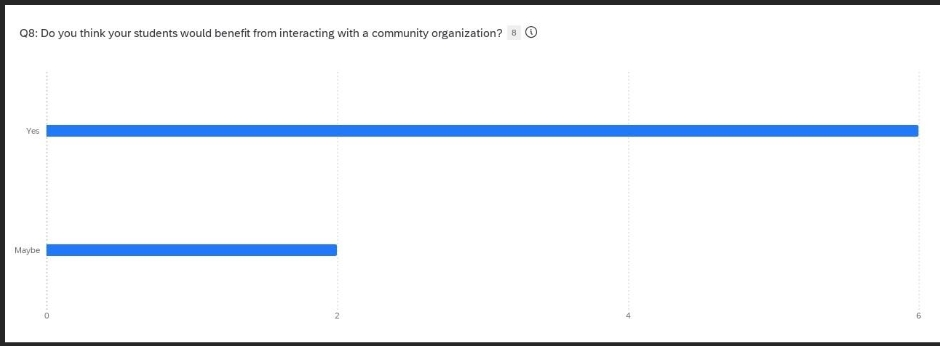
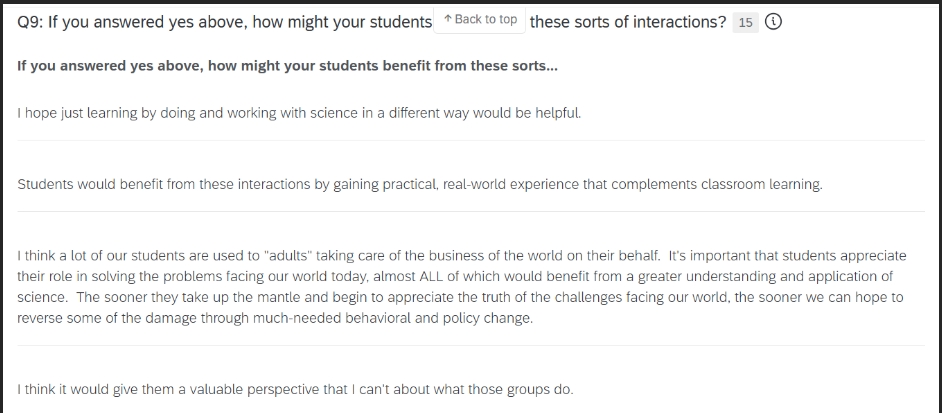
My research project this semester has been to connect students at SIUE to Heartlands through the professors who teach there. To divide the instructors who might be interested in water conservation from those who might not, I found 40 professors who teach courses related to ecology, environmental science, or general science. These professors, along with the courses they teach, are listed below. The department chairs of these subjects are also listed in order to allow for opportunities to connect with even more professors. These professors were sent a survey regarding their experiences and opinions on community organizations. Most of the professors showed little to no experience with community organizations, yet many were open to the opportunity to collaborate with organizations like Heartlands. Four out of five of those who did have prior experience showed an interest to allow Heartlands to either give a lecture in class or network with students. This list of professors and department chairs can allow for Heartlands to connect with professors outside of CODES, especially those who were a part of the survey I had sent out.
| Course Number | Course Name | Course Description | Professor |
| ANTH-340 | Environmental Anthropology | Surveys the relationship between humans and their environments from an anthropological perspective, including changes through time and cross-cultural comparisons. | Chad M. Huddleston |
| BIOL 464/ENSC 450 | Applied Ecology | Applying ecological concepts and principles for solving, predicting and managing current important ecological problems, such as global climate change, conservation, wetland restoration, and environmental remediation. | Zhiqing Lin |
| BIOL 472 | Topics in Plant Physiology | Examination of plant cells, tissues, and morphology. Two lectures and two labs per week. | Darron R. Luesse |
| BIOL 150 | Introduction to Biological Sciences I | First of a two-course sequence, introduction to biochemistry, molecular genetics, cell structure and function, and evolution. Lab required. | Elizabeth J. Esselman |
| BIOL 151 | Introduction to Biological Sciences II | Second of a two-course sequence, introduction to major taxonomic groups with emphasis on evolutionary relationships and ecological principles. Lab required. | Danielle N. Lee |
| BIOL 327 | Evolution | Evolutionary change as shown in heredity, population genetics, speciation, adaptation, natural selection, development, behavior, geographical distribution, and the origin of life. | Christopher W. Theodorakis |
| CE 380 | Environmental Engineering | Application of principles of chemistry, physics, biology, and mathematics to engineered systems for water purification, wastewater treatment, air pollution control, and solid waste management. Requires completion of stated prerequisite or consent of instructor. | Jianpeng Zhou |
| CE 482 | Water Resources Engineering and Management | Excessive water use has adverse impacts on environment and natural water resources. Sustainable management is a necessity. Course focuses on demand analysis and management of water resources for different use. | Rohan M. Benjankar |
| ENSC 111 | Intro to Physical Geology & Geography | Physical geology and geography of the solid earth. Hydrologic system, weathering, soils, landforms, sedimentary rocks. Tectonic system, magmatism, igneous rocks, crustal deformation, metamorphism. | Susannah Oettle |
| ENSC 111 | Intro to Physical Geology & Geography | Physical geology and geography of the solid earth. Hydrologic system, weathering, soils, landforms, sedimentary rocks. Tectonic system, magmatism, igneous rocks, crustal deformation, metamorphism. | Deirdre Smith |
| ENSC 125 | Topics of Environmental Health and Toxicology | Naturally occurring and anthropogenic toxicants can cause adverse environmental impacts. Provides the fundamental information concerning the effects of environmental toxicants on living organisms. | Kyong-Sup Yoon |
| ENSC 210 | Applied Research Methods | Research methods for the analysis of environmental problems. Survey research and other data collection techniques. Collection, interpretation, and critical evaluation of data. | Sanoar Rahman |
| ENSC 401 | Environmental Policy | Relationship between political processes and policy outcomes; correlation of environmental politics and science; balancing trade-offs between legal, economics, social and environmental goals, including service learning. | Nicholas P. Guehlstorf |
| ENSC 436 | Environmental Epidemiology | Environmental epidemiology, the study of how environmental factors (e.g., pollution, climate, geography) influence human health. Includes advanced training in data management and analysis using spreadsheets. | Joseph Kusi |
| ENSC 440 | Sustainable Environment Practices | Practices that meet the needs of the present generation without compromising the ability of future generations to meet their needs. | Nathaniel Adegboyega |
| GEOG 202 | Natural Resource Management and Sustainability | Examines the management, use, and sustainability of natural resources, including biodiversity, water, food, soil, and energy sources. Also considers issues in pollution and environmental degradation. | Shannon McCarragher |
| GEOG 211 | Meteorology | Introduction to weather controls and elements; and their relationship to human activities and human health; analysis and use of weather maps and forecasts. | Alan Black |
| GEOG 403 | Advanced Urban Geography | Selected topics in spatial patterns and processes of urbanization. Topics may include: planning, transportation, sustainability, society and culture, health, housing, global cities, and economic functions. | Emily R. Calderon |
| GEOG 418 | Geographic Information Systems | Concepts, basic theory, and principles of GIS using both Raster and Vector data models in a PC environment. | Tianyu Li |
| GEOG 424 | Vector Based Geographic Information Systems (GIS) | Examination of vector topology, digital map transformation, manipulation, analysis, and composition. | Shunfu Hu |
| SCI 241B | Foundations of Science: Physics, Earth Science and Inquiry Projects | General background in science. Laboratory emphasis on process skills, hands-on activities, and projects suitable for children in grades K-8. (b) physics, earth science, and inquiry projects. | Mary J. Kaemmerer |
| BIOL 111 | Contemporary Biology | Contributions of biology to understanding ourselves and our world. Development, nature and human implications of cell theory, heredity, the modern synthetic theory of evolution, population dynamics, ecology and environmental problems. | Thomas Anderson |
| BIOL 220 | Genetics | Introduction to transmission, molecular and population genetics with applications to all organisms. | Thomas James Fowler |
| BIOL 250 | Bacteriology | Structure, nutrition, and genetics of bacteria; control of microbial growth; comparison of medically important bacteria and viruses; host response to infectious disease. | Christine Simmons |
| BIOL 319 | Cell and Molecular Biology | Introduction to cellular processes including gene expression, protein and vesicular trafficking, and cell signaling. Differentiation between eukaryotes and prokaryotes. | Faith L.W. Liebl |
| BIOL 340 | Physiology | Function and regulation of major organ systems in vertebrates, neural responsiveness and integration, homeostasis of body fluids, circulation, respiration, organic maintenance, and hormonal control. | Jason Williams |
| BIOL 350 | Microbiology | Structure, metabolism, and genetics of bacteria and bacteriophages. Role of bacteria in disease, biotechnology, and the environment. | Susanne DiSalvo |
| CHEM 113 | Introduction to Chemistry | Preparation for University Chemistry. Mathematical techniques, problem solving, chemical terms, concepts, and laws. | Leanne J. Boyer |
| CHEM 120B | General, Organic, and Biological Chemistry | Primarily for students planning careers in Nursing and Allied Health professions. Not for Chemistry majors. Organic and biological Chemistry | Lawrence P. Norcio |
| CHEM 121A | General Chemistry | University-level modern chemistry for science and engineering students, atomic structure, molecular bonding, structure, stoichiometry, chemical change, equilibrium, and qualitative analysis. | Richard Edward Finger |
| CHEM 121B | General Chemistry | University-level modern chemistry for science and engineering students. Atomic structure, molecular bonding, structure, stoichiometry, chemical change, equilibrium, and qualitative analysis. | Thomas Holovics |
| CHEM 241A | Organic Chemistry | Structural types of organic compounds correlated with chemical and physical properties; bonding, reaction dynamics, reaction types, stereochemistry, functional groups, spectroscopic methods. | Yun Lu |
| CHEM 351 | Basic Biochemistry I | Topics will include the structure and function of biologically important macromolecules including: nucleic acids, proteins, carbohydrates, as well as regulation of metabolism, biosynthesis, and degradation of biological molecules. | Robert P. Dixon |
| CHEM 352 | Basic Biochemistry II | Topics will include the structure and function of biologically important macromolecules including: carbohydrates and lipids, as well as regulation of metabolism, biosynthesis, and degradation of biological molecules. | Chin-Chuan Wei |
| CHEM 361B | Physical Chemistry | Mathematical models of chemical behavior and its underlying causes. Experimental foundations of models, thermodynamics, statistical mechanics, kinetics, quantum mechanics, and spectroscopy with applications. | Debanjana Ghosh |
| CHEM 444 | Organic Reaction | Emphasis on mono-functional compounds. Topics not covered in elementary courses. | Sarah Luesse |
| CHEM 455 | Experimental Methods in Biochemistry | Current practice in enzyme isolation and assessment. Microcomputer-assisted data treatment, graphics, statistical methods, and data acquisition. | Mina Sumita |
| CHEM 482 | BioProcessing Chemistry and Biochemistry | Covers the intermediate principles of the historical, scientific, technological, and cultural aspects of fermentation of chemistry and biofuels, fermented beverages, and food production. | Jie Dong |
| CHEM 439 | Advanced Topics in Analytical Chemistry | Selected advanced topics. | Edward C. Navarre |
| CHEM 241B | Organic Chemistry | Structural types of organic compounds correlated with chemical and physical properties; bonding, reaction dynamics, reaction types, stereochemistry, functional groups, and spectroscopic methods. | Lynne Ann Miller |
Department Chairs:
Anthropology: Dr. Corey Ragsdale
Biology: Dr. Jakes Williams
Environmental Science: Dr. Adrianna Martinez
Civil Engineering: Nader Panahshahi
Geography: Dr. Stacey Brown Amilian
Science: Dr. Susan Hume
Chemistry: Dr. Erik Voss