In this section, I will share the experiences I have gained throughout my undergraduate journey that have helped prepare me for a career in nursing. Through my nursing classes, clinical experiences, work, and volunteer opportunities, I have developed skills in patient care, communication, teamwork, and leadership. These experiences have helped me become more confident in my abilities and have given me a better understanding of the type of nurse I want to become.
Experiences:
Walgreens – Pharmacy Technician August 2026 – Present
Work as a pharmacy technician at Walgreens, where I assist patients, help process prescriptions, and work alongside pharmacists and other pharmacy staff. This position has helped me become more familiar with medications, patient safety, and the importance of communication in healthcare.
SIUE Nursing Program – Clinical Experiences Undergraduate Nursing Student
Participate in clinical rotations as part of my nursing education at Southern Illinois University Edwardsville. These experiences allow me to apply what I learn in the classroom to real patient care settings. I have gained experience with patient assessments, basic nursing skills, communicating with patients, and working with healthcare professionals.
SIUE Campus Flu Shot Clinic – Volunteer September 2026
Volunteered at a campus flu shot clinic, helping support an event focused on disease prevention and community health. This experience allowed me to see the importance of vaccinations, patient education, and providing healthcare services to the community.
SIUE Division I Women’s Basketball – Student-Athlete December 2023- May 2026
Participated in Division I college basketball while balancing my academic responsibilities. Being a student-athlete taught me discipline, leadership, time management, and how to work well with others. These are skills I continue to use throughout nursing school and believe will help me in my future nursing career.
Community Volunteer Work – Metro East Children’s Events
Participated in community events involving children and families in the Metro East area. These opportunities helped me improve my communication skills, work with people of different ages, and understand the importance of supporting the community.
As with the survey analysis, discuss what you observed, why it’s significant, how it relates to the Garden’s current initiatives, and what next steps it might indicate. Include the following:
Contextualize and interpret themes and patterns. Why are they surprising or significant? How do they support or challenge your prior knowledge?
Mixed methods research allows us to approach a question from multiple angles to gain breadth and depth of understanding. How do your results relate to your survey? Did the qualitative study fill in the gaps you hoped it would? Did the results support your initial conclusions? Did they reveal complexity or tensions? Did they challenge them entirely?
In addition to exploring the data, also reflect on your research design. Did you learn everything you need to know? How might you design the study differently next time to encourage more detailed or accurate information?
While mixed methods research gives us a more holistic perspective on our topic than a single method, this doesn’t mean there’s nothing left to learn or that you’ve answered every question completely! Research is iterative – that means that we keep coming back to our topic in different ways to build up layers of knowledge and understanding. So, reflecting on what you’ve done so far, what else do you want to know?
–Surveys-
Phase one
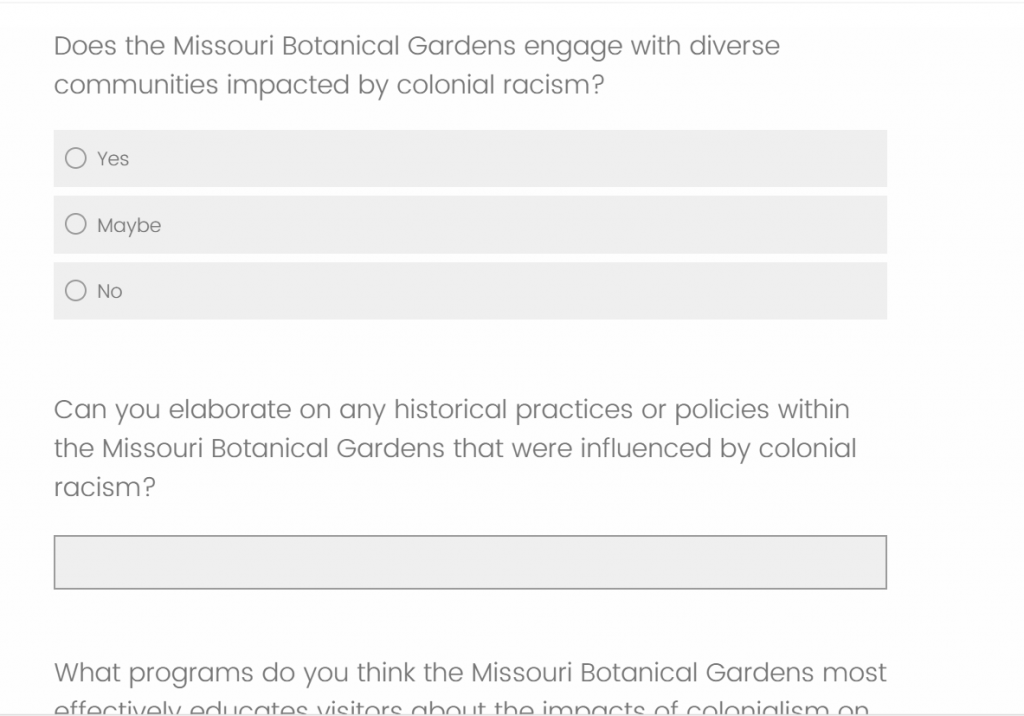
My group includes Jay, Jaidyn, and Sophia. We are focusing on “how does colonialism affects the garden and the herbarium”. This lab has two parts, the first part was our surveys, and the second part of the lab was the focus groups we conducted. Our surveys kind of fell off and didn’t get the attention of the garden partners like we were hoping to get. At the end of that phase of our lab, we ended up only getting one response all together. Which was kind of disappointing for me and my team because we worked really hard on the survey, formulating specific questions and strategizing for weeks. So, we had to ask ourselves "what exactly did go wrong", with our surveys. The topic of our research question has an "uncomfortable " aura around it already because it is a heavy topic, but it is still a very important topic to talk about and raise awareness about it. the best thing that we could think is that maybe our surveys were asking too "heavy" of questions for a survey. Here below is an example of some of our surveys.
–Focus Groups–
Phase two
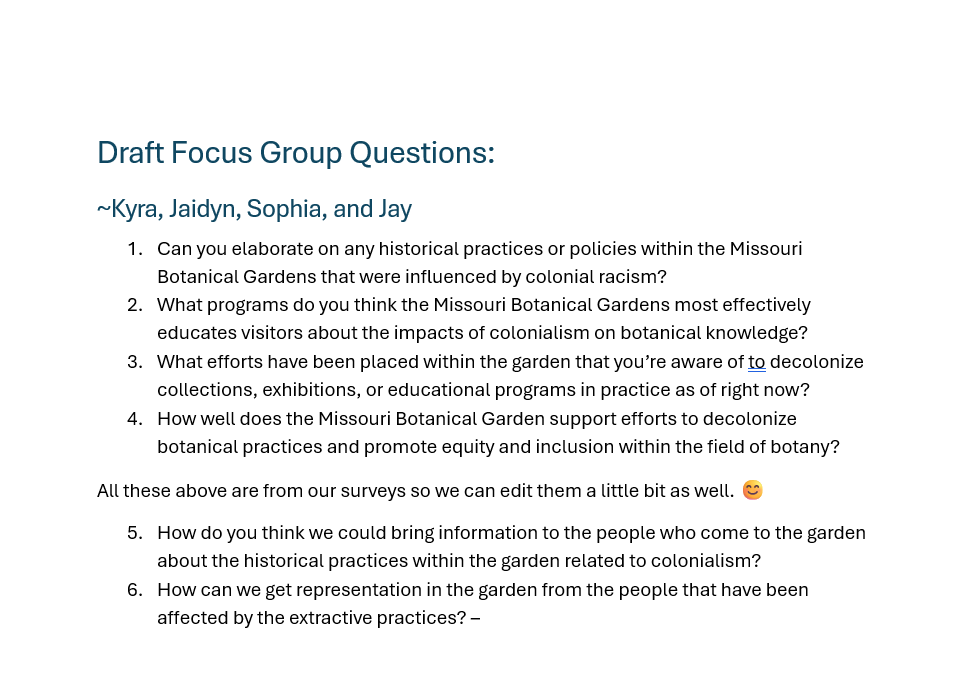
With the results that we got out of our survey (the one singular response), we decided to keep and re word some of the survey questions for our focus group. We also formulated new questions and points to ask the garden workers about during the focus groups. For the focus groups we had different people from the garden that we specifically wanted to ask our questions to. Here are the questions we ended up formulating:
With these questions in a focus group setting, we were much more successful in getting answers than these questions on the survey. I think we got a better response because in the settings of focus groups and interviews it kind of forces them to answer us. Because it is kind of an uncomfortable subject it’s hard to try and get a true honest response from people, but we were very happy with the results that we got. The focus groups included me and my team members (Jaidyn, Jay, and Sophia) and two employees from the garden at a time. We did a total of three different focus groups. We recorded and transcribed each interview at a time and had specific people asking specific people different questions that we formulated. After talking with the garden partners, we moved on to our last phase of this lab.
–The actual data and analysis-
The final phase
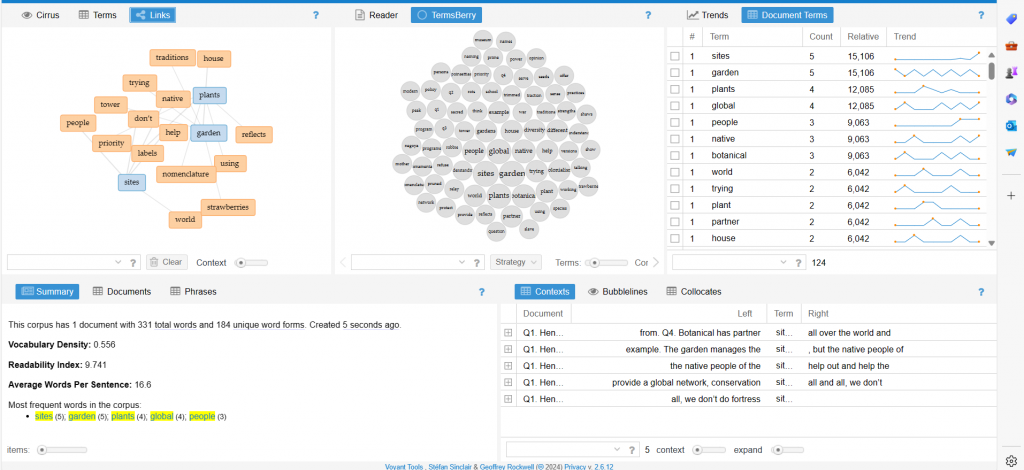
The last thing we did was data analyzing and data cleaning. Sitting down and putting together the data from the surveys and the focus groups and also really analyzing and looking at all of the data we got and looking at what we can do for the next steps with the gardens. I put our data from each interview that we had and plugged the transcription into (idk what it’s called). This was to get a visual and see if there are in patterns in the words across the focus groups.
To secure an A in this course, I have outlined the objectives I aim to accomplish during the upcoming semester and outlined the strategies I will implement to demonstrate my advancements towards these goals.
(3c.)- Applies ethical concepts to a question and considers their full implications.
The goal first I have chosen is to applies ethical concepts to a question and considers their full implications. I think this goal will be helpful in perspective to my personal overarching goal which is to better understand how the community fits into the Missouri Botanical Gardens and how it effects the Gardens themself. I want to show this in the survey questions we start out with and the actual analytics of the surveys themself after we send them out to the community around the Gardens.
(5b.) Accesses information using effective, well-designed search strategies and appropriate sources.
(9b.) Constructs insightful problem statements with evidence of relevant factors. (10%)
The fourth goal I have chosen for this specific course is 9b. The goal of constructing problem solving ideas have neem a struggle. But it is something I would like to continue to work on as I get more assignments and have time as the semester goes on. I would like to show this goal off when collaborating our surveys and our research questions.
Growing up biracial, I have experienced life differently than my parents and much of the rest of the world. Most people know exactly who and what they are; Asian, Black, Hispanic, or White. But not me, I’m none of those things. I ammixed, mulatto, a product of miscegenation. Is this how the world sees me, it feels that way. Most people fit perfectly into their ethnic puzzle. I, on the other hand, have always felt like a corner piece being shoved into the middle of a puzzle. Am I black enough to be black, am I too black to be white? This is what I have spent most of my conscious life trying to figure out.
my father and his 2 sisters in the 80’s
My father grew up as a typical black kid in Ferguson, Missouri. My mother grew up a typical white kid in Granite City, Illinois. They both knew what race they fit into. Growing up mixed is different and hard to understand if you have not lived it. I grew up surrounded by mostly white people outside my home. My dad’s family is spread out across the country. I never really had a large black presence in my life, besides my father. I had plenty of people making me feel like I didn’t fit in. I lived most of my life dividing myself into fractions.
age 5 gymnastics
In kindergarten, my teacher used me as an example for a lesson on racism. I was one of only two black kids in my class and my best friend was white. Our teacher explained in front of the class that historically speaking our friendship would not be allowed because of my skin color. At a very young age I was made to feel different. Even within the black community I was made to feel different. Whenever I say certain things at work my black coworkers say, “That was a very white thing to say,” or “Your white side is showing.” I could not just be me, I had to be black or white.
I always wanted to look white as a child. My hair was too curly, my skin was too bronzed. I just wanted to look like my friends. I used to use scarves to make a fake wig so I could have straight hair. I used to ask my mom all the time to straighten my hair. Even my black role models had their hair straight. It was very rare to see a black woman on television with their natural hair out. There was only one Disney princess who was black, but her hair wasn’t even super curly. There were no mixed-race princesses when I was growing up. So, there I was a mixed girl longing to find where I fit in.
1 of many straight hair photos
It took me a long time to realize that it is okay not to fit in everywhere I go. Being of a mixed race in prominently white surroundings, besides my family, made me stick out like a sore thumb. I didn’t know what to tell people when I was a kid. I didn’t even know what I was. According to co-author Kerry Ann Rockquemore “Identity is understanding who we are in the world,” from the book “Beyond Black: Biracial Identity in America”. I didn’t understand who or what I was as a kid. Instead of knowing my identity, I depended on what everyone else identified me as.
In the early years of high school, I changed the way I did my hair and my outfits. I would even avoid going outside because I didn’t want to look darker. I was so wrapped up in how other people perceived me I didn’t even care what I looked like. As long as I wasn’t dark. People say there’s a choice as a mixed-race persons must make. One race or the other.
There’s no “mixed race” button when putting an application in for a job, so what do I put? I don’t look white so I should put black, right? But I don’t always act “black” so maybe white? But what does either of those things really mean? Aren’t they just perceptions of each other. Though in reality people won’t ever perceive me as white. They will perceive me as black. Some people call this the “racial imposter syndrome.” That feeling you don’t fit in when hanging out with certain people. Sometimes I don’t resonate with other black people. My friends talk about how they went to cookouts at their aunties and uncles’ houses. And I never had any of that growing up. I got picked up for basketball games, before these white girls because I look like a “hooper”. I spend time trying to act black enough for my friends and trying to act white enough
2023 senior pictures
And cultural constructions of identity in a lot of ways too. for my other friends. Sounds tiring, doesn’t it. The identity struggle is real for any multiethnic person. And this leads to bad mental health. People say though if you look white, or black, or Asian or any race than you can claim that race. Comparing yourself constantly brings you to a very poor mental state. This is a real problem not only for multiethnic people but also for a big part of my life. I had to retrain my brain not to think in those ways. Honestly those mental patterns are very toxic.
Every corny joke I might make (which I make a lot) or every little “mistake” people around me will say or “that’s because you mixed” or “your defiantly not name brand”. Blaming it on the fact that I am half of something and not full.
Though I have experienced life in a different lens than the typical white person or black person, I’ve learned I don’t have to fit into other people’s defined identity categories. Our society is fixed on thinking you can only be one thing at a time but that is not the case at all. I am proud to be mixed.