Group #: _2_____ Team Members: Sonia Sheryr & Jaiden DeBoe
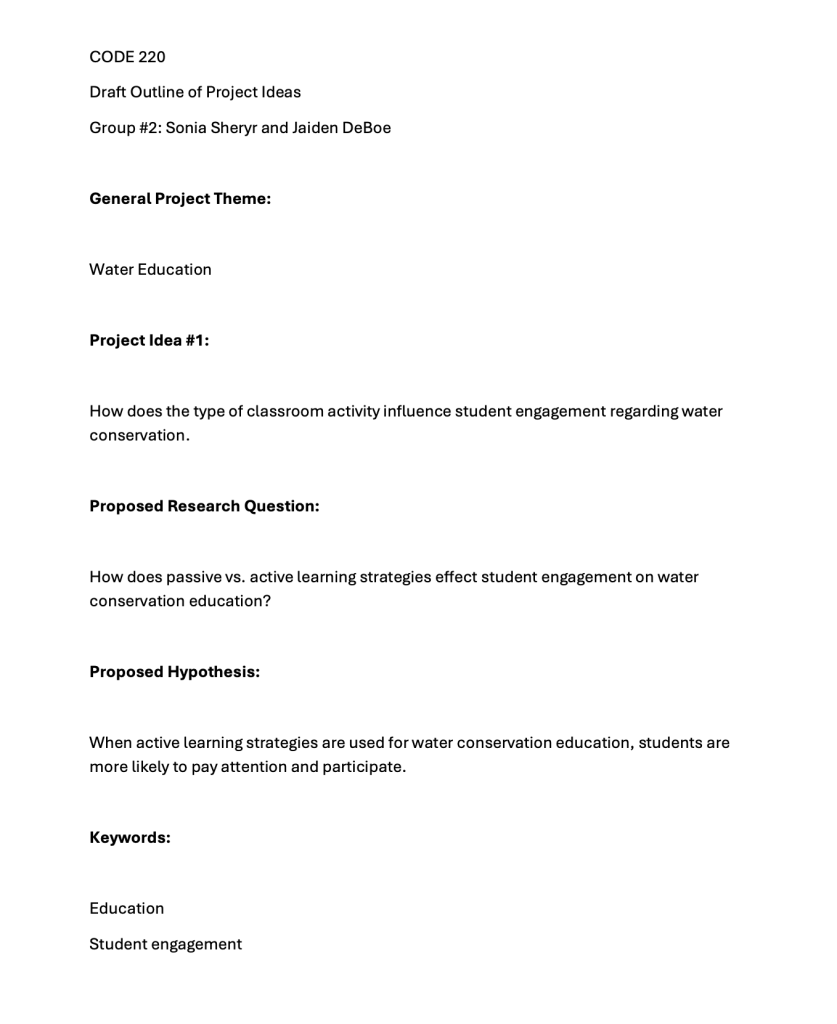
Research Question: How do passive vs active learning strategies affect student engagement?
a. Population/Focal Subject: Students K-12
b. Intervention/Treatment/Manipulation: Type or learning strategy (Passive or active)
c. Comparison: The effects of passive learning strategies vs the effects of active learning strategies
d. Outcome/Data Collected: Student Participation and Feedback
e. Time/Analytics: Note taking, response to questions, and participation in class discussions
1. Title: Impact of Active Learning Strategy on the Student Engagement
a. Article Type (primary research, review?)
b. URL:https://gnosijournal.com/index.php/gnosi/article/view/96
c. Citation (APA or MLA format) Iqbal, Maryam, and Syeda Maham Fatima. “Impact of Active Learning Strategy on the Student Engagement.” Gnosi: An Interdisciplinary Journal of Human Theory and Praxis, vol. 3, no. 2, 2020, pp. 34–42. Gnosi Journal, https://gnosijournal.com/index.php/gnosi/article/view/96.
2. Title: The Rules of Engagement: A Test of Instructor Inputs and Student Learning Outcomes in Active versus Passive Learning Environments.
a. Article Type (primary research, review?)
b. URL:https://eric.ed.gov/?id=EJ1276424
c. Citation (APA or MLA format)McDonald, DeShannon, Yvette Holmes, and Tammy Prater. “The Rules of Engagement: A Test of Instructor Inputs and Student Learning Outcomes in Active versus Passive Learning Environments.” e-Journal of Business Education and Scholarship of Teaching, vol. 14, no. 1, June 2020, pp. 25-39. ERIC, files.eric.ed.gov/fulltext/EJ1276424.pdf.
3. Title: Active Learning: A Shift from Passive Learning to Student Engagement Improves Understanding and Contextualization of Nutrition and Community Health
a. Article Type (primary research, review?)
b. URL:https://www.mdpi.com/2227-7102/12/7/430
c. Citation (APA or MLA format)Bavishi, Poyani, Alana Birnhak, John Gaughan, Jocelyn Mitchell-Williams, and Sangita Phadtare. “Active Learning: A Shift from Passive Learning to Student Engagement Improves Understanding and Contextualization of Nutrition and Community Health.” Education Sciences, vol. 12, no. 7, article 430, 2022, MDPI, https://doi.org/10.3390/educsci12070430
4. Title: Student Engagement in Active Learning Classes
a. Article Type (primary research, review?)
b. URL:https://link.springer.com/chapter/10.1007/978-3-030-33600-4_3
c. Citation (APA or MLA format)Hodges, Linda C. “Student Engagement in Active Learning Classes.” Active Learning in College Science: The Case for Evidence-Based Practice, edited by Joel J. Mintzes and Emily M. Walter, Springer, 2020, pp. 23-46. https://doi.org/10.1007/978-3-030-33600-4_3
5. Title: Active Student Engagement: The Heart of Effective Learning
a. Article Type (primary research, review?)
b. URL:https://link.springer.com/chapter/10.1007/978-3-319-10482-9_16
c. Citation (APA or MLA format)Strachan, Rebecca, and Lalith Liyanage. “Active Student Engagement: The Heart of Effective Learning.” Global Innovation of Teaching and Learning in Higher Education: Transgressing Boundaries, edited by Pranav Patel and Patrick Blessinger, Springer, 2015, pp. 145-156. https://doi.org/10.1007/978-3-319-10482-9_16
6. Title: The effects of passive and active learning on student preference and performance in an undergraduate basic science course
a. Article Type (primary research, review?)
b. URL:https://anatomypubs.onlinelibrary.wiley.com/doi/abs/10.1002/ase.1274
c. Citation (APA or MLA format)Michael, Joel. “The Effects of Passive and Active Learning on Student Preference and Performance in an Undergraduate Basic Science Course.” Anatomical Sciences Education, vol. 1, no. 4, 2008, pp. 200–206. Wiley Online Library, https://doi.org/10.1002/ase.1274
7. Title: STRATEGIES FOR ACTIVE LEARNING: AN ALTERNATIVE TO
PASSIVE LEARNING
a. Article Type (primary research, review?)
b. URL:http://www.savap.org.pk/journals/ARInt./Vol.1(3)/2011(1.3-20).pdf
c. Citation (APA or MLA format)Mahmood, Muhammad Asim, Maria Tariq, Saira Javed, and [two other authors if you have their names]. “Strategies for Active Learning: An Alternative to Passive Learning.” Academic Research International, vol. 1, no. 3, 2011, pp. 189–199. SAVAP International, http://www.savap.org.pk/journals/ARInt./Vol.1(3)/2011(1.3-20).pdf
8. Title: Impact of Innovative Teaching Strategies on Students’ Active Participation in Learning
a. Article Type (primary research, review?)
b. URL:https://pjsel.jehanf.com/index.php/journal/article/view/1147/854
c. Citation (APA or MLA format)Nazir, Muhammad, Noreen Iqbal, and Ghulam Fatima. “Impact of Innovative Teaching Strategies on Student’s Active Participation in Learning.” Pakistan Journal of Society, Education and Language (PJSEL), vol. 8, no. 1, 2022, pp. 148-162. https://pjsel.jehanf.com/index.php/journal/article/view/1147/854
9. Title: From Passive Listening to Active Learning: Reforming Management Innovation Education to Boost Student Engagement
a. Article Type (primary research, review?)
b. URL: http://www.upubscience.com/upload/20250715162750.pdf
c. Citation (APA or MLA format)Yang, Fan, Ying Wang, and GuoMin Chen. “From Passive Listening to Active Learning: Reforming Management Innovation Education to Boost Student Engagement.” Universal Journal of Educational Research, vol. 3, no. 7, 2025, pp. 1–10. UPub Science, http://www.upubscience.com/upload/20250715162750.pdf
10. Title: In-Class Active Engagement Strategies to Enhance Student Participation During Lectures: A Systematic Review
a. Article Type (primary research, review?)
b. URL:https://jbumdc.bahria.edu.pk/index.php/jbumdc/article/view/21/16
c. Citation (APA or MLA format) Waqar, Zubia, Shafaq Sultana, and Madiha Ata. “In-Class Active Engagement Strategies to Enhance Student Participation during Lectures: A Systematic Review.” Journal of Bahria University Medical and Dental College (JBUMDC), vol. 15, no. 2, 2025, pp. 146–158. https://jbumdc.bahria.edu.pk/index.php/jbumdc/article/view/21/16
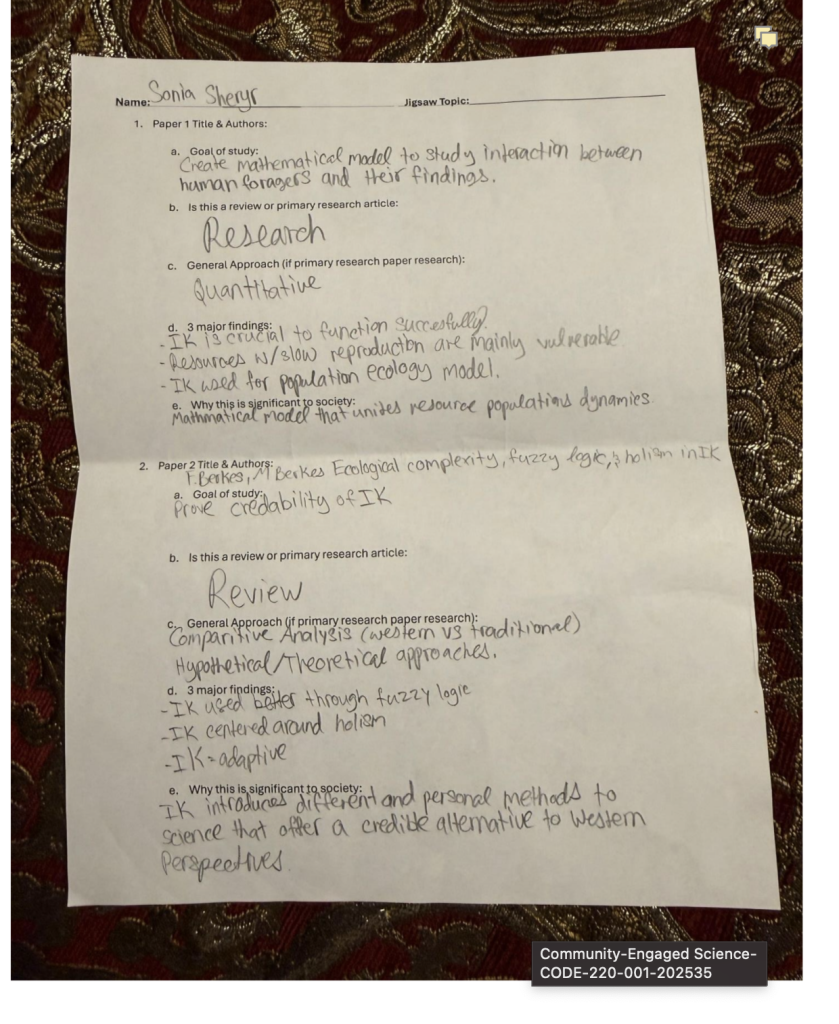
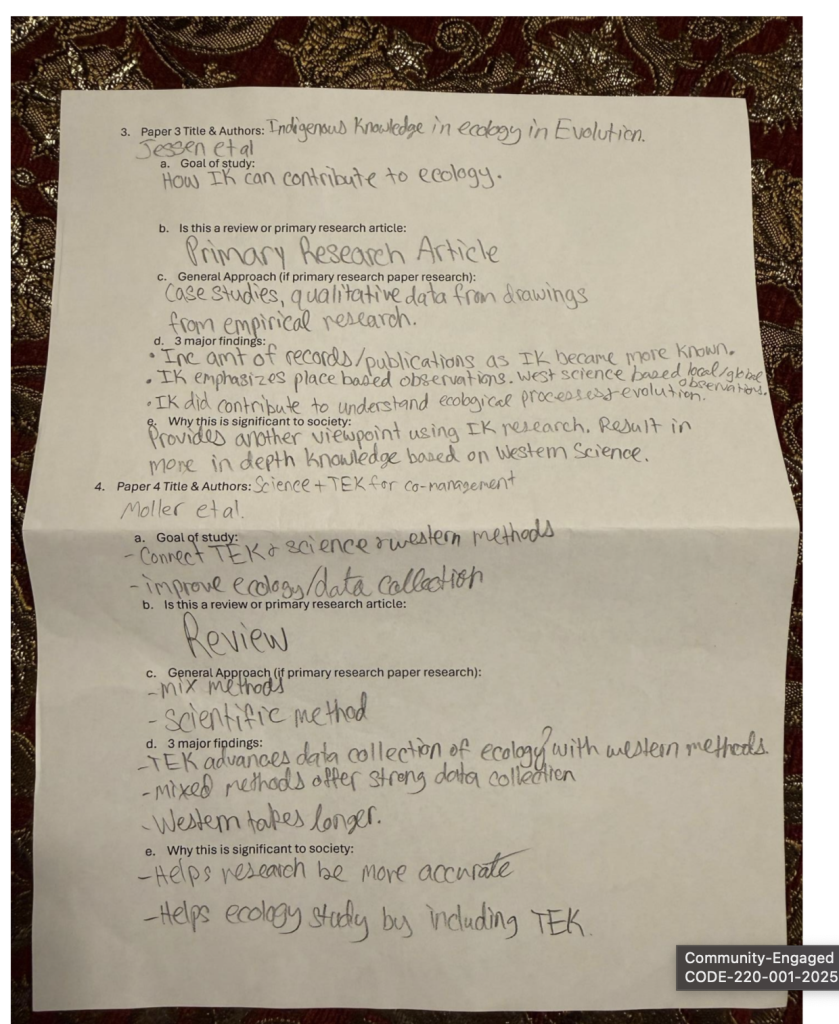
Article Title: 3 Name: Sonia Sheryr
What is the purpose/goal of this study?
The goal is to show how Indigenous Knowledge contributes to ecology and evolution.
Why is this issue significant/why do we care?
This can lead to better management in conservation and biodiversity with pressures of climate change within the community.
What words/vocab do you need to know to make this make sense? Define them here.
Indigenous Knowledge : Place-based, intergenerational knowledges encompassing ecological, cultural, and spiritual dimensions.
Traditional Ecological Knowledge: Subset of IK specifically about ecosystems, species, and ecological processes.
Two-Eyed Seeing: A framework that uses the strengths of both IK and Western science without forcing assimilation.
Shifting baseline syndrome: Loss of knowledge about past ecological conditions as each generation accepts a degraded state as “normal.”
What approach are they taking in this study (e.g., specific qualitative or quantitative methods)
Case studies, qualitative data such as conceptual synthesis drawings.
What are the results of the study? If there are figures – write a sentence summarizing each figure/table.
Between 1990 and 2018 number of records went up/publication, and the field of ecology had the most publications and records. Indigenous knowledge contributed to understanding ecological processes, applied ecology, physiology, and evolution. Within ecology IK emphasizes place based observations, while Western Science emphasizes local to global observations. Within Evolution IK emphasizes observation of animal form, while Western Science emphasizes morphological measurements.
Does the data make sense based on your experiences?
Yes, it shows that IK can surface observations/data that other researchers may miss, or not think about.
How is this pushing the field forward and helping society?
Provides another viewpoint using IK research and can promote further detailed models/figures.
Week 5 Reflection: Tending Sweetgrass Name: Sonia Sheryr
1. What is your favorite quote from this section of Tending Sweetgrass (include pg. number for quote) and why is this so memorable to you (100 word minimum).
My favorite quote from this section of Tending Sweetgrass is “The Pledge of Allegiance is a statement of loyalty to a flag, a symbol of nationhood. The Thanksgiving Address is a statement of loyalty to the land, to life.” pg.117. This quote describes how the Thanksgiving Address can make one reflect on our resources, the environment, and just to be grateful for what we have and those around us. While the Pledge of Allegiance is a loyalty to a flag and our nation, I feel that we could use something that would make us truly reflect on the positive aspect on life and to hold our resources to higher values.
2. Kimmerer discusses maple sap and how much is required to make just a little syrup and how much labor is involved not only for the people collecting and making it, but for the trees themselves to produce the sap. Think of an activity in your life that represents an amount of time that is unusually abbreviated. What shortcuts/conveniences do you rely on to live your daily life as you do? What would happen to your schedule if you could not count on these conveniences? (200-word minimum)
An activity in my life that represents an amount of time that is unusually abbreviated is getting ready in the morning. Some shortcuts and conveniences I rely on to live my daily life as I do is planning my outfits the night before or even at the start of the week. My outfits mean a lot to me as I love fashion. I take a lot of thought and time on my outfits. Therefore, I always plan my outfits a day in advance so that in the morning, I am not standing in my closet trying on 10 different tops to figure out which one matches best with the pants, or if it is the pants that need to be changed. I also set an alarm, so I have enough time to do my hair and makeup. I often set two alarms just in case, because especially in the wintertime, my bed is exceptionally cozy and comfortable, and I hate to leave my bed, especially if it is cold outside. Then if I wake up late, then I am rushing, stressed, and often tend to forget either my jewelry or have to pay for a close parking spot for my first class.
3. Kimmerer describes how Haudenosaunee children attending a school near her home recite a Thanksgiving Address every day. Imagine a public-school day in a typical public school in your area. (200 word minimum for combined response below)
a. What might it be like if the children followed a practice similar to the one Kimmerer describes in the school that the Haudenosaunee children attend? Is this a realistic suggestion? Why or why not?
b. Compare this to other standard schoolroom practices, like reciting the “Pledge of Allegiance.” In what ways is might this be similar? In what ways different?
c. What does this bring up for you about the changes you are willing to work for in order to live in the type of culture in which you hope to live?
If children followed a practice similar to the one Kimmerer describes in the school that the Haudenosaunee children attended, then they would have a different outlook on the way they reflect on their day-to-day life. Children would then have a different approach on their days, and be more thankful for what they have everyday. They would have a healthier mindset and have a deeper understanding on the resources that they have and be further grateful for them. Reciting the pledge of allegiance is very similar to this, it is something we recited every morning and became normalized in schools across the country. Although I feel like that after some years it became repetitive and we just did not see the purpose or the reason for why we do it. Us students were not annoyed by it, but reciting the pledge of allegiance did not really make a big change for us in our daily lives. Reciting the pledge of allegiance every day did not change our outlook on our daily lives, all we knew is that it was something we all had to recite everyday. For me this made me think about what would benefit children to reflecting on the environment, diversity, and respecting others.

© 2026 Sonia Sheryr
Theme by Anders Noren — Up ↑