Your Goal Grade
Highlight the header for the column below to indicate which grade you plan to work toward in the course. Meeting the basic requirements for your chosen letter grade, according to the table below, is mandatory.
| A Work | B Work | C Work |
-Misses one class or less, or completes make-up work for excused absences -Annotates all readings thoroughly -Makes substantive comments in discussions -Completes all assignments on time (or has an approved extension request) -Work demonstrates intellectual engagement, care, effort, and growth in response to feedback -Collaborates substantially, contributes to vision, works equally with peers | -Misses two classes or less, or completes make-up work for excused absences -Annotates readings -Often participates in discussion -Completes all major assignments on time (or has an approved extension request) -Completes most SAs on time -Work demonstrates care, effort and growth in response to feedback -Collaborates equally, completes required work | -Misses three classes or less, or completes make-up work for excused absences -Completes most readings -Sometimes adds to discussion -Completes all major assignments on time (or has an approved extension request) -Completes at least four SAs -Meets minimal expectations on assignments; shows limited growth in response to feedback -Completes required collaborative work |
Course Goals
Choose five goals from the CODES Student Learning Outcomes that you’d like to work toward. Choose goals that are relevant to the scope of this course, select artifacts/examples based on activities assigned for this course, and explain characteristics in a way that illustrates how your artifacts/examples demonstrate your progress toward the goal.
Student Name: Keith Hawkins
Grade Contracted For __X__ A ____ B ____ C
| What concepts are you going to learn, or skills are you going to develop? | How will you learn the content/ develop the skill? | What evidence will you add to the portfolio to demonstrate your learning? | How will you and I assess the evidence of your learning/skills? |
| (20%) Based on (3C) Ethical Reasoning: Identifies and analyzes their core beliefs and reflects upon their origin. | * I will use questions from reading reflections to reflect on my core beliefs and their origins. | Highlight my responses in Braiding Sweetgrass that show me reflecting on a personal level. | The Reflection responses that I choose should score at least a 90% proficiency level and show me reflecting on personal beliefs. |
| (20%) Based on (2C) Critical and Creative thinking: Transforms ideas through synthesizing knowledge from multiple domains | * Connect ideas and concepts from Braiding Sweetgrass book and Scientific content | Use questions from Exam 1 | Questions should earn full points |
| (20%) Based on (6A) Intercultural Knowledge and Competence: Articulates own cultural rules and biases and recognizes and responds to biases | * Read braiding sweetgrass and think about the differences between my culture and indigenous knowledges * Participate in class discussions over reading | * Select two reflections over braiding sweetgrass to display my goal * Show class discussion participation and attendance grades | *Score at least 90% on braiding sweetgrass reflections * Have a green check mark next to attendance on class discussions |
| (20%) Based on (4A) Global Learning: Adapts and applies a deep understanding of multiple worldviews, experiences, and power structures while initiating meaningful interaction with cultures. | * Scientist Spotlight reflections | * Show responses in Scientist Spotlight reflections | *Feedback for response should be a checkmark or 90% efficiency. |
| (30%) Based on (8B) Oral Communication: Uses compelling, appropriate delivery techniques. | * Oral Presentation *Jigsaw activities | * Show oral presentation grade *Show attendance on Jigsaw activity days *Show project presentation draft | * Jigsaw activity days should display a green checkmark *Oral presentation should show < 90% efficiency. *Group project presentation draft should show < 90% efficiency. |
(20%) 3C Ethical Reasoning: Applies ethical concepts to a question and considers their full implications.
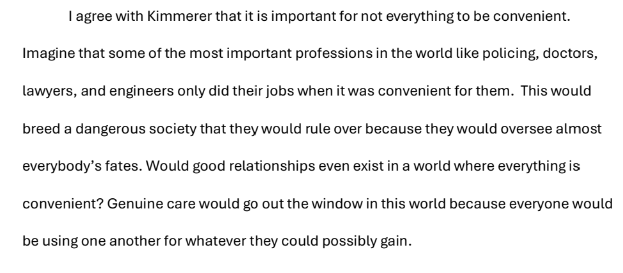
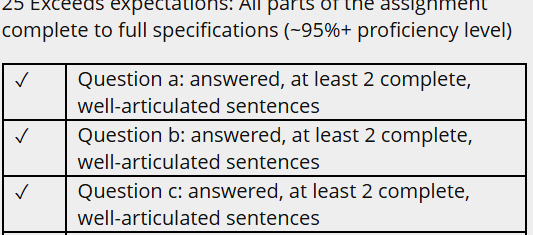
Artifact one is a paragraph from my picking sweetgrass reading reflection. In the paragraph I reflect on the ethical conflict of doctors, police, and engineers only doing their jobs when it is convenient for them. The second artifact is my grading for the reflection. The grading and feedback show an over 90% efficiency.
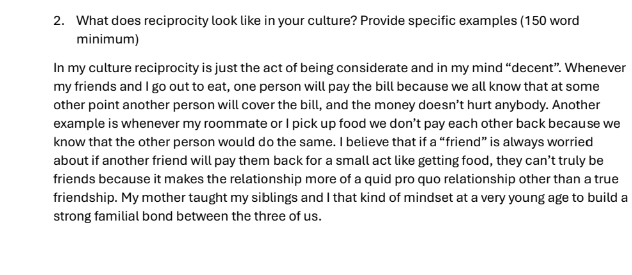
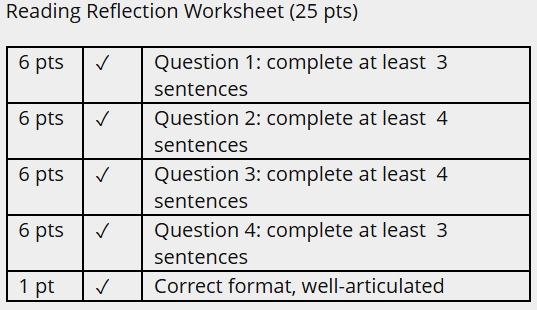
The third artifact is a paragraph from my Planting Sweetgrass reading reflection. In the paragraph I am reflecting on the ethicality of being reciprocal towards friends and family. The fourth artifact is my grading for that reflection. The grading and feedback show an over 90% efficiency.
(10%) 2C Creative and Critical thinking: Transforms ideas through synthesizing knowledge from multiple domains.
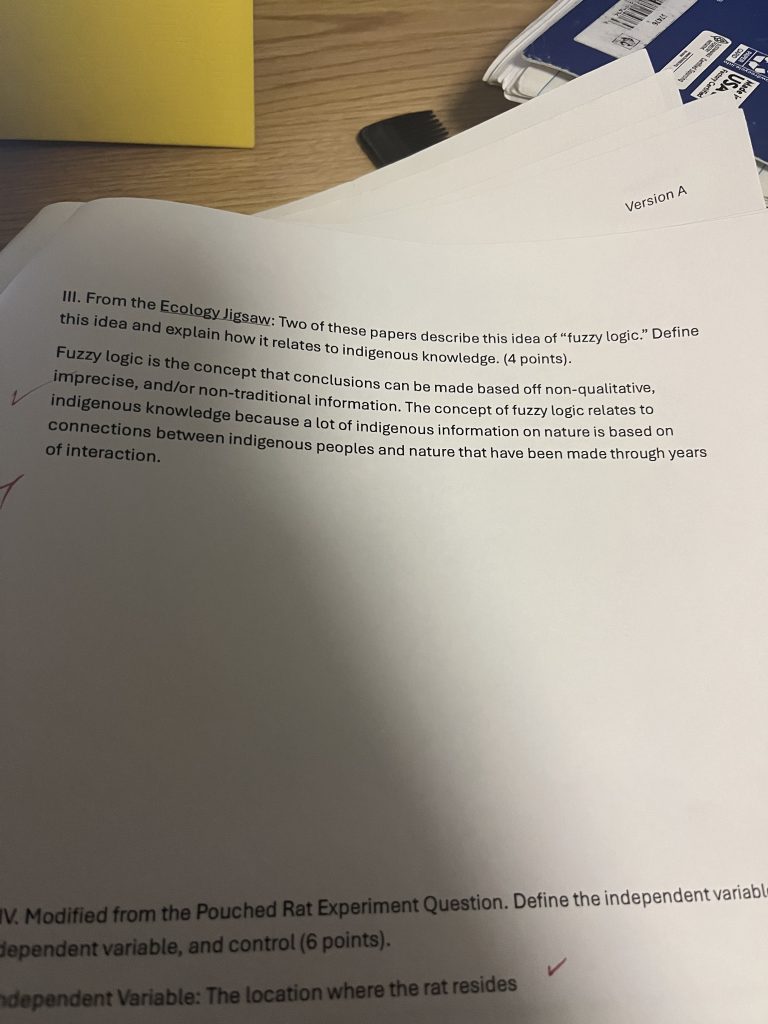
The first artifact is a question from Exam one in which I connect “fuzzy logic”, a mathematical approach that allows for multiple possible truths, to indigenous knowledge. I learned about Indigenous Knowledge through reading the book Braiding Sweetgrass and I learned the term fuzzy logic from review articles. The checkmark shows that I received full credit for my response.
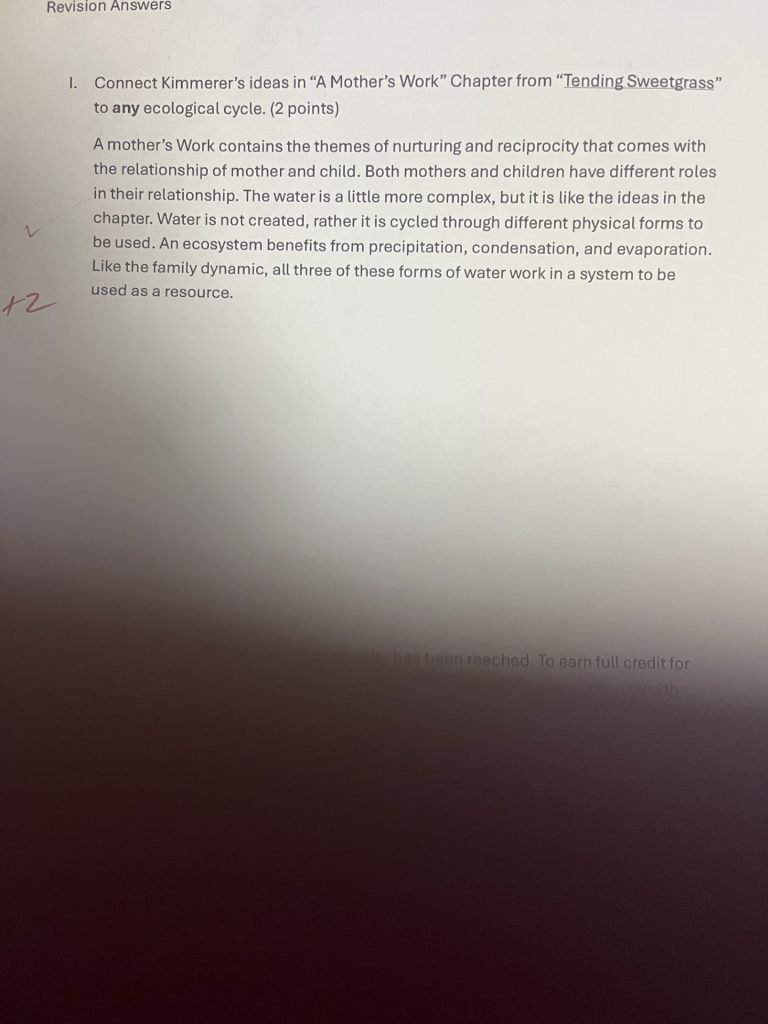
The second artifact is also a question from Exam one in which I connect ideas from the “A Mother’s Work” chapter in Braiding Sweetgrass to an ecological cycle. I learned about different kinds of ecological cycles through classroom lectures. The checkmark and +2 shows that I received full credit for my response.
(20%) 6A Intercultural Knowledge and Competence: Articulates own cultural rules and biases and recognizes and responds to biases.
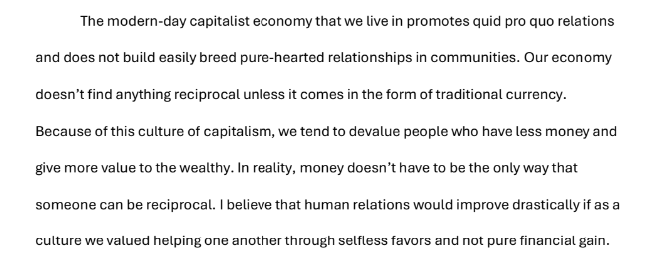



The first artifact is a paragraph from my Picking Sweetgrass reading reflection. In the paragraph I acknowledge my cultures tendency to value money over genuine acts of kindness/favors. I recognize that just because someone might not have as much money as another, it doesn’t mean they have less to offer. The second artifact is my grading for the reflection. The grading and feedback show an over 90% efficiency.
The third and fourth artifacts are week 5 and 7 Braiding Sweetgrass discussion attendance/participation grades. In these discussions we are asked to reflect on our own cultures and how we compare and contrast to the cultures in the book and their practices. The green checkmark shows that I participated in both sessions.
(20%) 4A Global Learning: Adapts and applies a deep understanding of multiple worldviews, experiences, and power structures while initiating meaningful interaction with other cultures to address significant global problems.

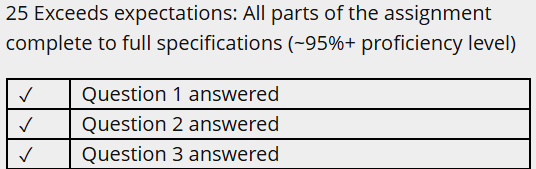
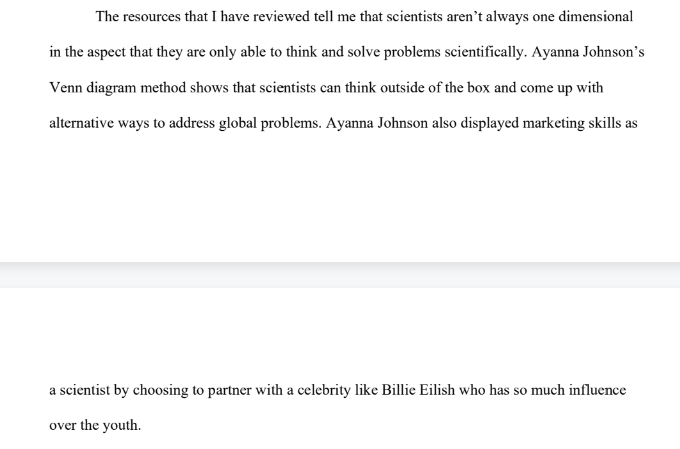
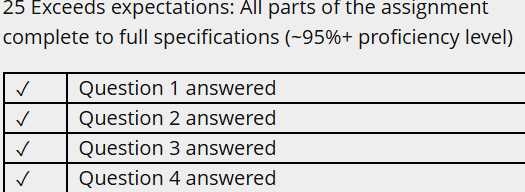
The first artifact is a paragraph from my Scientist Spotlight assignment over Dr. Danielle Lee. In the paragraph I reflect about how science is generally catered to a specific culture/demographic. The scientist being reviewed uses alternative methods to teaching science to children in a culture that science isn’t generally catered to. The second artifact is my grading on the reflection. The grading and feedback show an over 90% efficiency.
The second artifact is a paragraph from my Scientist Spotlight assignment over Ayanna Johnson. In the paragraph I talk about how science isn’t a common subject for the average person to be well-versed in. Ayanna Johnson comes up with alternative ways to teach people how they can help fight against a global issue without being a scientist. The fourth artifact is my grading on the reflection. The grading and feedback show an over 90% efficiency.
(30%) 8B Oral Communication: Uses compelling, appropriate delivery techniques






The first artifact is 48/50 grade I received on my oral presentation. The second artifact is the grade I received on the draft of this presentation. In this presentation I had to verbally communicate to summarize my research project. Both grades show over a 90% efficiency.
The 3rd, 4th, 5th, and 6th artifacts are participation/attendance grades for jigsaw activity days in class. During these Jigsaw activities, I was required to communicate with other students to share our findings from different scientific articles that we read. The green check mark shows that I was present and participated during these activities.