First-week Introduction
First week back! I’m excited to be back on my feet and ready to stay organized this semester. I am looking forward to finalizing a project I’ve been working on for 2 years now. When I first was introduced to our water conservation issue, I wasn’t interested in it. I have grown to become very passionate about water equity and aware about the struggling areas in our backyard. I am so grateful for the opportunities I have received from CODES and our partnership with JJK FAN. At the end of the semester, I hope to have my water fair toolkit ready to distribute to other after school programs and put CODES on the map!
Midterm Reflection
Halfway through the semester already! Part of me feels like the semester just began, but the other, bigger, part of me can’t believe we are only halfway to summer. So far this semester we have mostly worked on our Emplace group contribution. We were able to tell the story of the CODES Water Fair but also all of the work that got us to where we are now. I am proud of our final products: Toolkit, water fair, lesson plans, surveys, interviews, and so much more. I am excited to see what the rest of the semester entails.
Final Reflection
I can’t believe I’m saying it, but my CODES journey has ultimately come to an end. Two long years of research and implementation all summarized into one final project. I am so grateful for all of the faculty and staff that have served as mentors for me throughout my time here, but also my peers for always having confidence in me and pushing me to do my best. Looking forward, I am excited to revisit my project one year from now and see how far I’ve come. The CODES Program has changed my life, and I wouldn’t change a thing.
| A Work | B Work | C Work |
– Misses one class or fewer, or completes make-up work for excused absences – Annotates all readings thoroughly – Contributes deeply to discussions – Completes allassignments on time or has approved extension – Work shows engagement, care, effort, and growth – Collaborates substantially, contributes to vision, and works equally with peers – Abides by the CODE of Conduct and classroom norms | – Misses two classes or fewer, or does make-up work for excused absences – Annotates most readings – Often participates in discussion – Completes allassignments on time or has approved extension – Work shows care, effort, and growth – Collaborates equally and completes required work – Abides by the CODE of Conduct and classroom norms | – Misses three classes or fewer, or does make-up work for excused absences – Completes most readings – Sometimes adds to discussion – Completes all major assignments and at least five SAs – Meets minimal expectations on assignments; shows some growth – Completes required collaborative work – Abides by the CODE of Conduct and classroom norms |
Course Goals
Goal 1 (20%)
Based on 7c: Reviews prior learning inside and outside of the classroom to reveal significantly changed perspectives about educational and life experiences.
| What will you do to learn the content/ develop the skill? | What examples will you add to the portfolio to demonstrate your learning? | What characteristics of the chosen examples demonstrate you have met your goal? |
| Revisit my previous CODES assignments and make connections and real world decisions from them. | Reflections Emplace writing | These will show that I have taken my knowledge from previous CODES work and immersed myself in applying this to the real world. |
Below is an excerpt from our group Emplace contribution. This is just one short paragraph that touches on the work we have previously done in CODES. This shows that we reflected on our past work and, eventually, tie these to real world connections.
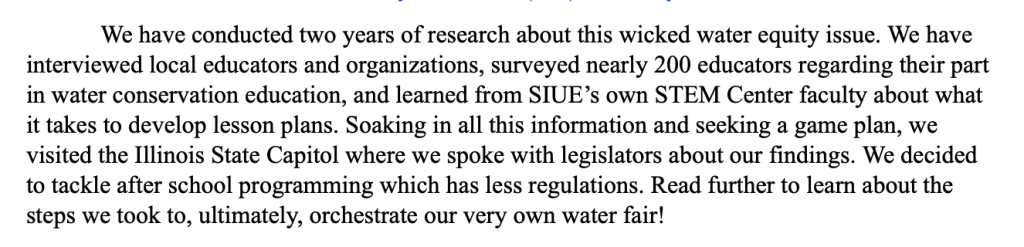
Throughout this entire course, we have talked about our previous semesters’ work; reflecting on what went well and what we could’ve done better at the Water Fair. This semester was truly a capstone to our journey, as our last semester we implemented all that we said we would.
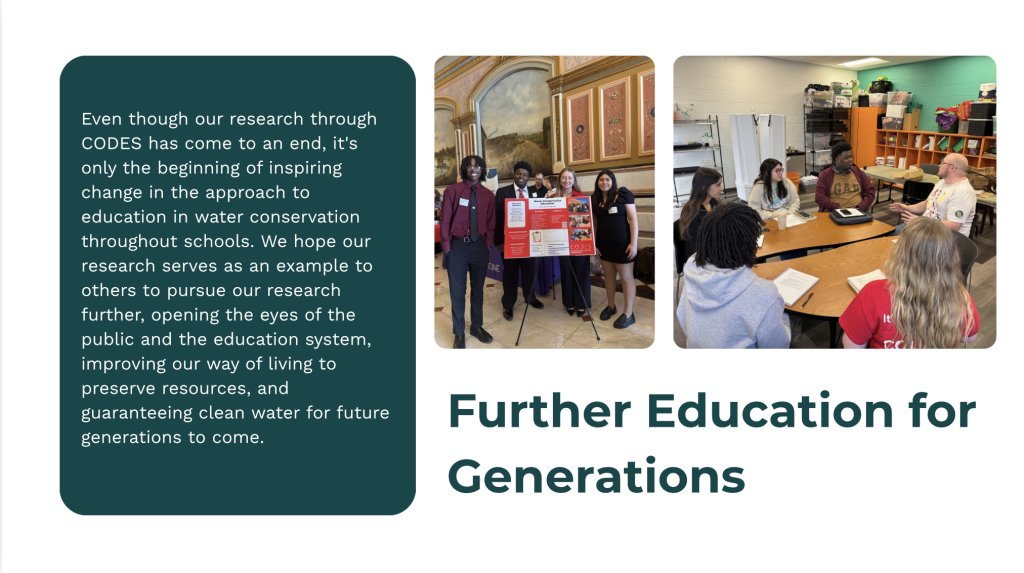
We’ve pulled everything together into our final CODES Presentation for the Undergraduate Scholars Showcase. We mostly focused on what the final outcomes were instead of our journey to get there, but nonetheless, we encapsulated two years of research into just ten minutes. Below is our conclusion slide of our presentation, which shows that we have drawn logical conclusions to our wicked problem.
Goal 2 (20%)
Based on 4a: Adapts and applies a deep understanding of multiple worldviews, experiences, and power structures while initiating meaningful interaction with other cultures to address significant global problems.
| What will you do to learn the content/ develop the skill? | What examples will you add to the portfolio to demonstrate your learning? | What characteristics of the chosen examples demonstrate you have met your goal? |
| Connect with Zach and Kurly from JJK and incorporate their feedback in order to improve. | Dissemination Plan Communication with JJK and others | Water Fair Toolkit is successful and distributed to local educational establishments. |
This goal has been shifted in another direction has the semester has progressed. We spent a lot less time communicating with our community partner because our last semester was spent both implementing and reflecting.
Collaborating with my classmates is one of the most prevalent artifacts that encompass this goal. Learning from their different backgrounds and experiences has shaped my CODES journey. I am grateful to have so many different viewpoints and backgrounds to differentiate my points of view.
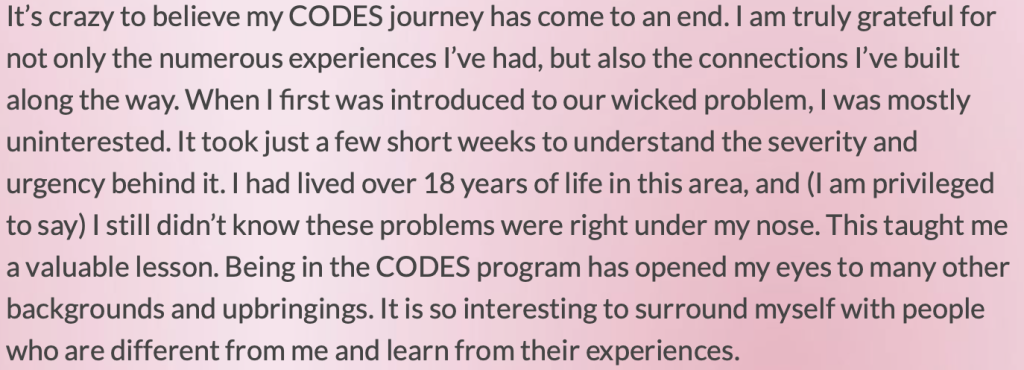
I would instead like to include an excerpt from my final reflection here. This shows my ultimate understanding of multiple worldviews and experiences while collaborating with other cultures to address this wicked problem. This is what CODES is all about!
The Water Fair Toolkit has been sent to Zach and Kurly at the JJK Academy. My hopes are that they continue to implement these activities long after our time at SIUE, and potentially share this with other schools (Maybe even incorporate it into the curriculum at the expanded Northern Campus).
Goal 3 (20%)
Based on 8c: Develops clear, innovative central messages with significant supporting materials.
| What will you do to learn the content/ develop the skill? | What examples will you add to the portfolio to demonstrate your learning? | What characteristics of the chosen examples demonstrate you have met your goal? |
| Take in feedback from peers and professors. Revise and practice presentation | Final presentation Speaking outline for Sophomore Showcase | Capture the audience’s attention at the Sophomore Showcase by presenting information in an engaging manner. |
Although this goal is focusing on oral presentation, I still think it is worth mentioning the introduction to our Emplace contribution. This introduction shows a clear central message and prepares the readers for the supporting materials to come.
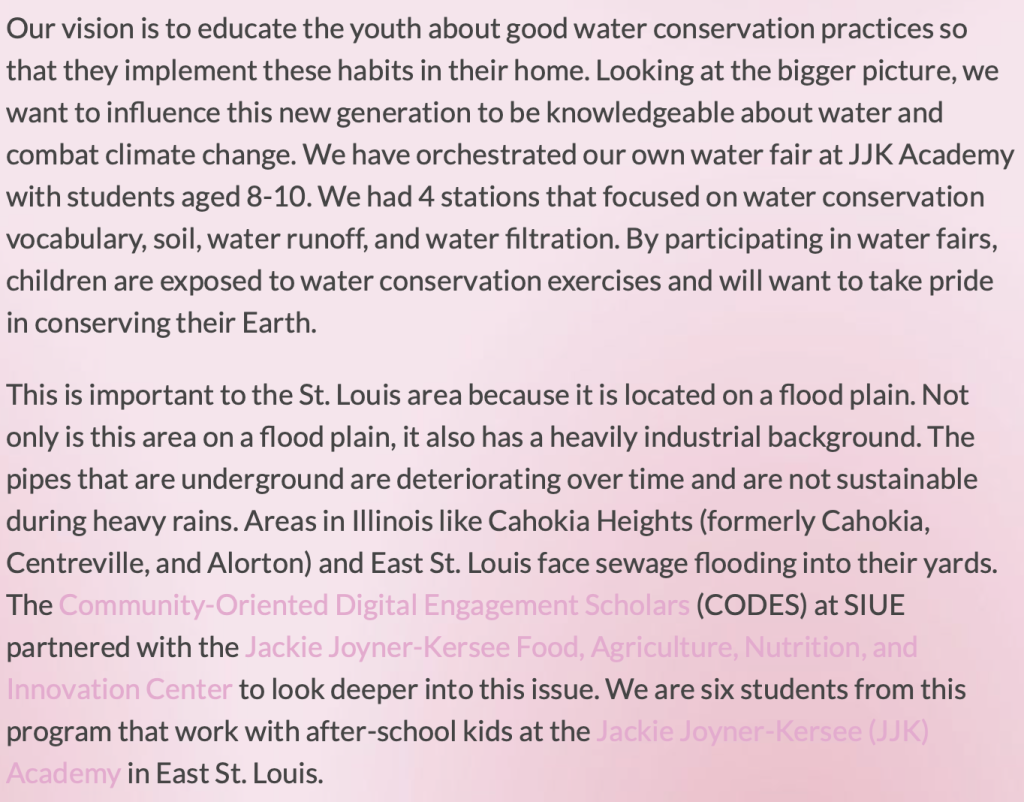
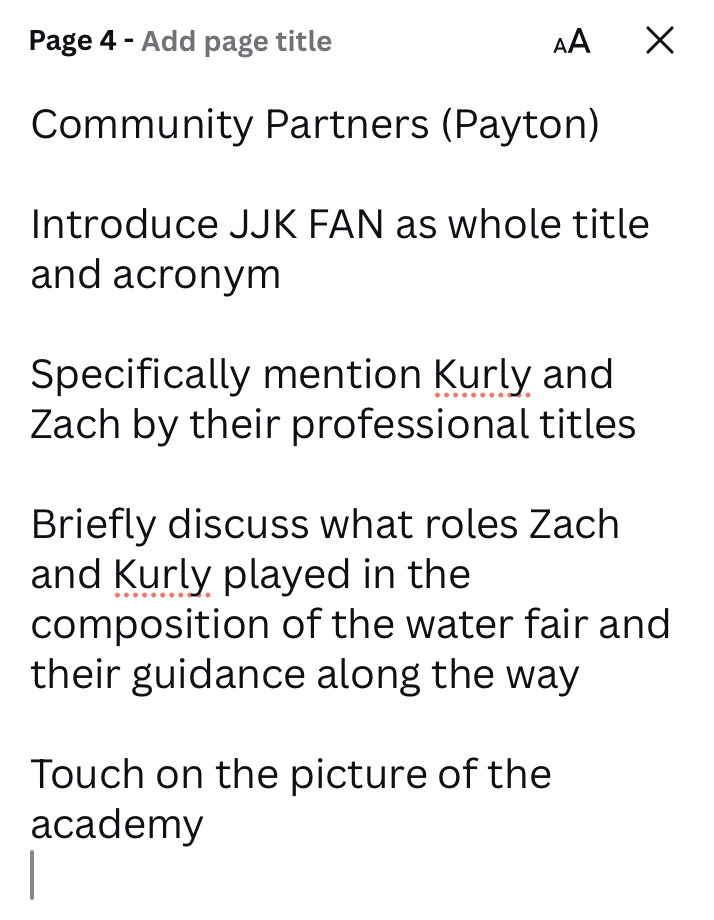
Although I had strep throat, our final presentation was a success! At least we are familiar with masks and social distancing 🙂 We practiced several times in front of different audiences to make sure we were prepared for our very last presentation. We made sure to include speaker notes in our Canva slideshow, that way each of us knew what slide we were focusing on ahead of time and what the main points to discuss were. Here is one slide as an example:
Goal 4 (20%)
Based on 9c: Implements solutions to address multiple contextual factors.
| What will you do to learn the content/ develop the skill? | What examples will you add to the portfolio to demonstrate your learning? | What characteristics of the chosen examples demonstrate you have met your goal? |
| Working with community partners, classmates, and faculty | Construction and finalization of toolkit Dissemination plan | Adaptability and changes shown along the way |
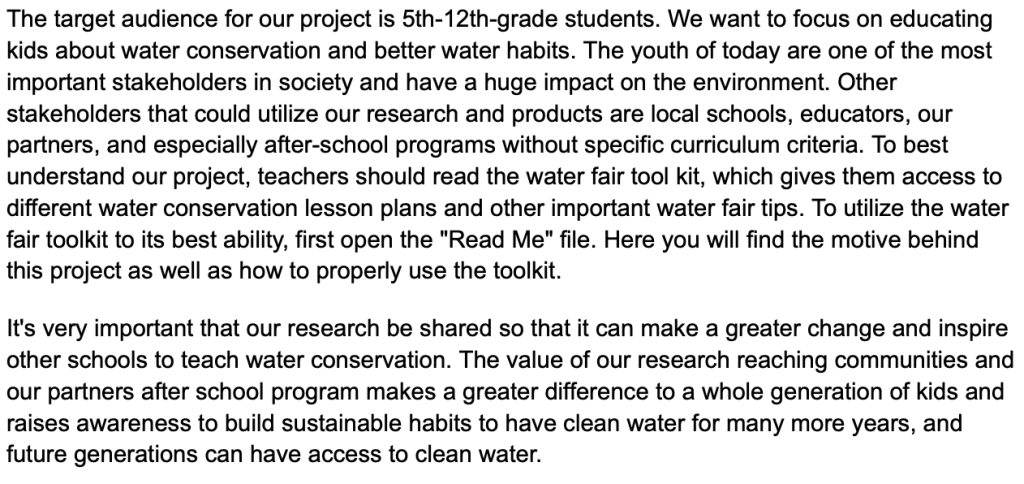
Our dissemination plan is a great example of achieving this goal. We contextualized stakeholders, addressed community partners, and planned solutions to our wicked problem. We still have 2 steps left in finalizing our dissemination plan. Below is just one piece from our plan
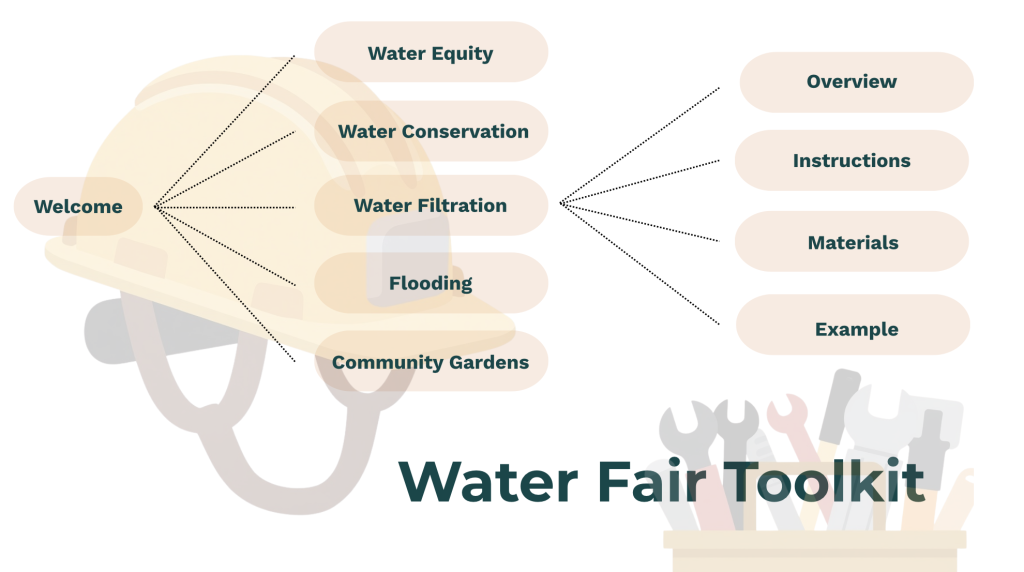
Here is my slide from our final presentation. This shows the final composition and layout of the Water Fair Toolkit. This truly ties in the goal of implementing solutions through various factors.
Goal 5 (20%)
Based on 12a: Helps collaboration move forward by articulating the merits of alternative ideas.
| What will you do to learn the content/ develop the skill? | What examples will you add to the portfolio to demonstrate your learning? | What characteristics of the chosen examples demonstrate you have met your goal? |
| Work with group mates to incorporate their ideas | Group communication and brainstorming, Feedback and construction of lesson plans | Revisions made to these examples In-class collaboration |
When constructing our Emplace contribution, there were talks of many different ideas, some of which not everyone was on board with. We were able to come together, brainstorm, and decide on a blog with links throughout that showcased all of the different work we have done. We were also able to receive feedback from research team professors to enhance our work.
Another aspect of our Emplace contribution composition is valuable here. When receiving feedback from Kezia, we went through and made comments on each part of the contribution that needed some love or tweaking. We all discussed these moments and decided on a game plan for each. I went through and revised all 30-some comments to create what is our final Emplace Contribution.
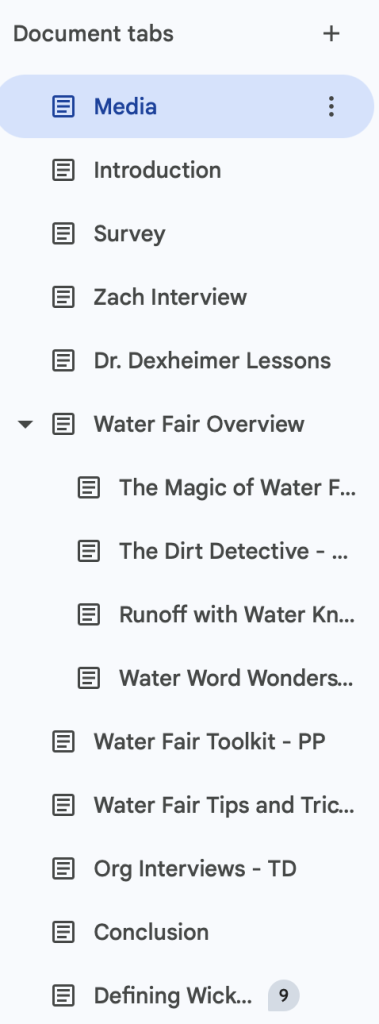
This is how we structured our Emplace Contribution. We separated each aspect into tabs and ultimately combined them into a final version, which we tweaked to maximize the flow of the blog. You can see at the bottom beside the “Defining Wicked” tab there are 9 comments on there (Remaining because they are positive feedback).