Category: Uncategorized (Page 1 of 2)

Reflection #5

It’s crazy to believe my CODES journey has come to an end. I am truly grateful for not only the numerous experiences I’ve had, but also the connections I’ve built along the way. When I first was introduced to our wicked problem, I was mostly uninterested. It took just a few short weeks to understand the severity and urgency behind it. I had lived over 18 years of life in this area, and (I am privileged to say) I still didn’t know these problems were right under my nose. This taught me a valuable lesson. Being in the CODES program has opened my eyes to many other backgrounds and upbringings. It is so interesting to surround myself with people who are different from me and learn from their experiences.

Although it is cliche to say, CODES really has changed my life. From a freshman in college, using Snap maps to find what buildings my classes were in, to presenting at the Illinois State Capitol and having lunch with Katie Stuart, I am grateful for the journey. Not many freshmen can say they participated and completed a 2 year research project before even starting their junior year. Thank you to Dr. DeSpain, for having faith in me and skyrocketing my confidence. Thank you to Dr. Martinez, who opened her arms to welcome all of us newbies and cared for us like her own. Thank you to Andrea, who never fails to make me laugh and empowers the girl boss in me. Thank you to Dr. Hildebrandt, who was an incredible mentor throughout completing our finishing touches. Thank you to Dr. Smith, Dan, Dr. Del Rio and so many more who have helped us navigate college life and technology. Lastly, thank you to Zach and Kurly for being patient with us, allowing us into your space, and guiding us in the right direction with this amazing opportunity.
Author Bio

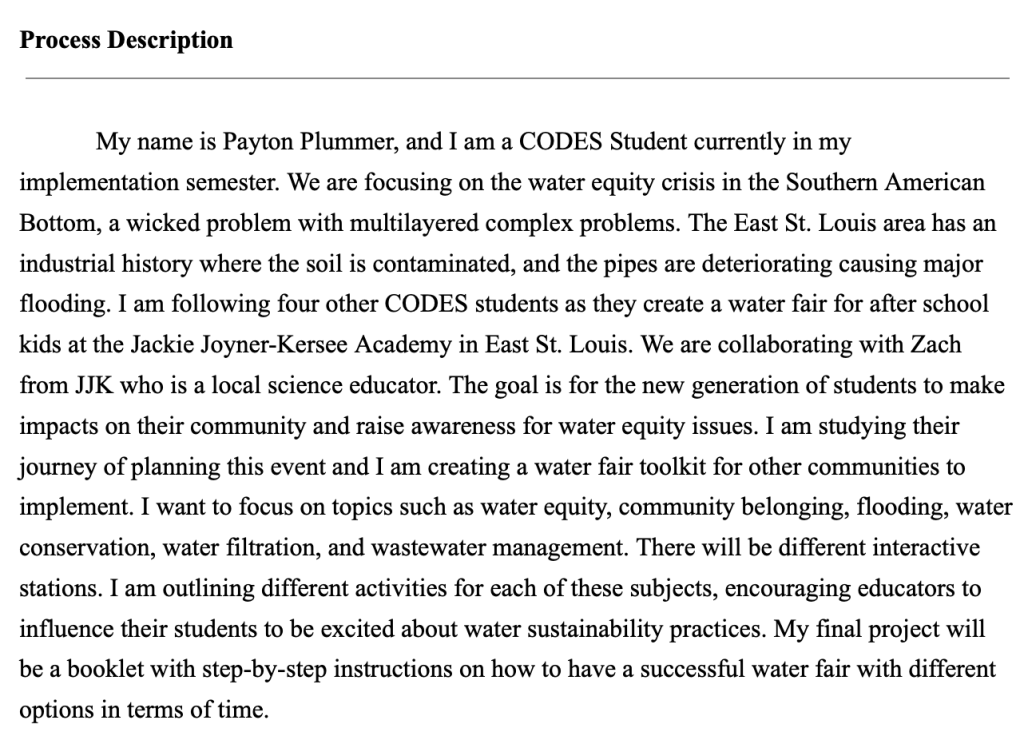
Payton Plummer is a second-year student at Southern Illinois University Edwardsville. She is pursuing a major in Business Administration with a concentration in Data Analytics and Mathematics. She is a member of the Community-Oriented Digital Engagement Scholars (CODES), which is an honors program and full-tuition scholarship at SIUE. She serves as a CODES Ambassador where she oversees CODES social media, aids in constructing CODES events, and contributes to website updates. Her work in CODES surrounds the water equity in the St. Louis area, educating after-school students at the Jackie Joyner-Kersee (JJK) Academy about good water practices. Her biggest inspiration is her mom, who was a data analyst, herself, inspiring Payton’s passion of statistics and management. She is driven by civic engagement and analytical insights, therefore she envisions a future in statistical analysis management.

Teachers’ Perspectives on Water Conservation Education

Survey data

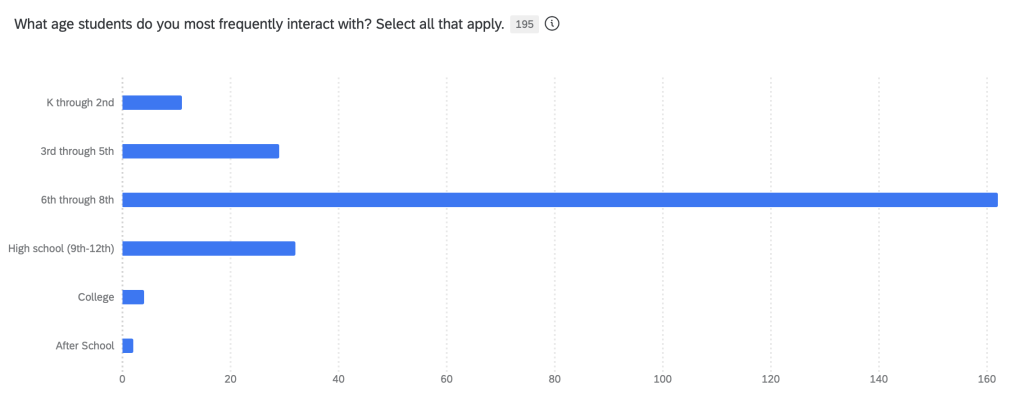
What age students do you most frequently interact with? Select all that apply

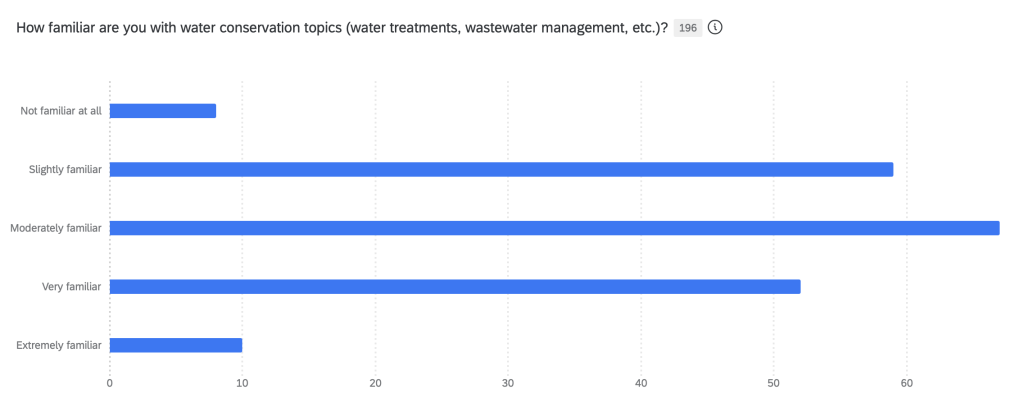
How familiar are you with water conservation topics (water treatment, wastewater management, etc.)?

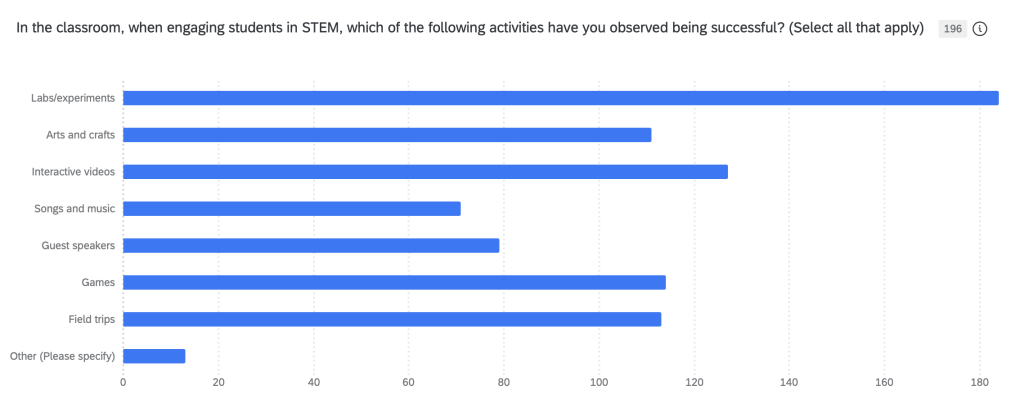
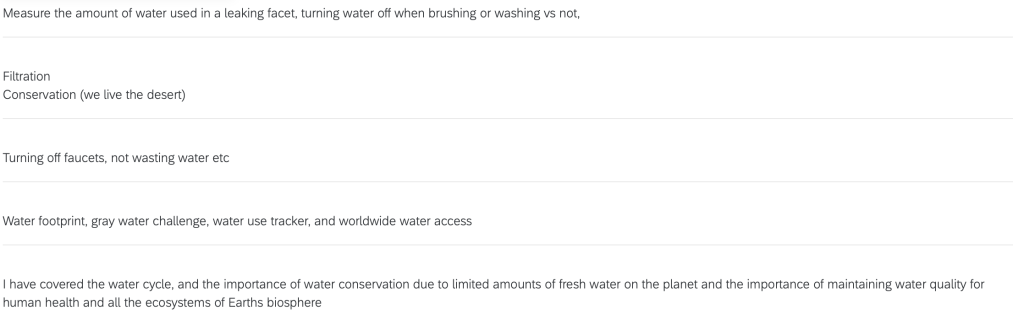
In the classroom, when engaging students in STEM, which of the following activities have you observed being successful? (Select all that apply)

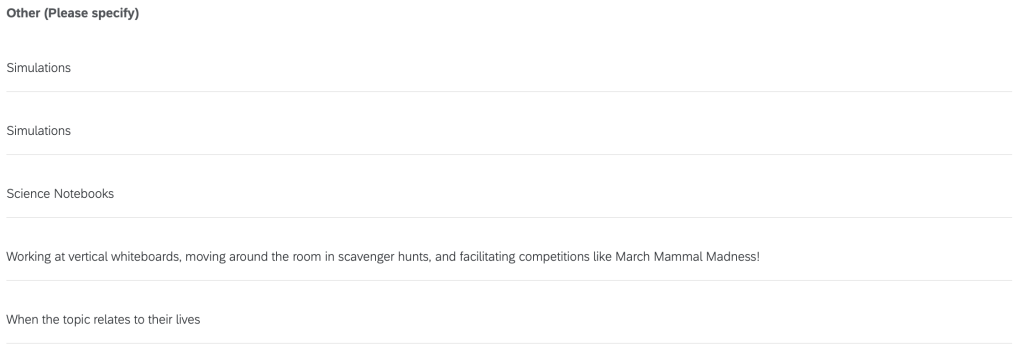
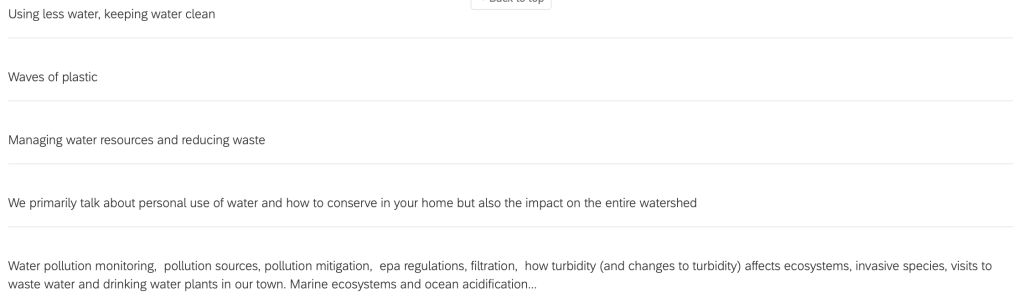
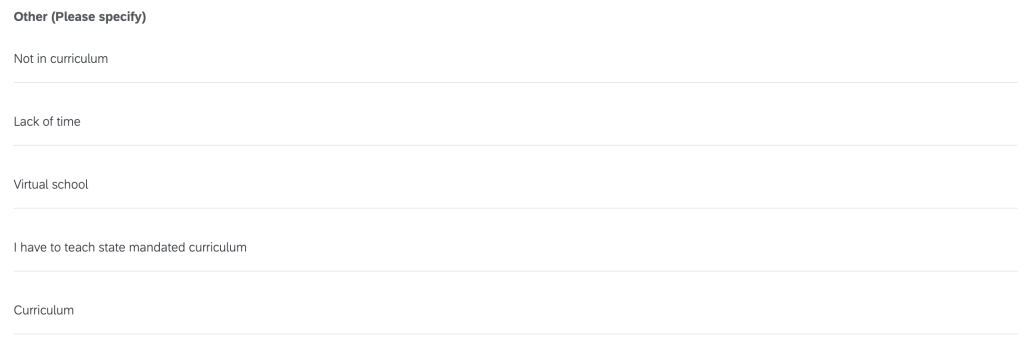
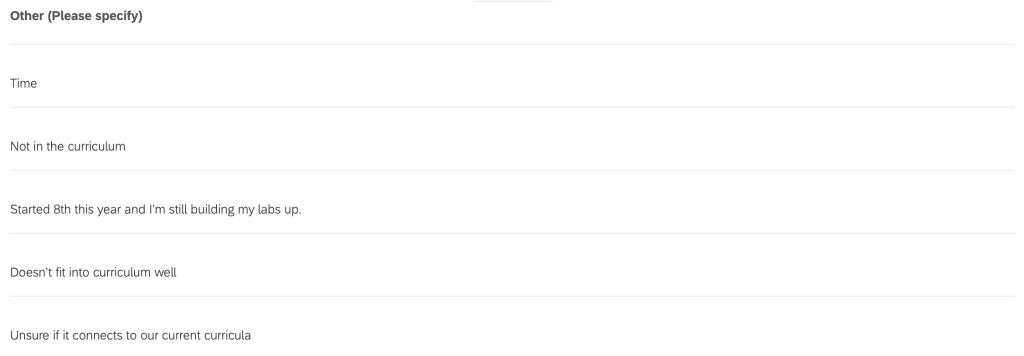
The following are responses to the “other” category:

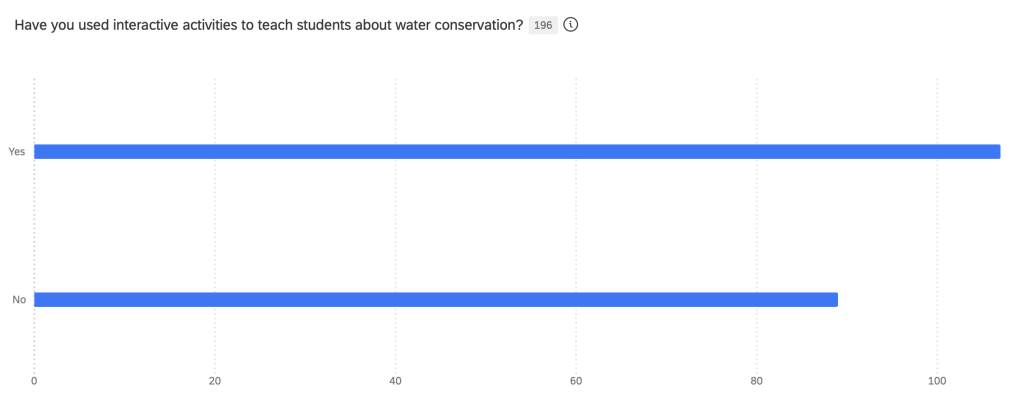
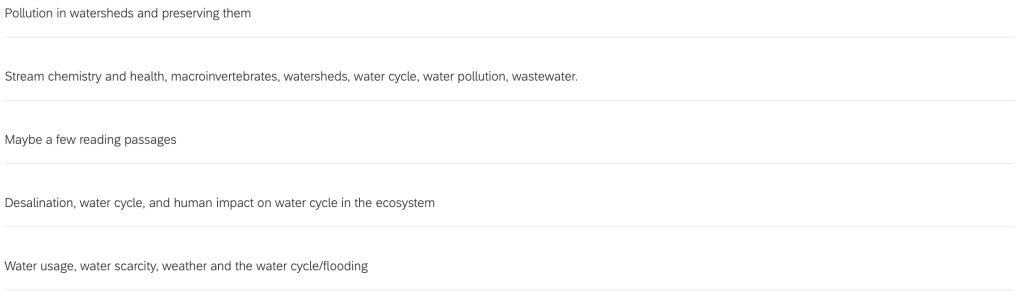
Have you used interactive activities to teach students about water conservation?

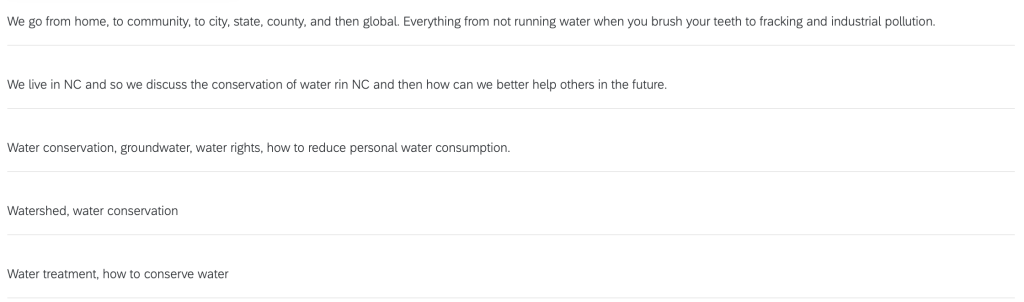
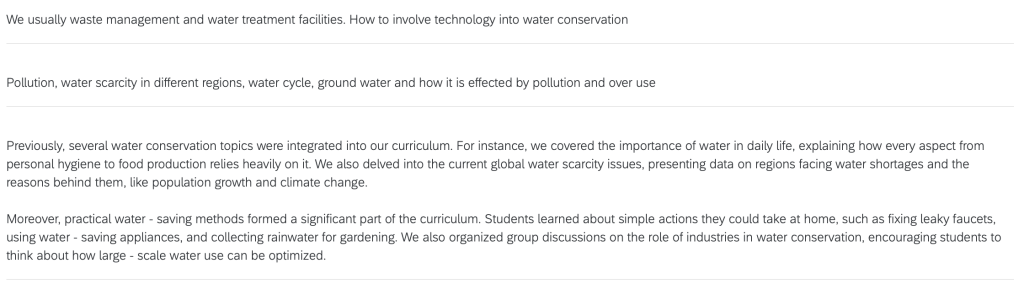
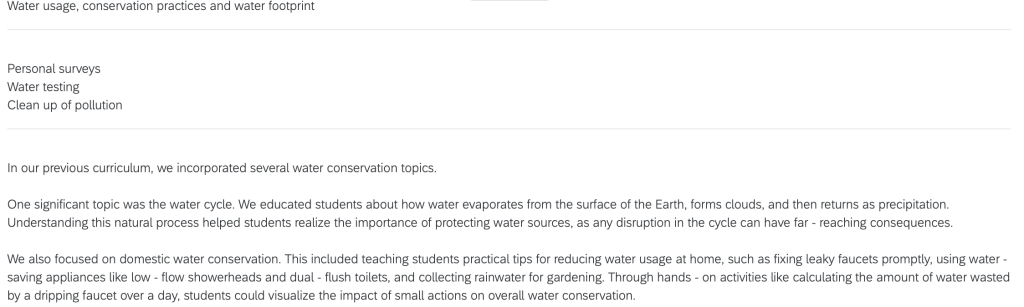
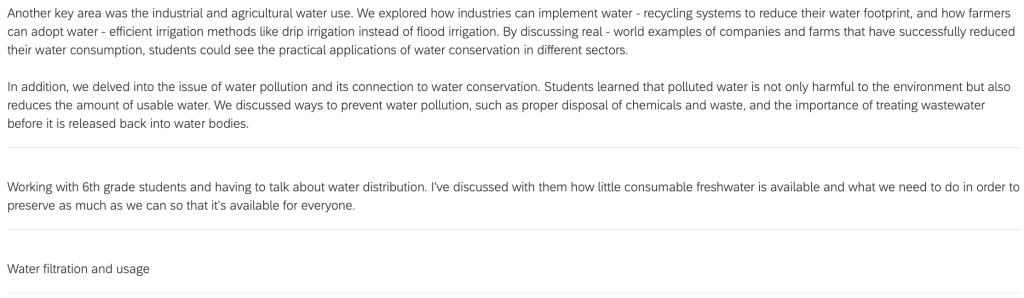
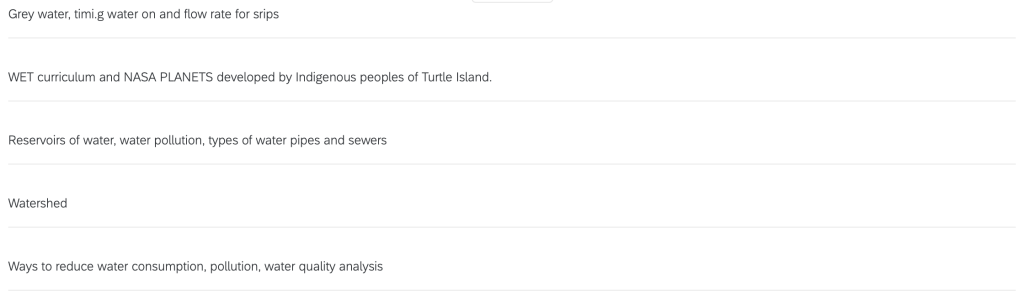
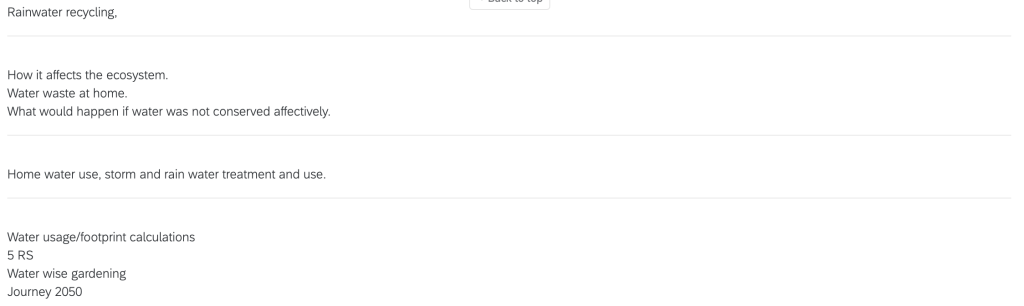
If yes, what water conservation topics have you previously included into your curriculum?

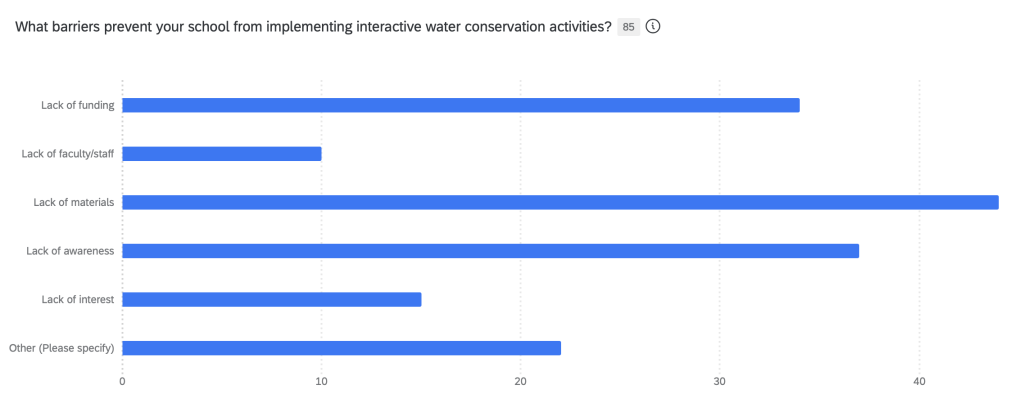
If no, what barriers prevent your school from implementing interactive water conservation activities?

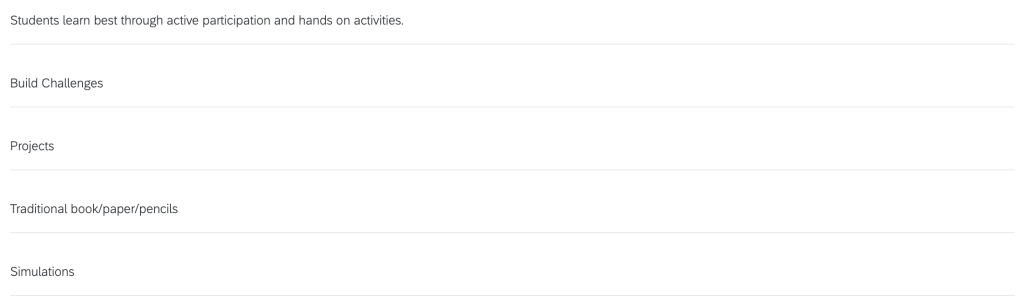
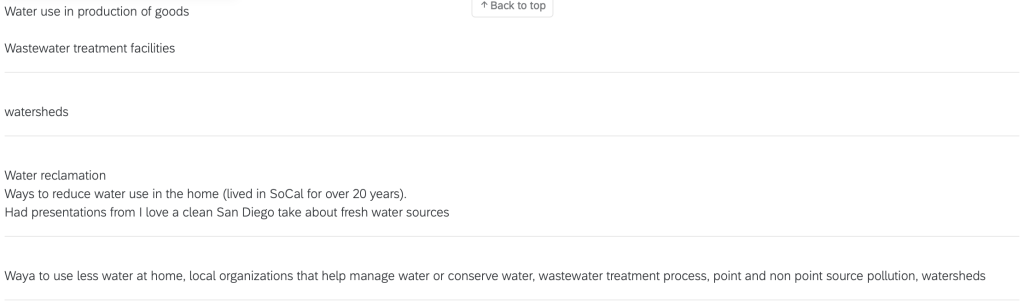
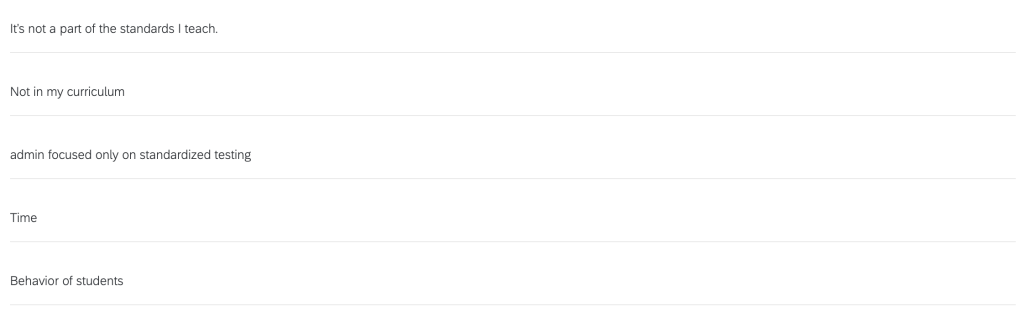
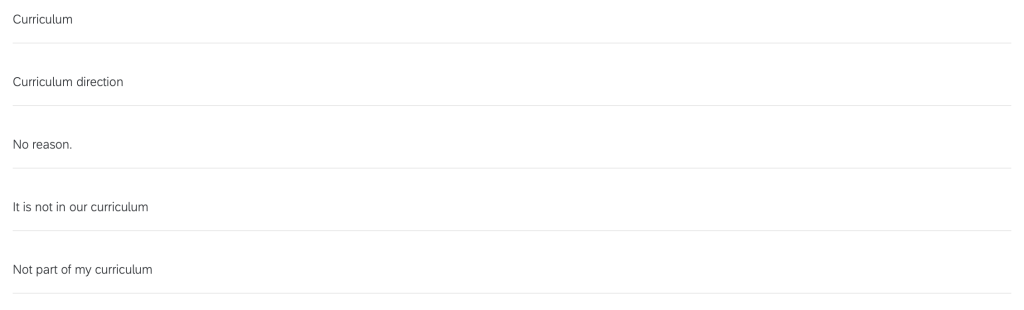
The following are responses to the “other” category:

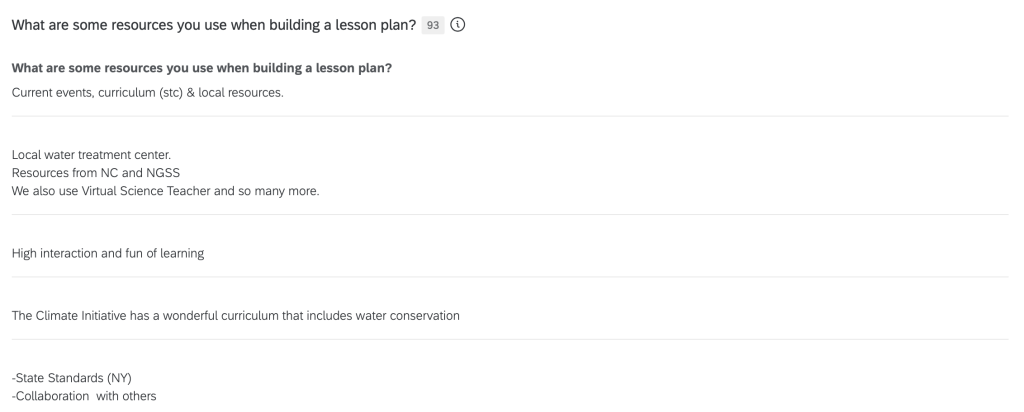
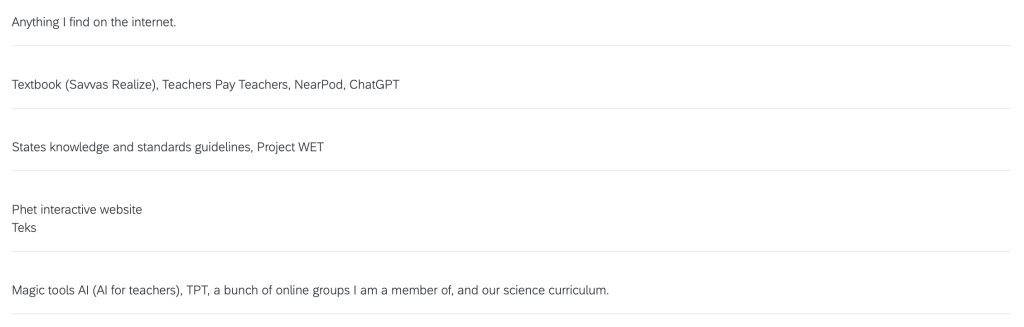
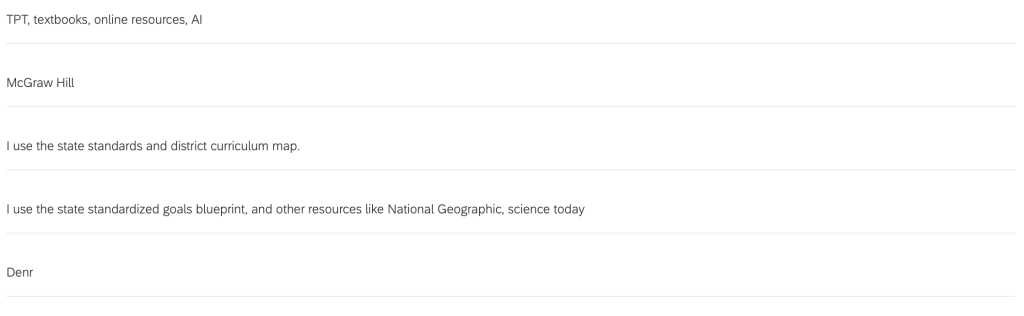
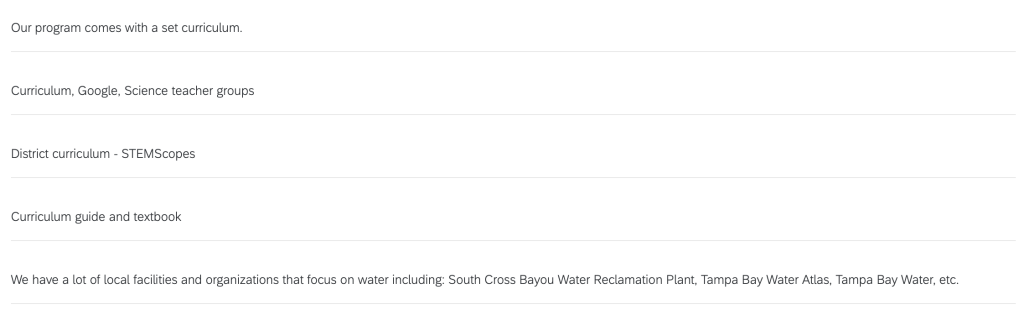
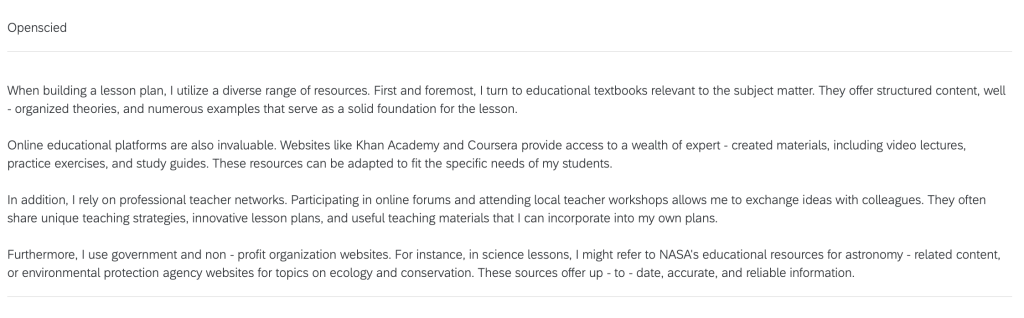
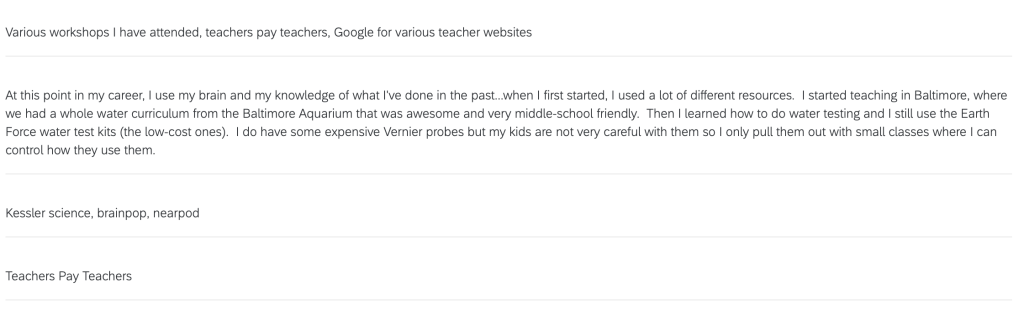
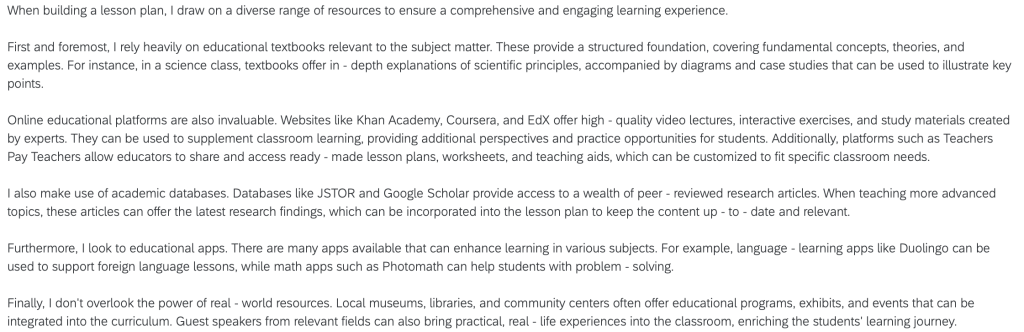
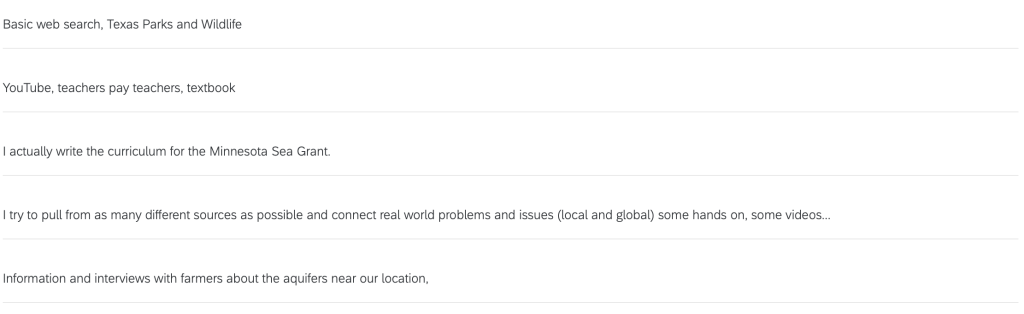
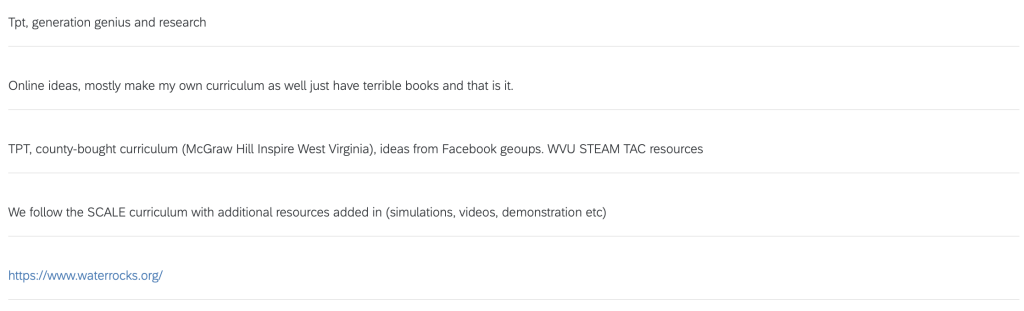
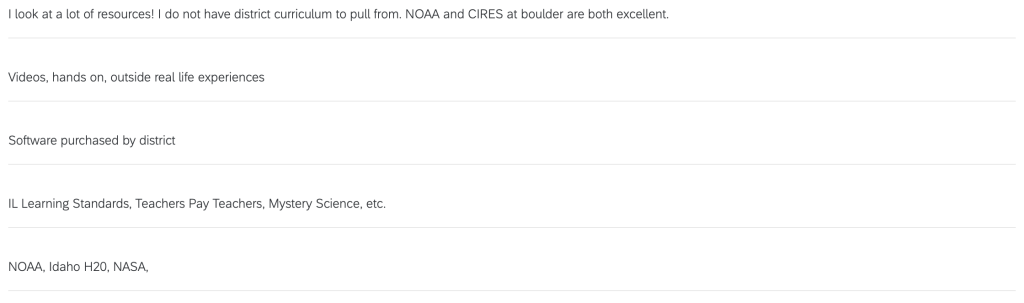
What are some resources you use when building a lesson plan? (Sample)

Can you share any success stories or examples of students who have positively impacted water conservation? (Private)

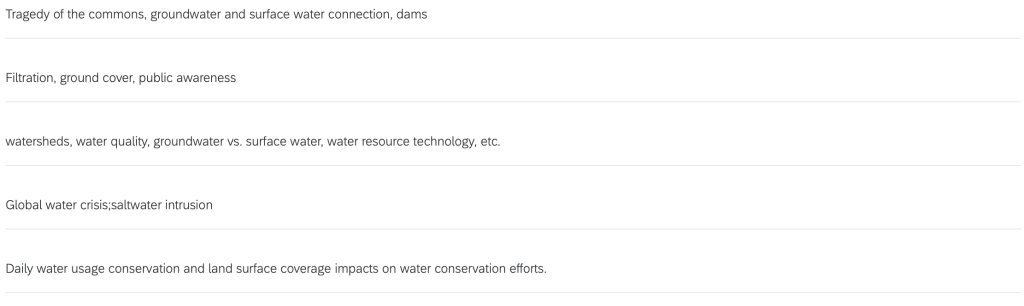
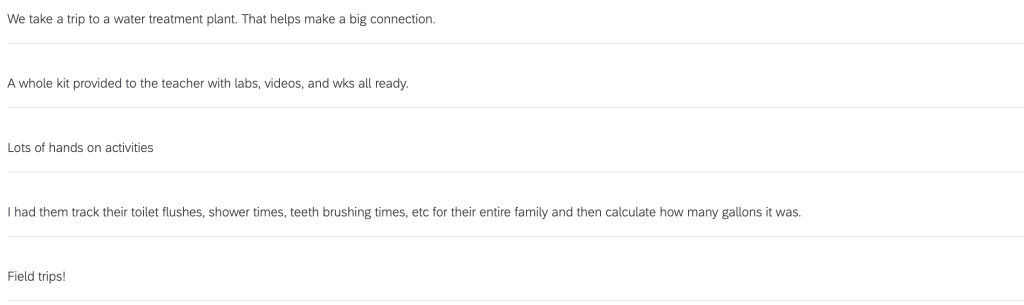
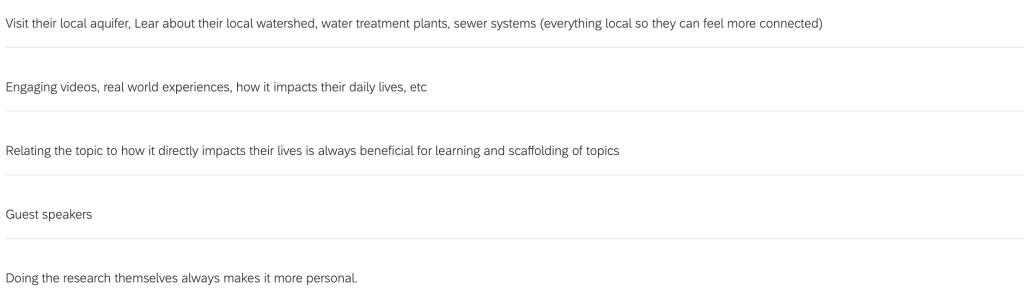
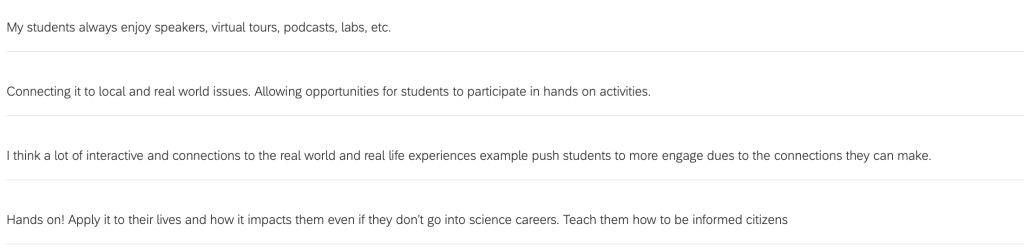
Are there any additional ideas or suggestions on how to make water conservation education more engaging for students? (Sample)

Reflection #4

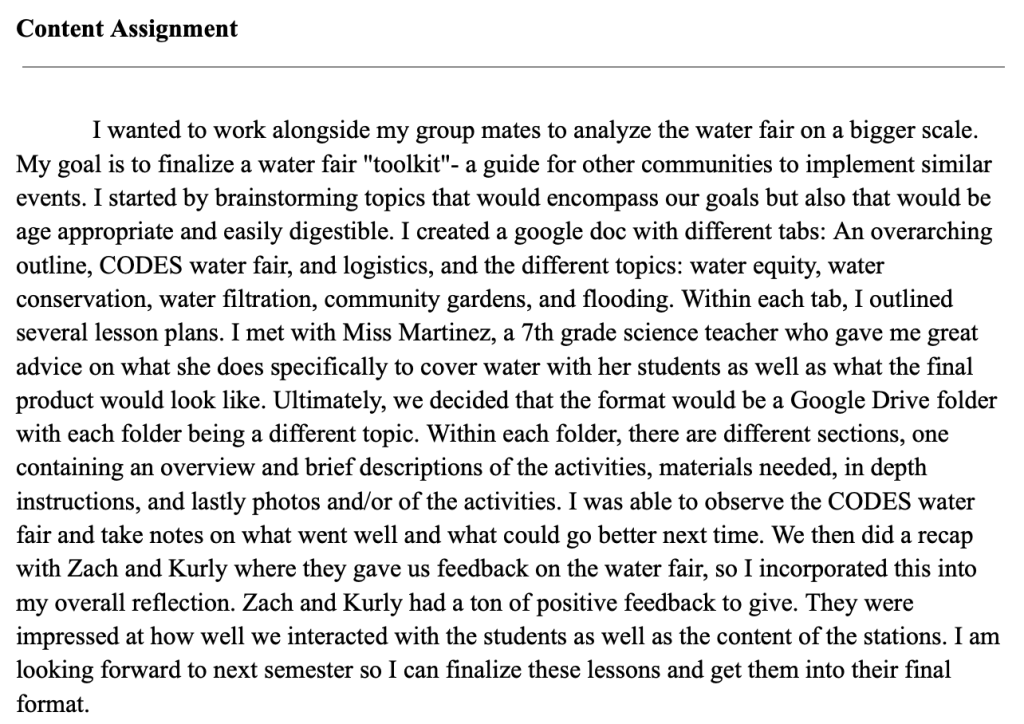
In order to finish the semester strong, there are a few things that our group needs to accomplish and be proud of. We need to finish our group Emplace Contribution. We each have different roles in this process and look forward to revising with edits from Kezia. This being said, my work is shaped moving forward, individually. We are going to begin working on our individual Emplace Contributions which will essentially be a mini autobiography. The last thing on our to-do list is our presentation for the Undergraduate Showcase at the end of April. I am excited to turn our Emplace Contribution into a more personalized presentation.
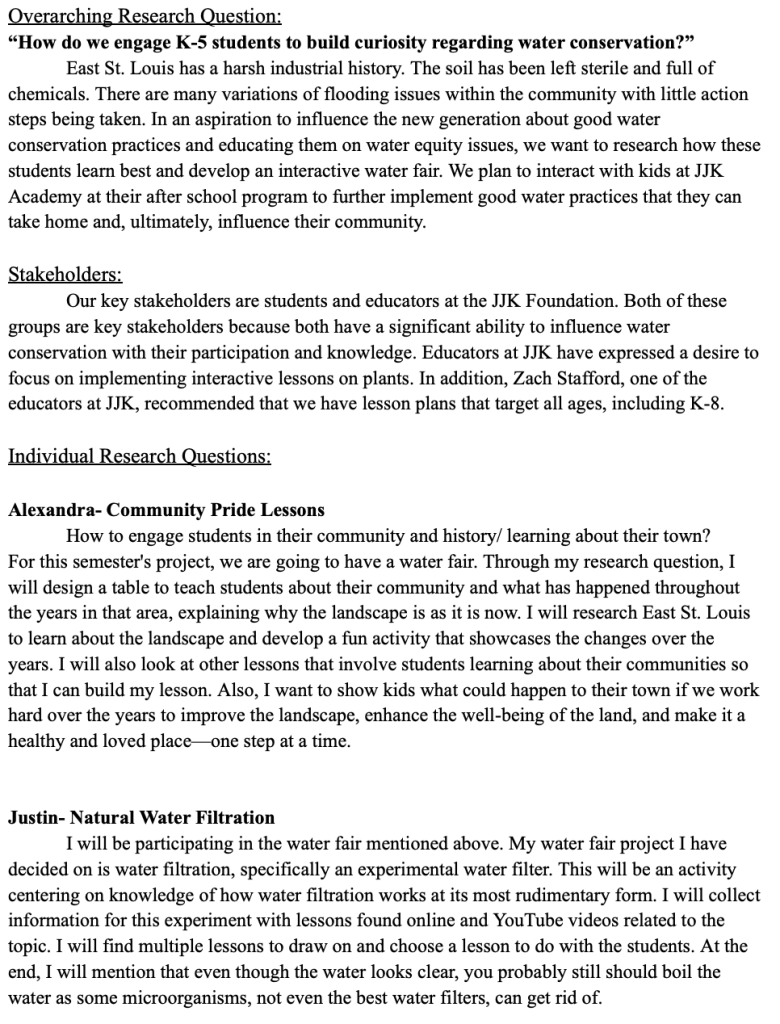
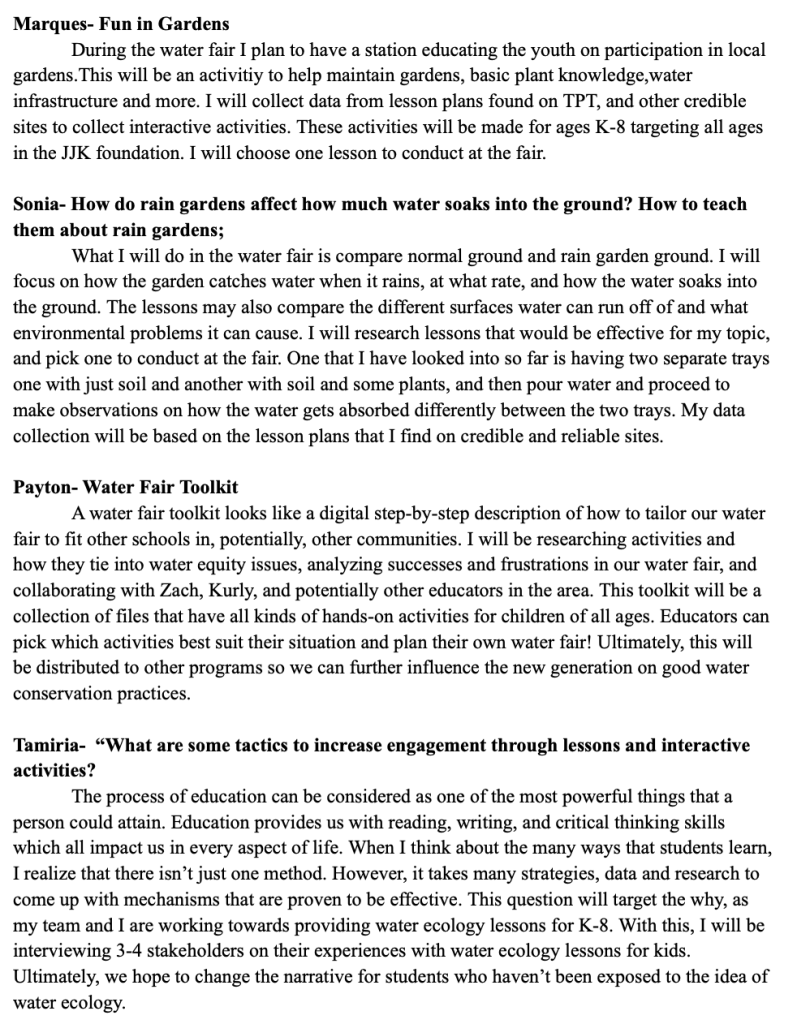
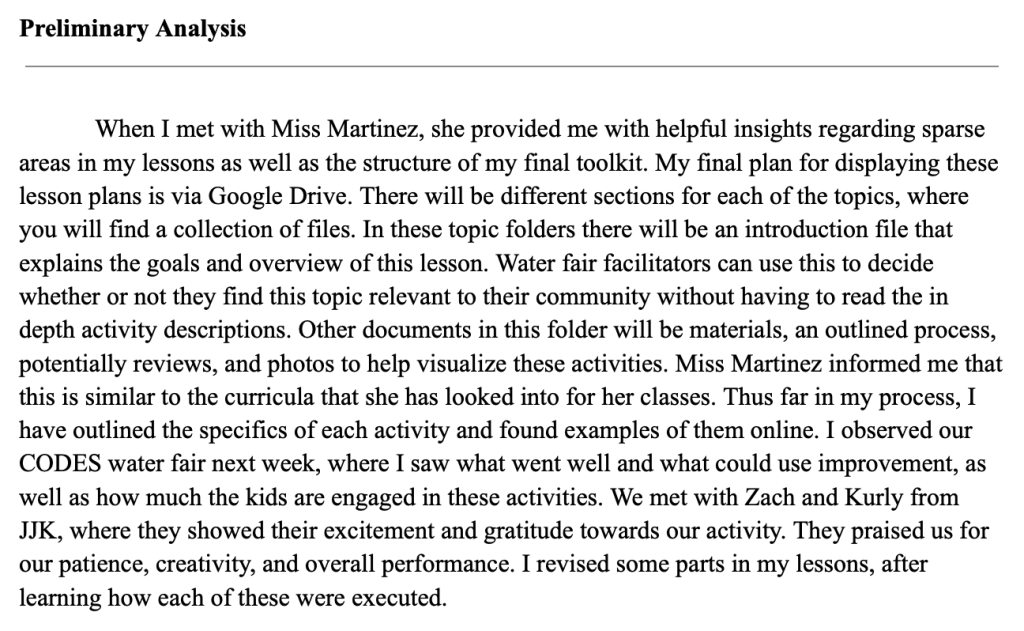
As far as my final piece in our projects, I still need to finalize my toolkit. The raw materials are there but I need to assemble the toolkit so it is readily available for those other communities with whom we are thinking about sharing. I am seeking advice and guidance from Dr. Martinez, Zach from JJK, and Dr. Hildebrandt to provide any other suggestions for my final piece.

Reflection #3

There are ways to soften the blow from negative feedback, such as starting with a positive, but that doesn’t always feel good, especially when you worked so hard and are so proud of your work. One exercise we did for CODES orientation was very helpful: everyone filled out a sheet of paper that had their preferred way of feedback on it. For example, when someone is telling me about something rough happening in their life, usually I tell them how strong they are, or sometimes I may relate to their situation, so I try to resonate with them. However, some people may find this offensive. Everyone had their preferred response style available on this shared online space so we could see how they would benefit from the right kind of feedback.

Oftentimes I am good at giving feedback, but struggle with receiving it. When giving feedback, I begin with what I enjoyed. Instead of saying, “buuuut…” I use suggestions. I don’t tell them what needs to change, I offer my opinion. So, instead of saying, “I enjoyed your introduction, buuuut you need to reinforce your claims in your conclusion.” I would say, “Your introduction really pulls the reader in, I enjoy this. Maybe you could revisit what you said in the introduction back into the conclusion so readers can remember what the takeaways of your paper are.” This way is much more friendly and it seems more suggestive rather than demanding.

I struggle with receiving feedback because I am usually proud of what I create. When someone has revisions, sometimes it is hard for me to change what I really like about my piece. I need to work on taking things less personally and take my heart out of this process.

« Older posts

© 2026 Payton Plummer

Theme by Anders NorenUp ↑