| A Work | B Work | C Work |
| -Misses few classes or completes make-up work -Annotates all readings -Makes substantive weekly comments on discussion board -Makes weekly in-class comments about reading -Completes all assignment -Collaborates equally and effectively | -Misses few classes or completes make-up work -Annotates most readings -Makes weekly comments on the discussion board -Completes all major assignments Collaborates with others | -Misses several classes without make-up work -Completes most readings -Makes less than the required weekly comments on the discussion board -Comments in class on occasion -May miss a major assignment or meet minimal expectations on all assignments -Does not effectively collaborate |
Course Goals
Goal 1: (Information Literacy) 5b. Accesses information using effective, well-designed search strategies and appropriate sources. (20%)
| What will you do to learn the content/ develop the skill? | What examples will you add to the portfolio to demonstrate your learning? | What characteristics of the chosen examples demonstrate you have met your goal? |
| Use good research tactics we learned in class to aid in research paper constructing. Working with my group on research project. Selecting articles to use for research paper. | Annotated bibliography Project outlines Notes from research lecture Section 4 on research paper | Revised project outlines as needed Integrating feedback on research paper 90% on annotated bibliography |
Below, you can find that I received full points on my part of our annotated bibliography. This shows that I chose helpful articles for our research paper and that I was effectively contributing to it.

In our original project outline, we didn’t do so hot. However, we met with Dr. Lee durning the CODE220 focus group in the IRIS Center and we were able to revise. Below is our project outline after Dr. Lee’s help. This shows that we were adaptable and willing to learn.

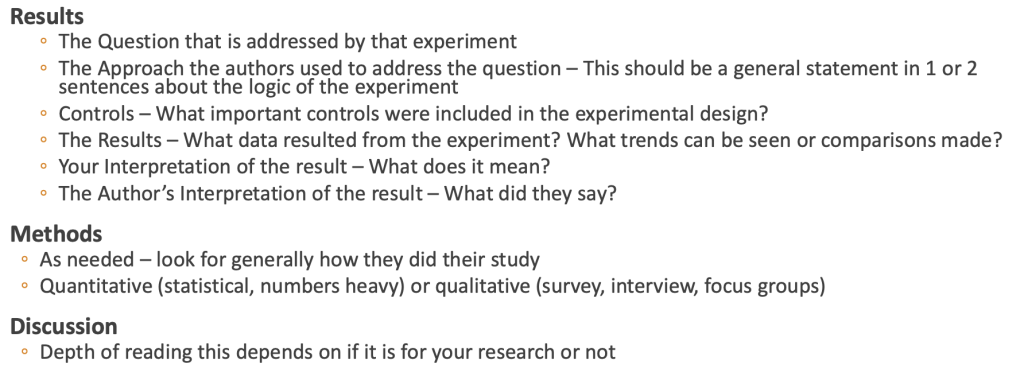
Below are slides from Dr. Lee’s lecture that were especially helpful when finding and reading sources for our final research paper. This shows that I paid attention to lectures in order to access information using good search strategies.

Lastly, below you will find text messages sent from myself to my group, wanting feedback on section 4 of our final research paper. This proves that I was willing to accept feedback to better my part of the project.


Goal 2: (Global Learning) 4c. Applies knowledge and skills to implement sophisticated, workable solutions to address complex global problems using interdisciplinary perspectives. (20%)
| What will you do to learn the content/ develop the skill? | What examples will you add to the portfolio to demonstrate your learning? | What characteristics of the chosen examples demonstrate you have met your goal? |
| Complete Braiding Sweetgrass reflections Participate in Braiding Sweetgrass discussions Connecting Jigsaw Papers to global problems | Braiding Sweetgrass notes (personal) Braiding Sweetgrass reflections Scientist Spotlights Concluding statements on Jigsaw prep assignments | Full points on Exam I questions regarding connections between material and real world problems Revisions if needed on assignments Connections from conclusions to real world problems Connecting Scientist Spotlights to real world problems |
Below are my personal Braiding Sweetgrass notes/study guides. This proves that I was going out of my way to apply knowledge and skills outside of the classroom to better understand the class material. This is just one collection of notes from the Burning Sweetgrass section, but this was done for all sections of the book.


Below is part of my favorite Braiding Sweetgrass reflection. This, along with all other Braiding Sweetgrass reflections, received full points and were very helpful for participating in class discussions.

Below are some questions from Exam I that connected class material to real world concepts. Full points were rewarded on these questions.


Below are snapshots of the final questions on Jigsaw Prep assignments. This question asks how this is pushing society forward. This very clearly draws a connection between in class learning and real world problems. Full points were rewarded.




Goal 3: (Quantitative Literacy) 10c. Uses quantitative information to support arguments and draw logical conclusions. (20%)
| What will you do to learn the content/ develop the skill? | What examples will you add to the portfolio to demonstrate your learning? | What characteristics of the chosen examples demonstrate you have met your goal? |
| Taking notes during class Participating in class discussions Reading and summarizing articles for annotated bibliography | Experimental design section (#5) Jigsaw Prep Assignments Appropriate questions on Exam I Appropriate questions on Exam II | Completes all listed assignments to “exceeds expectations” Full points on specific questions on both Exam I and Exam II Revised experimental design if needed |
Below is the graph I constructed for my group on our research paper. I was able to conclude that we predict that if elementary-age children receive environmental education from a young age, then they will be more inclined to apply sustainable practices in their homes. This shows that I can use quantitative information to support an argument and draw logical conclusions.

Below are excerpts from various Jigsaw papers. This question analyzes the methods and results of any primary research articles we read. During class, I participated in discussions in both small groups and as a whole class.


Next, I included a question on Exam I that assess drawing conclusions and displaying them on a graph. This shows that I was able to grasp the concept of numerical relationships between data.

When writing section 5 for our group research paper, I was in charge of creating and analyzing our graph. Although the physical graph is used as above evidence, I’d like to reiterate its importance towards this goal. Below is a blurb I wrote for our section 5 of our paper. This shows that I can not only create a graph that displays specific data, but also analyze and reflect on it.

Goal 4: (Intercultural Knowledge and Competence) 6c. Demonstrates sophisticated understanding of the complexity of elements important to members of another culture in relation to history, values, politics, communication styles, economy, or beliefs and practices. (20%)
| What will you do to learn the content/ develop the skill? | What examples will you add to the portfolio to demonstrate your learning? | What characteristics of the chosen examples demonstrate you have met your goal? |
| Actively participate in Braiding Sweetgrass discussions Come prepared with notes of each section Follow reading guide while reading Same goals for Jigsaw discussions | Jigsaw assignments Questions on Exam I and II that connect to RW examples Exam I and II study guides Braiding Sweetgrass notes and reflections | Complete all listed assignments to 95% Full points awarded on relevant exam questions Complete all necessary revisions Concluding paragraphs on Jigsaw prep assignments that relate to society |
Jigsaw assignment questions on Exam I (and II, but do not have scores yet) demonstrated my understanding of the importance of elements important to other cultures. Below I have included test questions that received full points regarding the jigsaw assignments. These tie together the biological material we are learning in class to real world problems.


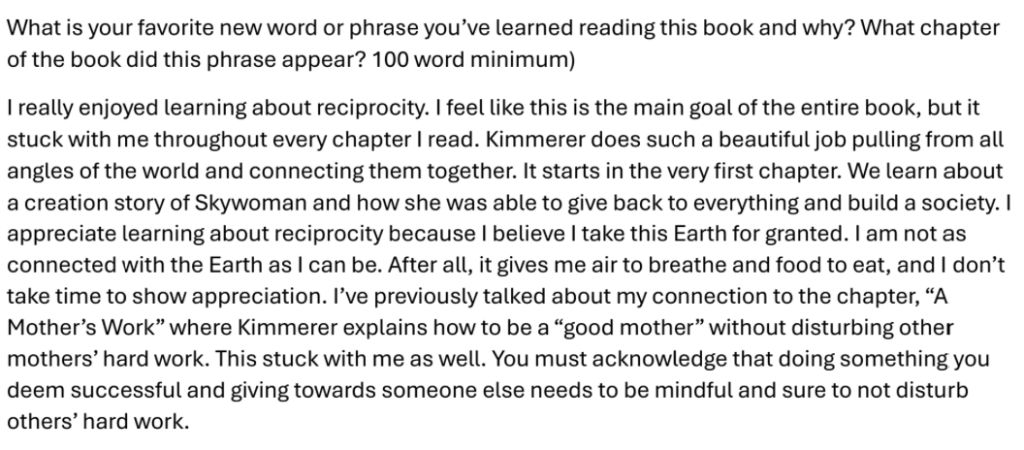
Below is a snapshot of part of a Braiding Sweetgrass reflection. Here I analyze my contribution to the Earth and themes of reciprocity. This shows my understanding of political and cultural issues connected to class material.
Below is part of a Scientist Spotlight, highlighting Nina Jablonski and her background of analyzing skin color bias. I grew up in a primarily white neighborhood and school, so I wasn’t exposed to a lot of people who grew up differently than I did. When I joined CODES, I met so many cool people that have very different experiences than I do, and I will forever be grateful for this experience. It has opened my eyes to a much broader scope. This spotlight discusses the complex history of skin color.

Below is one piece of a Braiding Sweetgrass reflection. This reflection analyzes politics and Indigenous teachings. I loved learning about the Thanksgiving Address that many Indigenous children recite like we do the Pledge of Allegiance.

Goal 5: 3c. Applies ethical concepts to a question and considers their full implications. (20%)
| What will you do to learn the content/ develop the skill? | What examples will you add to the portfolio to demonstrate your learning? | What characteristics of the chosen examples demonstrate you have met your goal? |
| Connecting scientists’ work to our class and the betterment of society Working collaboratively with my group for our research paper Gathering good sources for our annotated bibliography | Braiding Sweetgrass notes and takeaways/Utilizing reading guides Scientist Spotlights Braiding Sweetgrass reflections Final research paper | Connecting scientists’ work to our class and the betterment of society Full points on braiding sweetgrass reflections 80%+ on final research paper |
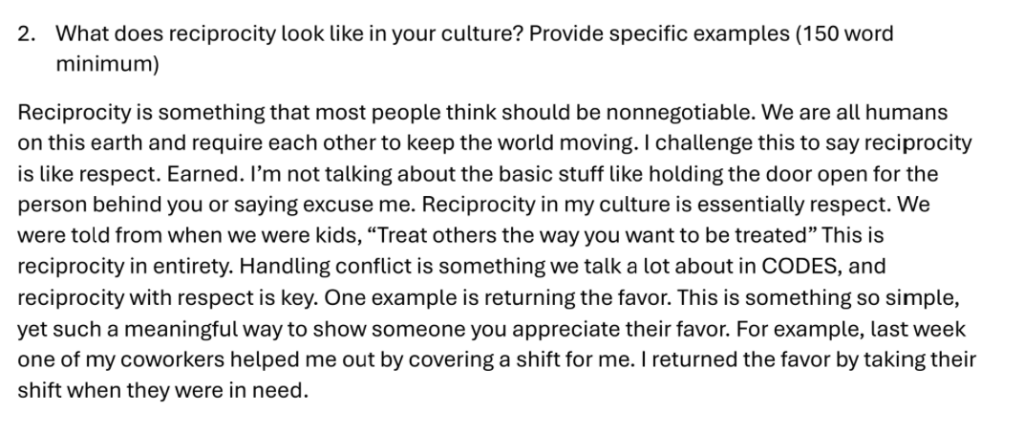
Reciprocity, to me, is the heart of ethics. Moral dilemma is all the rave in my community. With a new administration stepping in, a lot of us are questioning the validity of words from government officials, and peers who support it. Below is an excerpt of a Braiding Sweetgrass reflection that assesses reciprocity in my community.
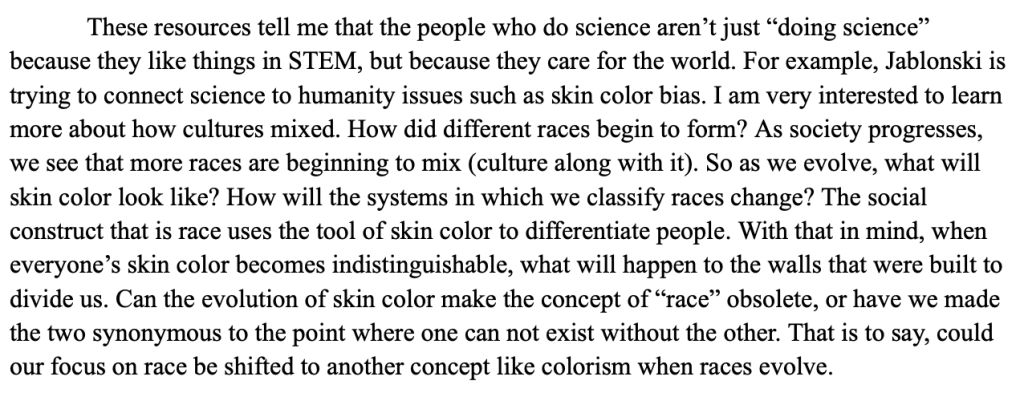
Below is the final paragraph of a Scientist Spotlight highlighting skin color bias. I am very proud of this conclusion, not only because skin color bias fascinates me, but also because it made me think harder. I was able to ask many follow up questions that got me thinking about our future.
In the introduction to our final research paper, we address the water equity crisis along the Southern American Bottom. Here is a piece I wrote in this, reflecting on ethical issues in this community.
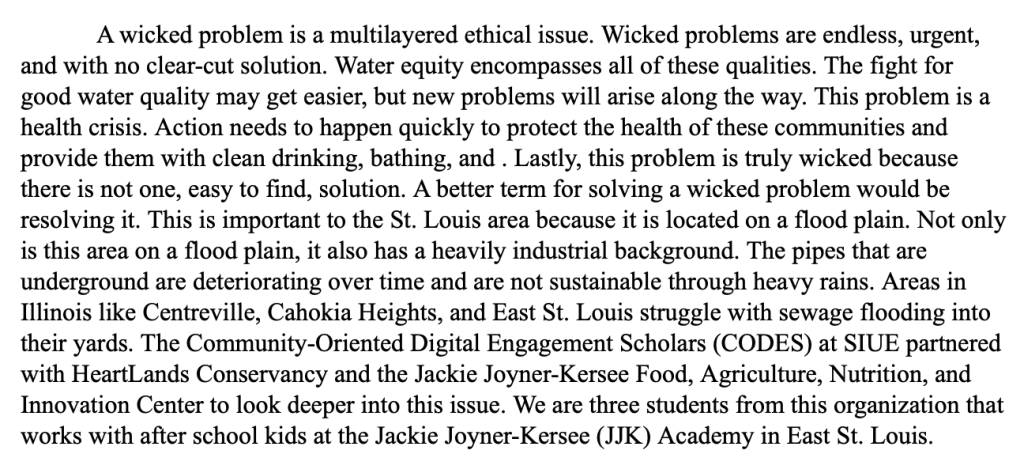
Lastly, class discussions were a huge part of analyzing ethical issues and their full implications. It is important for your peers to challenge you. Participating in group discussions and hearing opposing viewpoints was very helpful in constructing good arguments. Below, I have attached several questions from the Braiding Sweetgrass reading guides that sparked engaging conversations among my small groups.
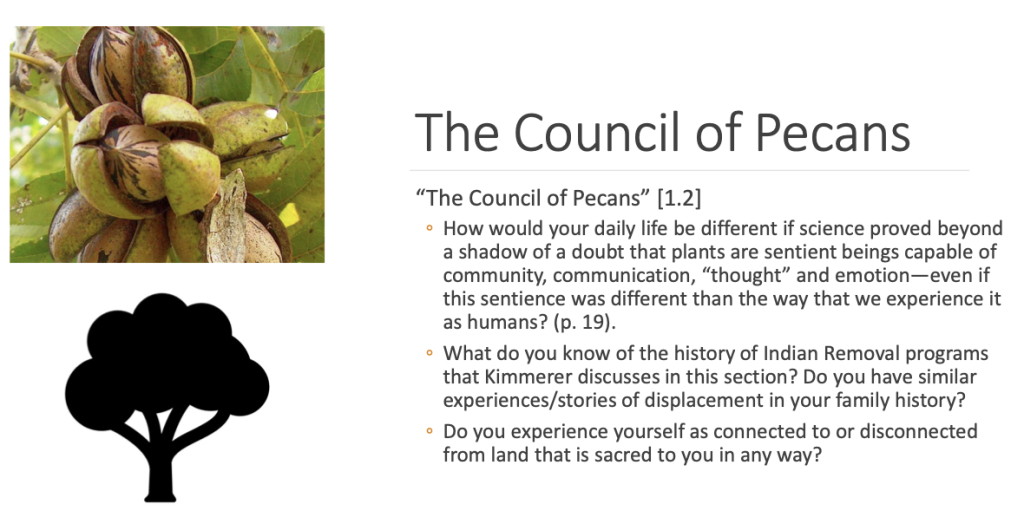
I was uneducated about Indian Removal programs, so my group filled me in and we discussed what schools choose to teach their kids.
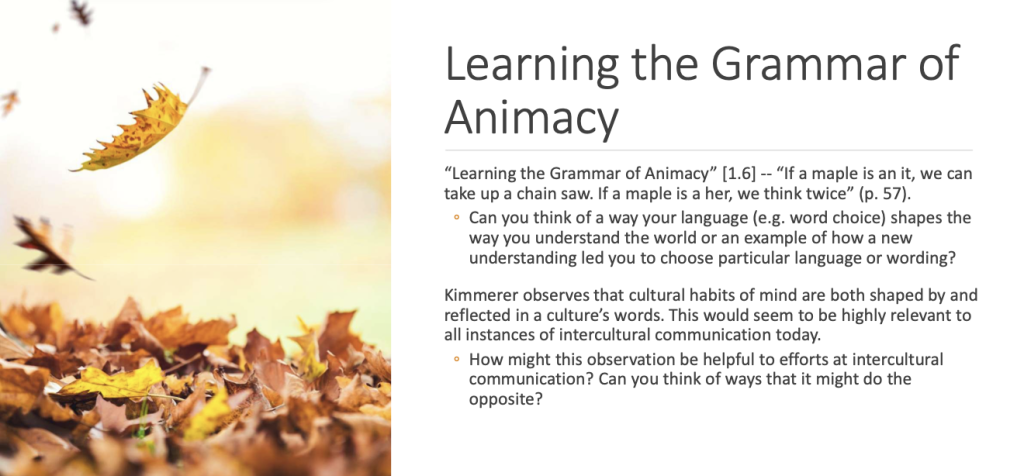
In CODES, we often talk about how certain words have certain backstories, and it is important to be careful when choosing words. This question sparked conversation about the current administration and the disgusting term, “Illegal aliens”
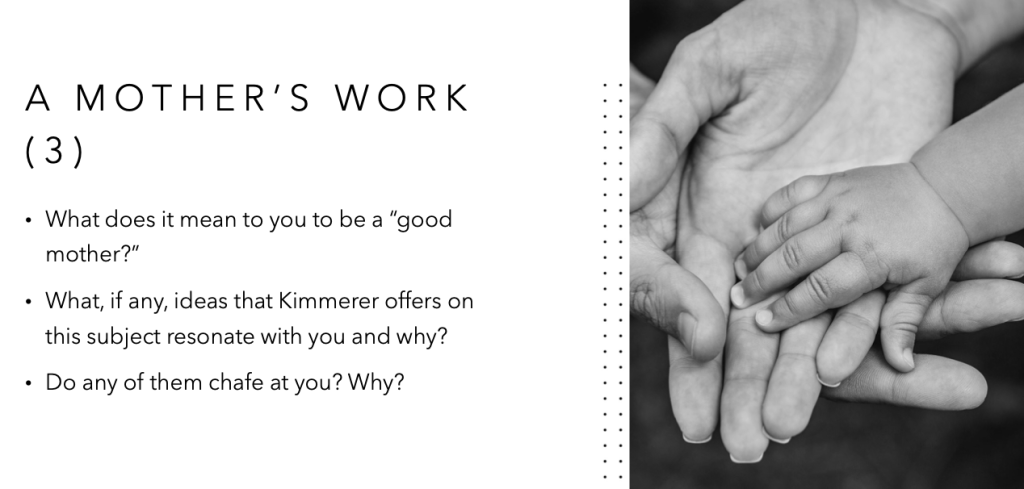
A Mother’s Work sparked a conversation about reciprocity and the role Mother’s have in society.
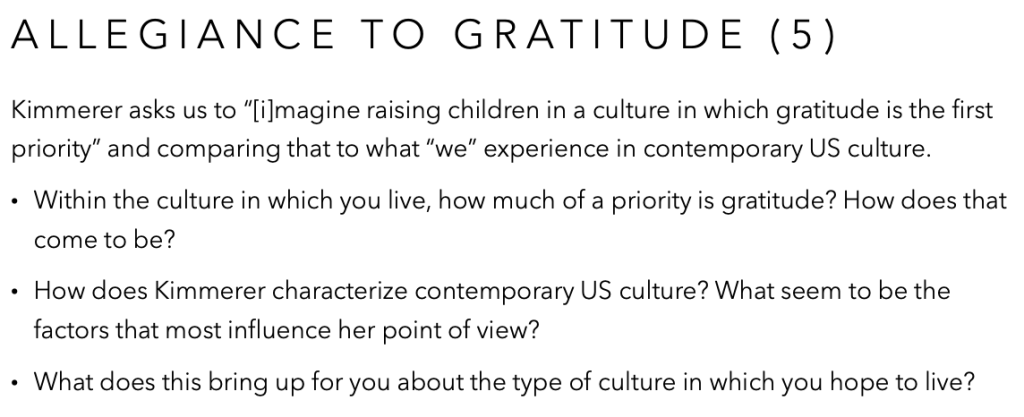
In our small groups, we discussed the desire to recite this allegiance instead of the Pledge of Allegiance every morning. We decided we would rather show gratitude to our Earth than to our government.
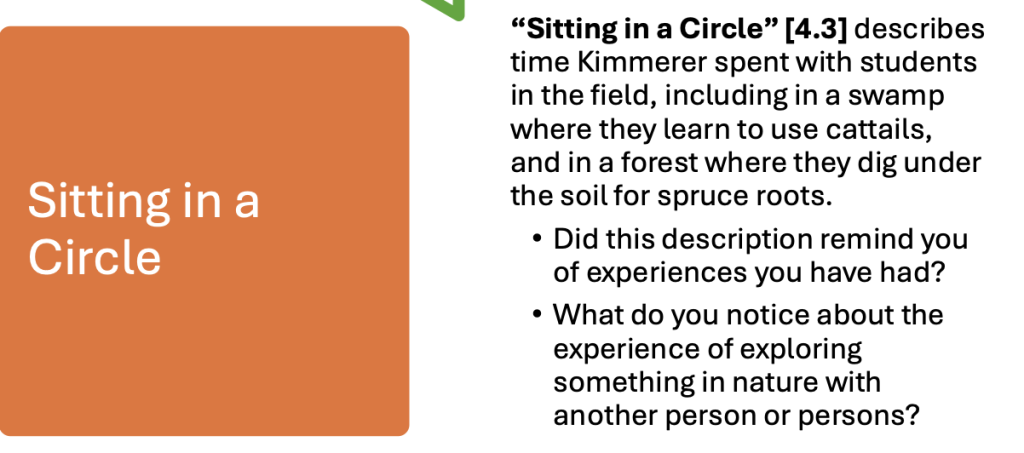
Lastly, “Sitting in a Circle” led my group to talk about how we would sit in a big circle in Dr. DeSpain’s class and it was very nice to see everyone’s faces while they were talking and it eliminated any hierarchy.